



If $25$ people applied for programme A, $50$ people for programme B, $10$ people for both. So find the number of employees applied only for A.
Answer
 Verified
561k+ views
Hint: This question is related to basic concepts of set theory. Here we are given 2 programmes and number of persons applied for each programme respectively. We have to find the number of persons who applied for programme A.
Complete step-by-step answer:
So, we have two programmes A and B.
Number of people applied for programme A $ = n\left( A \right) = 25$
Number of people applied for programme B $ = n\left( B \right) = 50$
We are also given the number of people that have applied for both the programmes. We also know that intersection of two sets A and B represents the events that are common to both the sets.
Now, number of people applied for both the programmes $ = n\left( {A \cap B} \right) = 10$
Now, we have to find the number of persons that applied for programme A only which are given by subtracting the number of persons applied for both programmes from number of persons who applied for programme A, these are denoted by $n\left( {only\,A} \right)$.
We will visualise the situation diagrammatically as below.
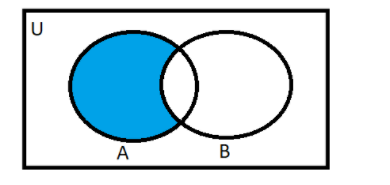
\[n\left( {only\,A} \right) = n\left( A \right) - n\left( {A \cap B} \right)\]
Substituting the values of $n\left( A \right)$ and $n\left( {A \cap B} \right)$, we get,
\[ \Rightarrow n\left( {only\,A} \right) = 25 - 10\]
\[ \Rightarrow n\left( {only\,A} \right) = 15\]
Hence, the number of people that applied only for the programme A is $15$.
So, the correct answer is “15”.
Note: The main thing to keep in mind while doing this question is the basic concepts of set theory and basic formulas which are applied directly, that is, \[n\left( {only\,A} \right) = n\left( A \right) - n\left( {A \cap B} \right)\]. Take care while doing the calculations. Keep in mind other formulas such as $n\left( {A \cup B} \right) = n\left( A \right) + n\left( B \right) - n\left( {A \cap B} \right)$ to solve many other such questions.
Complete step-by-step answer:
So, we have two programmes A and B.
Number of people applied for programme A $ = n\left( A \right) = 25$
Number of people applied for programme B $ = n\left( B \right) = 50$
We are also given the number of people that have applied for both the programmes. We also know that intersection of two sets A and B represents the events that are common to both the sets.
Now, number of people applied for both the programmes $ = n\left( {A \cap B} \right) = 10$
Now, we have to find the number of persons that applied for programme A only which are given by subtracting the number of persons applied for both programmes from number of persons who applied for programme A, these are denoted by $n\left( {only\,A} \right)$.
We will visualise the situation diagrammatically as below.
\[n\left( {only\,A} \right) = n\left( A \right) - n\left( {A \cap B} \right)\]
Substituting the values of $n\left( A \right)$ and $n\left( {A \cap B} \right)$, we get,
\[ \Rightarrow n\left( {only\,A} \right) = 25 - 10\]
\[ \Rightarrow n\left( {only\,A} \right) = 15\]
Hence, the number of people that applied only for the programme A is $15$.
So, the correct answer is “15”.
Note: The main thing to keep in mind while doing this question is the basic concepts of set theory and basic formulas which are applied directly, that is, \[n\left( {only\,A} \right) = n\left( A \right) - n\left( {A \cap B} \right)\]. Take care while doing the calculations. Keep in mind other formulas such as $n\left( {A \cup B} \right) = n\left( A \right) + n\left( B \right) - n\left( {A \cap B} \right)$ to solve many other such questions.

Recently Updated Pages
What are the two major island groups in India class 9 social science CBSE

What is Jhum cultivation class 9 biology CBSE
Write an Article on Save Earth Save Life
Silk is obtained from of the silk moth APupa BLarva class 9 chemistry CBSE
Write chemical formulas of the following compounds class 9 chemistry CBSE
The Indo Gangetic Plains of India are fertile due to class 9 social science CBSE
Trending doubts
Fill the blanks with the suitable prepositions 1 The class 9 english CBSE
Difference Between Plant Cell and Animal Cell
Name 10 Living and Non living things class 9 biology CBSE
What is the full form of pH?
On an outline map of India show its neighbouring c class 9 social science CBSE
What is pollution? How many types of pollution? Define it