




Identify Z in the following series ${C_2}{H_5}OH\xrightarrow{{PB{r_3}}}X\xrightarrow{{alc.KOH}}Y\xrightarrow{{dil.{H_2}S{O_4}}}Z$
$(A)C{H_2} = C{H_2}$
$(B)C{H_3}C{H_2}OH $
$(C)C{H_3} - C{H_2} - O - C{H_2} - C{H_3}$
(D)None
Answer
 Verified
566.7k+ views
Hint: In these types of questions, we need to know step by step the product formed after the reaction in the presence of a catalyst. If we need to find the compound of $Z$, first we need to know the products formed at $X$ and $Y$.
Complete answer:
First we see the product formed after the reaction between ethanol and $PB{r_3}$. This reaction proceeds in two steps. In the first step the alcohol is converted into a good leaving group by forming a bond to $P$( $O - P$ bonds are very strong) and displacing $Br$ from $P$, this is essentially a nucleophilic substitution at phosphorus.
Now that the oxygen has converted to a good leaving group, a substitution reaction at carbon can occur. The bromide ion that is displaced from phosphorus attacks carbon via a backside attack, forming $C - Br$ and left with a new ethyl bromide. So, the $X$ is ${C_2}{H_5}Br$.

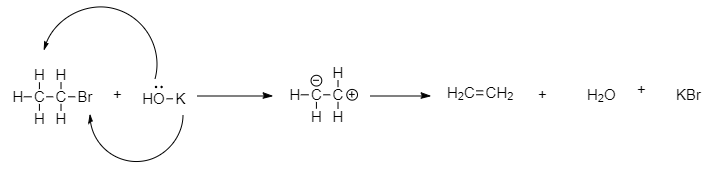
Now, ethyl bromide undergoes reaction in the presence of alcohol $KOH$, forming ethane. When ethyl bromide is boiled with $KOH$, the hydrogen atom transfers its electron pair to the adjacent carbon bond, and bromide is removed from the molecule. This forms a double bond between the alpha and beta carbon atoms and gives ethane as a product. So. The $Y$ is $C{H_2} = C{H_2}$.
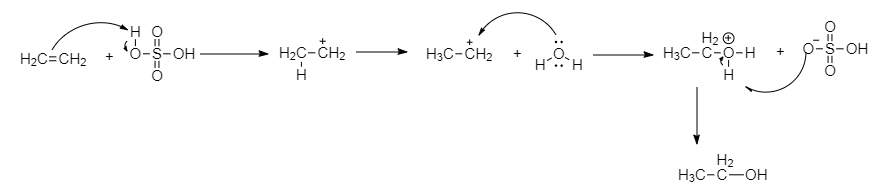
When ethane reacts with dilute sulphuric acid, it forms ethanol. All alkenes react with dilute sulphuric acid and give alcohol. This is a hydration reaction. A water molecule is added through double bonds and may give primary, secondary or tertiary alcohol. So the element $Z$, we get ethanol.
Therefore the correct answer is option B.
Note:
When haloalkane with $\beta $- hydrogen atoms are boiled with an alcoholic solution of potassium hydroxide, they undergo the elimination of hydrogen halide $(HX)$ resulting in the formation of alkenes.. The dilute sulphuric acid acts as a catalyst in hydrolysis of alkene.
Complete answer:
First we see the product formed after the reaction between ethanol and $PB{r_3}$. This reaction proceeds in two steps. In the first step the alcohol is converted into a good leaving group by forming a bond to $P$( $O - P$ bonds are very strong) and displacing $Br$ from $P$, this is essentially a nucleophilic substitution at phosphorus.
Now that the oxygen has converted to a good leaving group, a substitution reaction at carbon can occur. The bromide ion that is displaced from phosphorus attacks carbon via a backside attack, forming $C - Br$ and left with a new ethyl bromide. So, the $X$ is ${C_2}{H_5}Br$.
Now, ethyl bromide undergoes reaction in the presence of alcohol $KOH$, forming ethane. When ethyl bromide is boiled with $KOH$, the hydrogen atom transfers its electron pair to the adjacent carbon bond, and bromide is removed from the molecule. This forms a double bond between the alpha and beta carbon atoms and gives ethane as a product. So. The $Y$ is $C{H_2} = C{H_2}$.
When ethane reacts with dilute sulphuric acid, it forms ethanol. All alkenes react with dilute sulphuric acid and give alcohol. This is a hydration reaction. A water molecule is added through double bonds and may give primary, secondary or tertiary alcohol. So the element $Z$, we get ethanol.
Therefore the correct answer is option B.
Note:
When haloalkane with $\beta $- hydrogen atoms are boiled with an alcoholic solution of potassium hydroxide, they undergo the elimination of hydrogen halide $(HX)$ resulting in the formation of alkenes.. The dilute sulphuric acid acts as a catalyst in hydrolysis of alkene.
Recently Updated Pages
Which of the following graphs shows the variation of class 12 physics CBSE

Draw a labelled diagram of the human male reproductive class 12 biology CBSE
Describe the experiment to compare the emf of two cells class 12 physics CBSE
What is standard hydrogen electrode
What is conventional current and electric current class 12 physics CBSE
2Bromopentane is treated with an alcoholic KOH solution class 12 chemistry CBSE
Trending doubts
Draw a labelled sketch of the human eye class 12 physics CBSE
Which are the Top 10 Largest Countries of the World?
A member of Simon commission later became Prime Minister class 12 social science CBSE
Differentiate between homogeneous and heterogeneous class 12 chemistry CBSE
Draw ray diagrams each showing i myopic eye and ii class 12 physics CBSE
Which is the correct genotypic ratio of mendel dihybrid class 12 biology CBSE