




Identify the structures indicated by the labels (i), (ii), (iii) and (iv). Select the correct option.
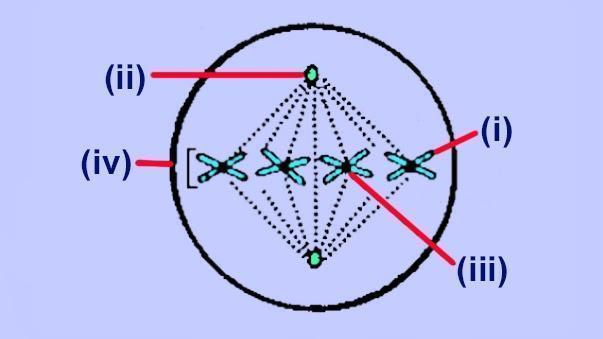
(a) (i)-Chromatid, (ii)-Centriole, (iii)-Centromere, (iv)-Chromosome
(b) (i)-Chromosome, (ii)-Centriole, (iii)-Centromere, (iv)-Chromatid
(c) (i)-Chromatid, (ii)-Centromere, (iii)-Centriole, (iv)-Chromosome
(d) (i)-Chromosome, (ii)-Centromere, (iii)-Centriole, (iv)-Chromatid
Answer
 Verified
578.4k+ views
Hint: In the metaphase stage of the cell cycle, the sister chromatids which are joined at their centres by the centromere, are pulled apart by centrosomes with the help of spindle fibres. The two centrosomes are present as one each on the two opposite poles of the cell.
Complete Answer:
The given picture is of the metaphase stage in cell division. The two sister chromatids (i) which form a chromosome (iv) are joined together by the centromeres i.e. (iii). They are pulled apart from the centre by centrioles i.e. (ii) which are present one on each pole of the cell.
Additional information:
Cells divide for many different reasons such as healing of a wound or simply for growth of the organism. Cell division is of two types: mitosis or equational division and meiosis a reductional division. Both types have four common stages: prophase, metaphase, anaphase and telophase. Mitosis is called an equational division due to the reason that the number of chromosomes remains the same in the daughter cells formed. However, in meiosis, the number of chromosomes reduces to half. In order to achieve this, it has two divisions: meiosis 1 in which the chromosome number is halved and meiosis 2 which is similar to mitosis.
So, the correct answer is (i)-Chromatid, (ii)-Centriole, (iii)-Centromere, (iv)-Chromosome.
Note:
Spindle fibres which arise from centrosomes are of two types: kinetochore spindle fibres and non-kinetochore spindle fibres. Kinetochore spindle fibres attach to centromeres and push themselves towards the centrosome. Non-kinetochore fibres do not attach to any chromosomes but to each other only and push against each other. Hence the balance between this pushing and pulling forces drag the chromatids towards the centrosome.
Complete Answer:
The given picture is of the metaphase stage in cell division. The two sister chromatids (i) which form a chromosome (iv) are joined together by the centromeres i.e. (iii). They are pulled apart from the centre by centrioles i.e. (ii) which are present one on each pole of the cell.
Additional information:
Cells divide for many different reasons such as healing of a wound or simply for growth of the organism. Cell division is of two types: mitosis or equational division and meiosis a reductional division. Both types have four common stages: prophase, metaphase, anaphase and telophase. Mitosis is called an equational division due to the reason that the number of chromosomes remains the same in the daughter cells formed. However, in meiosis, the number of chromosomes reduces to half. In order to achieve this, it has two divisions: meiosis 1 in which the chromosome number is halved and meiosis 2 which is similar to mitosis.
So, the correct answer is (i)-Chromatid, (ii)-Centriole, (iii)-Centromere, (iv)-Chromosome.
Note:
Spindle fibres which arise from centrosomes are of two types: kinetochore spindle fibres and non-kinetochore spindle fibres. Kinetochore spindle fibres attach to centromeres and push themselves towards the centrosome. Non-kinetochore fibres do not attach to any chromosomes but to each other only and push against each other. Hence the balance between this pushing and pulling forces drag the chromatids towards the centrosome.
Recently Updated Pages
If x a + bt + ct2 where x is in meters and t is in class 11 physics CBSE

A car covers the first half distance between two places class 11 physics CBSE
The resultant of two vectors overrightarrow P and overrightarrow class 11 physics CBSE
Find the value of cos 135 class 11 maths CBSE
A mass M is held in place by an applied force F and class 11 physics CBSE
A solution of glucose in water is labelled as 10 dfracwv class 11 chemistry CBSE
Trending doubts
One Metric ton is equal to kg A 10000 B 1000 C 100 class 11 physics CBSE
Find the value of the expression given below sin 30circ class 11 maths CBSE
What do you mean by retardation What is its SI uni class 11 physics CBSE
Draw a diagram of nephron and explain its structur class 11 biology CBSE
10 examples of friction in our daily life
Difference between physical and chemical change class 11 chemistry CBSE