




Identify the parts labelled as P, Q, R and S in the figure and select the correct option.
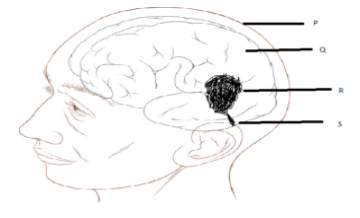
A. (P) Cerebrum (Q) Medulla (R) Skull (S) Cerebellum
B. (P) Skull (Q) Cerebrum (R) Cerebellum (S) Medulla
C. (P) Medulla (Q)Cerebrum (R) Cerebellum(S) Skull
D. (P)Cerebellum (Q) Skull (R) Medulla (S) Cerebrum
Answer
 Verified
591.9k+ views
Hint: The brain is divided into the cerebrum, the midbrain, the pons, the medulla and the cerebellum. The brainstem is a centre which joins the cerebrum and cerebellum to the spinal cord. It helps in the body’s automatic functions.
Complete answer:
The human brain is the nervous system command centre. This takes the signals from the sensory organs of the body and gives the outputs to the muscles. It helps in every important system of the body. The brain is the organ in the body which is protected. It has various protective layers like skull or cranium which serves as an armor protecting the brain from hits.
Skull is a bony structure which forms the head. It shields the face structures and gives the brain a shelter type of cavity. The skull is important for providing frontal, dorsal and lateral shelter to the brain.
Cerebrum is the largest part of the brain which consists of the cerebral cortex of the brain and other subcortical structures. The cerebrum has two cerebral hemispheres. The cerebrum serves to control and coordinate movement, temperature, touch, vision, hearing, judgement, reasoning, problem solving activities, emotions and learning.
Cerebellum is the second largest part of the brain located in the posterior area of the pons and medulla. The transverse fissure and tentorium cerebelli separates the cerebrum and the cerebellum. The function of the cerebellum is to coordinate voluntary muscle movement and also to maintain the posture, balance and equilibrium.
Medulla is the lowest area of the brain. It is a tiny structure which helps to control the body’s autonomic functions like digestion, heartbeat. It joins the cerebral cortex and the spinal cord and helps to manage the human body reflexes.
Hence, the correct answer is option (B).
Note: The nervous system consists of two main parts: The central nervous system is made up of the brain and the spinal cord. The peripheral nervous system is composed of nerves that come from the spinal cord and ends to all parts of the body. The brain comprises four lobes. The parietal lobe gives the information about touch, taste etc. The frontal lobe controls the voluntary movements. The occipital lobe is responsible for vision. The temporal lobe is related to the memories.
Complete answer:
The human brain is the nervous system command centre. This takes the signals from the sensory organs of the body and gives the outputs to the muscles. It helps in every important system of the body. The brain is the organ in the body which is protected. It has various protective layers like skull or cranium which serves as an armor protecting the brain from hits.
Skull is a bony structure which forms the head. It shields the face structures and gives the brain a shelter type of cavity. The skull is important for providing frontal, dorsal and lateral shelter to the brain.
Cerebrum is the largest part of the brain which consists of the cerebral cortex of the brain and other subcortical structures. The cerebrum has two cerebral hemispheres. The cerebrum serves to control and coordinate movement, temperature, touch, vision, hearing, judgement, reasoning, problem solving activities, emotions and learning.
Cerebellum is the second largest part of the brain located in the posterior area of the pons and medulla. The transverse fissure and tentorium cerebelli separates the cerebrum and the cerebellum. The function of the cerebellum is to coordinate voluntary muscle movement and also to maintain the posture, balance and equilibrium.
Medulla is the lowest area of the brain. It is a tiny structure which helps to control the body’s autonomic functions like digestion, heartbeat. It joins the cerebral cortex and the spinal cord and helps to manage the human body reflexes.
Hence, the correct answer is option (B).
Note: The nervous system consists of two main parts: The central nervous system is made up of the brain and the spinal cord. The peripheral nervous system is composed of nerves that come from the spinal cord and ends to all parts of the body. The brain comprises four lobes. The parietal lobe gives the information about touch, taste etc. The frontal lobe controls the voluntary movements. The occipital lobe is responsible for vision. The temporal lobe is related to the memories.
Recently Updated Pages
Master Class 11 Social Science: Engaging Questions & Answers for Success

Master Class 11 English: Engaging Questions & Answers for Success
Master Class 11 Maths: Engaging Questions & Answers for Success
Master Class 11 Chemistry: Engaging Questions & Answers for Success
Master Class 11 Biology: Engaging Questions & Answers for Success
Master Class 11 Physics: Engaging Questions & Answers for Success
Trending doubts
Differentiate between an exothermic and an endothermic class 11 chemistry CBSE
One Metric ton is equal to kg A 10000 B 1000 C 100 class 11 physics CBSE
Difference Between Prokaryotic Cells and Eukaryotic Cells
There are 720 permutations of the digits 1 2 3 4 5 class 11 maths CBSE
Draw a diagram of a plant cell and label at least eight class 11 biology CBSE
1 Quintal is equal to a 110 kg b 10 kg c 100kg d 1000 class 11 physics CBSE