




Identify the incorrect statement with respect to Calvin cycle.
(A) The carboxylation of RuBP is catalysed by rubisco.
(B)The first stable intermediate compound formed is phosphoglycerate.
(C) 18 molecules of ATP are synthesized during carbon fixation.
(D) \[NADP + {H^ + }\] produced in light reaction is used to reduce diphosphoglycerate.
Answer
 Verified
621.6k+ views
Hint: Malvin Calvin used radioactive \[14C\] in algal photosynthesis studies. This led to the discovery that the first \[C{O_2}\] fixation product was a three-carbon organic acid. He also helped to mark out the complete biosynthetic pathway hence it is called Calvin Cycle. The first stable product identified was 3- phosphoglyceric acid (PGA) hence named $\mathop C\nolimits_3 $ pathway.
Complete answer:
It occurs in 3 steps :-
Carboxylation :- It is the fixation of \[C{O_2}\] into a stable organic intermediate. In this, \[C{O_2}\], is used for the carboxylation of RuBP. This reaction is catalysed by the enzyme Rubisco.
Reduction These reactions lead to the formation of glucose. The steps involve utilisation of two molecules of ATP for phosphorylation and two of NADPH for reduction, per molecule of $\mathop {CO}\nolimits_2 $ fixed.
Regeneration :- This step requires one ATP for phosphorylation to form RuBP. To make one molecule of glucose six turns of the cycle are required. \[18{\text{ }}ATP{\text{ }} and {\text{ }}12{\text{ }}NADPH\]molecules are used to make a molecule of glucose.
Now let us match this with given options :-
Option A :- the first step is carboxylation and is catalysed by Rubisco. Thus this option is not correct as this statement is in accordance with Calvin cycle .
Option B :- The first stable product identified was 3- phosphoglyceric acid (PGA) hence named $\mathop C\nolimits_3 $ pathway. So this option is not correct as it occurs in Calvin cycle
Option C :- 18 molecules of ATP are used and not synthesised . Thus this option correct as this statement is wrong
Option D :- \[12{\text{ }}NADPH\] molecules are used to make a molecule of glucose and in the process of reduction. Thus this option is not correct as this statement is in accordance with Calvin cycle .
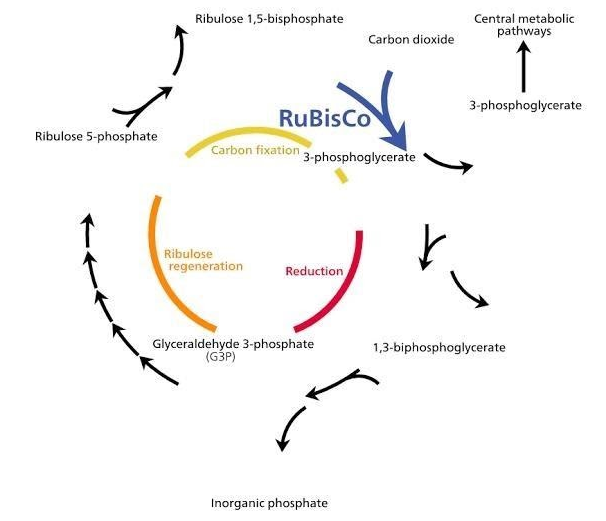
Our required answer is option C that is 18 molecules of ATP are synthesized during carbon fixation.
Note:
The primary acceptor molecule during the $\mathop C\nolimits_3 $ cycle is a five-carbon ketose sugar-Ribulose bisphosphate (RuBP). The enzyme for $\mathop {CO}\nolimits_2 $, fixation is Rubisco (Ribulose Bisphosphate Carboxylase Oxygenase). It is the most abundant enzyme on earth. It is characterised by the fact that its active site can bind to both $\mathop {CO}\nolimits_2 $ and $\mathop O\nolimits_2 $ hence the name Rubisco.
Complete answer:
It occurs in 3 steps :-
Carboxylation :- It is the fixation of \[C{O_2}\] into a stable organic intermediate. In this, \[C{O_2}\], is used for the carboxylation of RuBP. This reaction is catalysed by the enzyme Rubisco.
Reduction These reactions lead to the formation of glucose. The steps involve utilisation of two molecules of ATP for phosphorylation and two of NADPH for reduction, per molecule of $\mathop {CO}\nolimits_2 $ fixed.
Regeneration :- This step requires one ATP for phosphorylation to form RuBP. To make one molecule of glucose six turns of the cycle are required. \[18{\text{ }}ATP{\text{ }} and {\text{ }}12{\text{ }}NADPH\]molecules are used to make a molecule of glucose.
Now let us match this with given options :-
Option A :- the first step is carboxylation and is catalysed by Rubisco. Thus this option is not correct as this statement is in accordance with Calvin cycle .
Option B :- The first stable product identified was 3- phosphoglyceric acid (PGA) hence named $\mathop C\nolimits_3 $ pathway. So this option is not correct as it occurs in Calvin cycle
Option C :- 18 molecules of ATP are used and not synthesised . Thus this option correct as this statement is wrong
Option D :- \[12{\text{ }}NADPH\] molecules are used to make a molecule of glucose and in the process of reduction. Thus this option is not correct as this statement is in accordance with Calvin cycle .
Our required answer is option C that is 18 molecules of ATP are synthesized during carbon fixation.
Note:
The primary acceptor molecule during the $\mathop C\nolimits_3 $ cycle is a five-carbon ketose sugar-Ribulose bisphosphate (RuBP). The enzyme for $\mathop {CO}\nolimits_2 $, fixation is Rubisco (Ribulose Bisphosphate Carboxylase Oxygenase). It is the most abundant enzyme on earth. It is characterised by the fact that its active site can bind to both $\mathop {CO}\nolimits_2 $ and $\mathop O\nolimits_2 $ hence the name Rubisco.
Recently Updated Pages
Master Class 12 Business Studies: Engaging Questions & Answers for Success

Master Class 12 Chemistry: Engaging Questions & Answers for Success
Master Class 12 Biology: Engaging Questions & Answers for Success
Class 12 Question and Answer - Your Ultimate Solutions Guide
Master Class 11 English: Engaging Questions & Answers for Success
Master Class 11 Social Science: Engaging Questions & Answers for Success
Trending doubts
Which are the Top 10 Largest Countries of the World?
Draw a labelled sketch of the human eye class 12 physics CBSE
Differentiate between homogeneous and heterogeneous class 12 chemistry CBSE
In order to find out the different types of gametes class 12 biology NEET_UG
Why is the cell called the structural and functional class 12 biology CBSE
Draw ray diagrams each showing i myopic eye and ii class 12 physics CBSE