




Identify the given figures A, B, C, D, and E
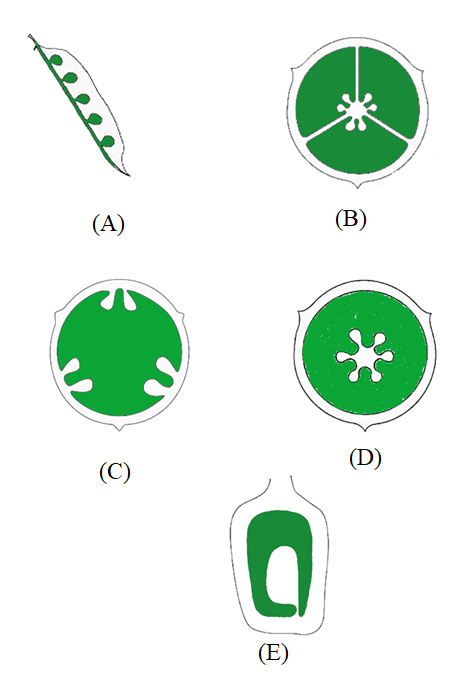
(a) A: Marginal, B: Axile, C: Free Central, D: Parietal, E: Basal
(b) A: Marginal, B: Parietal, C: Free Central, D: Axile, E: Basal
(c) A: Marginal, B: Axile, C: Parietal, D: Free Central, E: Basal
(d) A: Marginal, B: Axile, C: Parietal, D: Basal, E: Free Central
Answer
 Verified
619.2k+ views
Hint: The ovules attach to the walls of the ovary through a cushion-like structure known as placenta and the arrangement of the placenta inside the ovary is known as placentation. There are five different types of placentation based on the arrangement of attachment of ovules to the placenta.
Complete step by step answer:
The mode of attachment of the ovule to the placenta present on the walls of the ovary is known as Placentation. There are various types of placentation found in flowering plants and they are as follows-
Marginal Placentation: The placenta forms a ridge along the walls of the ovary to provide the point of attachment. The ovules attach to this ridge in a straight line or series of rows running alongside the arrangement of the placenta. This type of pattern or arrangement is commonly seen in pod plants.
E.g.- Pea, beans.
Axile Placentation: In this type of placentation, the ovules attach to the central column of the ovary. The cushion-like structure which is the placenta is arranged at the very central axis of the ovary, and that is why it is known as axile placentation. The ovules attach to the placenta on the axis of the ovary in a multilocular arrangement. The multilocular arrangement refers to the formation of different compartments due to the arrangement of the placenta. Such placentation is commonly seen in citrus fruits.
E.g.- Lemon, Bell pepper.
Parietal Placentation: In parietal placentation, the ovules directly attach to the walls of the ovary along the lines of edges of the cavity of the ovary which is called peripheral parts of the ovary. It forms only one compartment or chamber inside the ovary but due to the presence of a false septum, it appears to be divided into two chambers. A false septum is a septum that looks like a placenta formed in the ovary but it is not a placenta.
E.g.- Mustard, Argemone.
Basal Placentation: This type of placentation involves a single ovule attached to the base of the ovary with the help of a funiculus. The funiculus is a stalk-like structure connecting an ovule to the placenta, although in this there is no formation of a complete placenta. E.g.- Sunflower, Marigold.
Free Central Placentation: This type of placentation is similar to axile placentation, but there is an absence of placenta on the axis. The ovules develop on the central axis but the placental septa are absent. E.g.- Dianthus, Primrose.
So, the correct answer is ‘(c) A: Marginal, B: Axile, C: Parietal, D: Free Central, E: Basal’.
Note:
- Most people link placentation with mammalian placental animals, but it is to be noted that pants too contain the placenta although the function is quite different. The placenta present in plants act as a cushion-like group of cells which provide the point of attachment of the ovules to the walls of the ovary.
- The placentation occurs only in the type of plant known as Angiosperms. Each developing seed attaches to the wall or the central structure in the ovary. A filament of plant tissue called funiculus transports the nutrients and nourishment to the seed in a similar way to an umbilical cord providing nutrition to the fetus in the womb.
Complete step by step answer:
The mode of attachment of the ovule to the placenta present on the walls of the ovary is known as Placentation. There are various types of placentation found in flowering plants and they are as follows-
Marginal Placentation: The placenta forms a ridge along the walls of the ovary to provide the point of attachment. The ovules attach to this ridge in a straight line or series of rows running alongside the arrangement of the placenta. This type of pattern or arrangement is commonly seen in pod plants.
E.g.- Pea, beans.
Axile Placentation: In this type of placentation, the ovules attach to the central column of the ovary. The cushion-like structure which is the placenta is arranged at the very central axis of the ovary, and that is why it is known as axile placentation. The ovules attach to the placenta on the axis of the ovary in a multilocular arrangement. The multilocular arrangement refers to the formation of different compartments due to the arrangement of the placenta. Such placentation is commonly seen in citrus fruits.
E.g.- Lemon, Bell pepper.
Parietal Placentation: In parietal placentation, the ovules directly attach to the walls of the ovary along the lines of edges of the cavity of the ovary which is called peripheral parts of the ovary. It forms only one compartment or chamber inside the ovary but due to the presence of a false septum, it appears to be divided into two chambers. A false septum is a septum that looks like a placenta formed in the ovary but it is not a placenta.
E.g.- Mustard, Argemone.
Basal Placentation: This type of placentation involves a single ovule attached to the base of the ovary with the help of a funiculus. The funiculus is a stalk-like structure connecting an ovule to the placenta, although in this there is no formation of a complete placenta. E.g.- Sunflower, Marigold.
Free Central Placentation: This type of placentation is similar to axile placentation, but there is an absence of placenta on the axis. The ovules develop on the central axis but the placental septa are absent. E.g.- Dianthus, Primrose.
So, the correct answer is ‘(c) A: Marginal, B: Axile, C: Parietal, D: Free Central, E: Basal’.
Note:
- Most people link placentation with mammalian placental animals, but it is to be noted that pants too contain the placenta although the function is quite different. The placenta present in plants act as a cushion-like group of cells which provide the point of attachment of the ovules to the walls of the ovary.
- The placentation occurs only in the type of plant known as Angiosperms. Each developing seed attaches to the wall or the central structure in the ovary. A filament of plant tissue called funiculus transports the nutrients and nourishment to the seed in a similar way to an umbilical cord providing nutrition to the fetus in the womb.
Recently Updated Pages
Master Class 12 Business Studies: Engaging Questions & Answers for Success

Master Class 12 Biology: Engaging Questions & Answers for Success
Master Class 12 Chemistry: Engaging Questions & Answers for Success
Class 12 Question and Answer - Your Ultimate Solutions Guide
Master Class 11 Social Science: Engaging Questions & Answers for Success
Master Class 11 English: Engaging Questions & Answers for Success
Trending doubts
Which are the Top 10 Largest Countries of the World?
Draw a labelled sketch of the human eye class 12 physics CBSE
Differentiate between homogeneous and heterogeneous class 12 chemistry CBSE
Why is the cell called the structural and functional class 12 biology CBSE
Draw ray diagrams each showing i myopic eye and ii class 12 physics CBSE
Which is the correct genotypic ratio of mendel dihybrid class 12 biology CBSE