




Identify the following animals and the classes to which they belong.
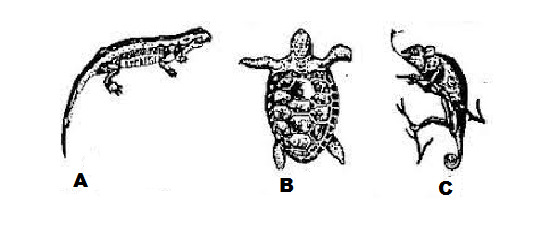
(a)A - Salamandra, Amphibia, B- Chelone, Reptilia, C-Chameleon, Reptilia
(b)A- Salamandra, Reptilia, B- Chelone, Reptilia, C-Chameleon, Reptilia
(b)A- Salamandra, Amphibia, B- Chelone, Amphibia, C-Chameleon, Amphibia
(b)A- Salamandra, Urochordata, B- Chelone, Cephalochordata, C-Chameleon, Hemichordata
Answer
 Verified
400.8k+ views
Hint: Amphibians are the animals that can survive on land and water both. Reptiles are animals that have scales and crawl on land. Urochordates have a notochord and hollow nerve cord while hemichordates have only some characteristics of chordates.
Complete step-by-step answer:
Salamanders are usually found in damp habitats near or in water. They have moist skin and are closely related to frogs despite how different frogs and salamanders are. These are classified into the category of tailed amphibians. It is a shy and cryptic animal. It is always seen hiding behind the rocks or stones. Most salamanders live in moist habitats, frequently adjacent to or in streams, lakes or swamps. It is also said that they belong to the amphibian order Caudata which means tails.
Chelone is a marine reptile that resembles a turtle. A green sea turtle is scientifically known as Chelonia mydas. It is a species in the genus Chelonia.
Chameleon belongs to the class reptilian. It has the adaptation to change its colour according to the surroundings. They can change their body colour to green, grey, yellow, red, etc. They also have prehensile tails.
So, the correct answer is an option (a)A-Salamandra, Amphibia,B- Chelone, Reptilia,C-Chameleon, Reptilia
Note: Amphibians are mostly found in moist places and can breathe air through their skin. The study of amphibians and reptiles is known as Herpetology. Reptilian families include lizards, turtles, alligators, crocodiles and snakes. Scales are found on every reptile.
Complete step-by-step answer:
Salamanders are usually found in damp habitats near or in water. They have moist skin and are closely related to frogs despite how different frogs and salamanders are. These are classified into the category of tailed amphibians. It is a shy and cryptic animal. It is always seen hiding behind the rocks or stones. Most salamanders live in moist habitats, frequently adjacent to or in streams, lakes or swamps. It is also said that they belong to the amphibian order Caudata which means tails.
Chelone is a marine reptile that resembles a turtle. A green sea turtle is scientifically known as Chelonia mydas. It is a species in the genus Chelonia.
Chameleon belongs to the class reptilian. It has the adaptation to change its colour according to the surroundings. They can change their body colour to green, grey, yellow, red, etc. They also have prehensile tails.
So, the correct answer is an option (a)A-Salamandra, Amphibia,B- Chelone, Reptilia,C-Chameleon, Reptilia
Note: Amphibians are mostly found in moist places and can breathe air through their skin. The study of amphibians and reptiles is known as Herpetology. Reptilian families include lizards, turtles, alligators, crocodiles and snakes. Scales are found on every reptile.
Recently Updated Pages
Master Class 9 Social Science: Engaging Questions & Answers for Success

Master Class 9 Science: Engaging Questions & Answers for Success
Master Class 9 Maths: Engaging Questions & Answers for Success
Master Class 9 General Knowledge: Engaging Questions & Answers for Success
Class 9 Question and Answer - Your Ultimate Solutions Guide
Master Class 8 Social Science: Engaging Questions & Answers for Success
Trending doubts
The common characteristics between tomato and potato class 11 biology NEET_UG
What is the full form of PNG A Petrol Natural Gas B class 10 chemistry CBSE
What are gulf countries and why they are called Gulf class 8 social science CBSE
Which are the Top 10 Largest Countries of the World?
One Metric ton is equal to kg A 10000 B 1000 C 100 class 11 physics CBSE
Explain the Treaty of Vienna of 1815 class 10 social science CBSE