




Identify the figure showing the process of budding in yeast
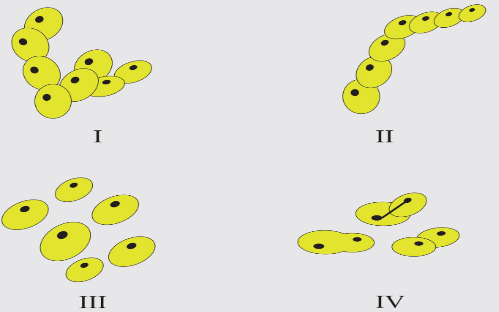
(a) I, II, and III
(b) II and IV
(c) I, II, and IV
(d) III, IV, and I
Answer
 Verified
623.7k+ views
Hint: They reproduce by budding, a bud is formed on the parental cell. The nucleus of the parental cell split and one daughter nucleus shifts into the bud. The bud increases in size and detaches and develops further.
Complete answer:
Budding is an asexual mode or give rise to new organisms. In this process, a new organism is developed from a little part of the parent’s body. A bud that is formed detaches to become a new organism. The newly developed organism remains attached as it grows further. It is detached from the parent organism when it gets matured by leaving scar tissues behind. As this is asexual reproduction, the newly grown organism is a duplicate of the parent and is genetically similar.
In options I, II, and IV the bud formation occurs. In image I, there are several buds formed and remain connected to the parent cell. In image II, a sequence of the yeast cells is made. In image III, there are only cells that appear. In image IV, there are daughter cells that are connected to the parent cell.
Additional information:
Yeasts are non-green, eukaryotic, single-celled microorganisms classified to the kingdom fungus. They are basically larger than the bacteria and they typically measure 3-4 micrometer in diameter. Yeast cells reproduce asexually through an asymmetric division process known as budding. In yeast, budding commonly takes place during the abundant supply of nutrition. In this process of reproduction, a little bud arises as an outgrowth of the parent body. Later the nucleus of the parent yeast is separated into two parts and one among the nuclei shifts into the bud. The newly created bud divides and grows into a replacement cell.
So, the correct answer is ‘I, II, and IV’.
Note:
Budding is asexual reproduction, which is most generally associated with both multicellular and unicellular organisms. Yeast is a unicellular fungus. The average size of yeast is around 3-4 µm. Yeast is a sac fungus and belongs to ascomycetes and the Saccharomyces. Yeast is widely utilized in the assembly of alcoholic beverages and baking industries.
Complete answer:
Budding is an asexual mode or give rise to new organisms. In this process, a new organism is developed from a little part of the parent’s body. A bud that is formed detaches to become a new organism. The newly developed organism remains attached as it grows further. It is detached from the parent organism when it gets matured by leaving scar tissues behind. As this is asexual reproduction, the newly grown organism is a duplicate of the parent and is genetically similar.
In options I, II, and IV the bud formation occurs. In image I, there are several buds formed and remain connected to the parent cell. In image II, a sequence of the yeast cells is made. In image III, there are only cells that appear. In image IV, there are daughter cells that are connected to the parent cell.
Additional information:
Yeasts are non-green, eukaryotic, single-celled microorganisms classified to the kingdom fungus. They are basically larger than the bacteria and they typically measure 3-4 micrometer in diameter. Yeast cells reproduce asexually through an asymmetric division process known as budding. In yeast, budding commonly takes place during the abundant supply of nutrition. In this process of reproduction, a little bud arises as an outgrowth of the parent body. Later the nucleus of the parent yeast is separated into two parts and one among the nuclei shifts into the bud. The newly created bud divides and grows into a replacement cell.
So, the correct answer is ‘I, II, and IV’.
Note:
Budding is asexual reproduction, which is most generally associated with both multicellular and unicellular organisms. Yeast is a unicellular fungus. The average size of yeast is around 3-4 µm. Yeast is a sac fungus and belongs to ascomycetes and the Saccharomyces. Yeast is widely utilized in the assembly of alcoholic beverages and baking industries.
Recently Updated Pages
Explain the structure of megasporangium class 12 biology CBSE

Why is chloroform kept in dark coloured bottles class 12 chemistry CBSE
Derive the balancing condition of a Wheatstone bri class 12 physics CBSE
Draw VI characteristics of a pn junction diode Explain class 12 physics CBSE
Is it possible to carry pride in ones language too class 12 english CBSE
In a population at Hardy Weinberg equilibrium the allele class 12 biology CBSE
Trending doubts
Draw a labelled sketch of the human eye class 12 physics CBSE
Which are the Top 10 Largest Countries of the World?
Draw ray diagrams each showing i myopic eye and ii class 12 physics CBSE
One megawatt is equal to how many units of electri class 12 physics CBSE
Which is the correct genotypic ratio of mendel dihybrid class 12 biology CBSE
Give 10 examples of unisexual and bisexual flowers