




Identify the diagrams.
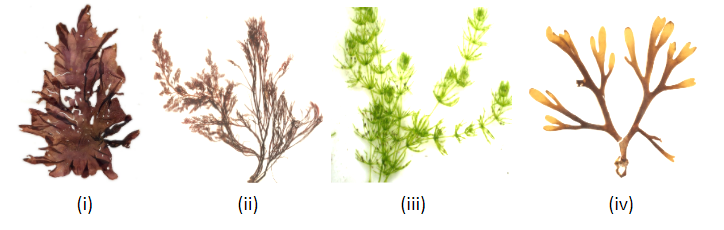
A. (i) – Porphyra, (ii) – Polysiphonia, (iii) – Chara, (iv) – Dictyota
B. (i) – Polysiphonia, (ii) – Porphyra, (iii) – Chara, (iv) – Ectocarpus
C. (i) – Laminaria, (ii) – Polysiphonia, (iii) – chlamydomonas, (iv) – Fucus
D. (i) – Dictyota, (ii) – Polysiphonia, (iii) – Chara, (iv) – Porphyra
Answer
 Verified
591.9k+ views
Hint: In the images given above, three of the organisms are a type of algae and one of them is seaweed. One of them grows in seawater, one is found on coastal rocks, one is found in freshwaters of temperate zones, and one is found in a natural pool like water bodies. All the species belong to different families.
Complete answer:
Porphyra:
It is a kind of red algae that is found in shallow portions in seawater. In the earlier stages, it is green in colour and becomes brownish-red as it matures. It is irregular in shape and has a small thallus. It can grow up to 20 cm. It is generally found to be attached to the rocks.
Polysiphonia:
It is also a type of red algae. They are found in the marine environment, attached to the rocks. This species is multiaxial and the thallus is well-branched. They can grow up to 30 cm in length.
Chara:
It is a type of green algae. They are found in freshwaters, attached to the muddy surface. They look similar to a typical plant with a stem and leaf-like structures. It thrives in less oxygenated waters.
Dictyota:
It is a type of seaweed that is found in rocky ponds or pools. It has a flat thallus with many dichotomous branches. It is goldish-brown and translucent in appearance.
Hence, the correct answer is option (A). Here Porphyra, Polysiphonia, and Chara are different types of algae, whereas Dictyota is a seaweed.
Note: Ectocarpus is a type of brown algae that is highly filamented. It is a free-floating alga and found throughout the world.
Laminaria, also known as kelp, is a type of brown algae. It is large in size and has long and leathery laminae.
Fucus is also a brown algae and is found on rocky seashores. The thallus is disc-shaped and perennial.
Complete answer:
Porphyra:
It is a kind of red algae that is found in shallow portions in seawater. In the earlier stages, it is green in colour and becomes brownish-red as it matures. It is irregular in shape and has a small thallus. It can grow up to 20 cm. It is generally found to be attached to the rocks.
Polysiphonia:
It is also a type of red algae. They are found in the marine environment, attached to the rocks. This species is multiaxial and the thallus is well-branched. They can grow up to 30 cm in length.
Chara:
It is a type of green algae. They are found in freshwaters, attached to the muddy surface. They look similar to a typical plant with a stem and leaf-like structures. It thrives in less oxygenated waters.
Dictyota:
It is a type of seaweed that is found in rocky ponds or pools. It has a flat thallus with many dichotomous branches. It is goldish-brown and translucent in appearance.
Hence, the correct answer is option (A). Here Porphyra, Polysiphonia, and Chara are different types of algae, whereas Dictyota is a seaweed.
Note: Ectocarpus is a type of brown algae that is highly filamented. It is a free-floating alga and found throughout the world.
Laminaria, also known as kelp, is a type of brown algae. It is large in size and has long and leathery laminae.
Fucus is also a brown algae and is found on rocky seashores. The thallus is disc-shaped and perennial.
Recently Updated Pages
Master Class 11 Economics: Engaging Questions & Answers for Success

Master Class 11 English: Engaging Questions & Answers for Success
Master Class 11 Maths: Engaging Questions & Answers for Success
Class 11 Question and Answer - Your Ultimate Solutions Guide
Master Class 11 Social Science: Engaging Questions & Answers for Success
Master Class 11 Business Studies: Engaging Questions & Answers for Success
Trending doubts
Differentiate between an exothermic and an endothermic class 11 chemistry CBSE
One Metric ton is equal to kg A 10000 B 1000 C 100 class 11 physics CBSE
There are 720 permutations of the digits 1 2 3 4 5 class 11 maths CBSE
In what year Guru Nanak Dev ji was born A15 April 1469 class 11 social science CBSE
Difference Between Prokaryotic Cells and Eukaryotic Cells
Draw a diagram of a plant cell and label at least eight class 11 biology CBSE