




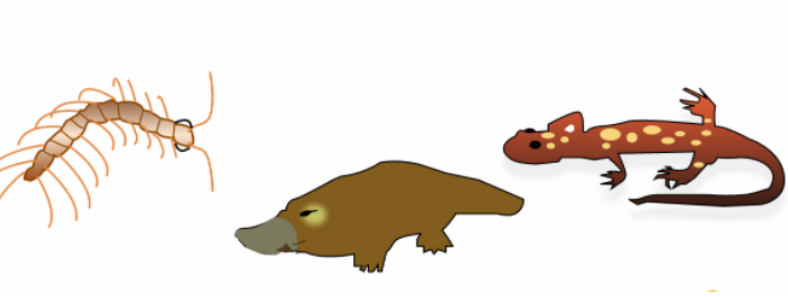
Identify the animal in the following diagram. How can this be evidence regarding evolution?
Answer
 Verified
585.9k+ views
Hint: The first diagram is a predatory belonging to arthropods, the second one is a semi-aquatic egg-laying mammal and the last one belongs to a group of amphibians typically characterized by a lizard-like appearance, with slender bodies, and the presence of a tail in both larvae and adults.
Complete answer
The unfolding of the process of different types of organism formation tells us about organic evolution.
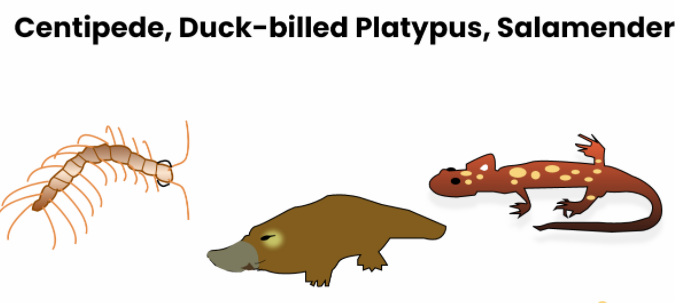
1. Centipede- They belong to Myriapoda and their fossil records extend back to 430 million years ago. The modification of the first pair of legs into venomous forceps is unique in the animal world, resulting in venom-producing cells from the transformation of related subepidermal gland units into an adaptation to a new terrestrial predatory niche. It is one of the most ancient known terrestrial venomous organisms.
2. Duck-billed Platypus- has a link with both reptiles and mammals. Platypus was one of the earliest offshoots of mammals. At least 166 million years ago monotremes (which includes the platypus) are thought to have split from other mammals. This means that the platypus genes carry information on the evolutionary timeline leading from reptiles to mammals so we understand what genes were present in the ancestral reptiles and how mammals evolved their particular traits.
3. Salamander- Ancestral salamanders had a basic tetrapod body form and had a complex aquatic-to-terrestrial life cycle. In the embryonic development of all vertebrates (fishes to mammals) the gill lifts and notochord appears but the notochord is replaced by the vertebral column in all vertebrates.
Note:
Tetrapods are four-limbed animals which include amphibians, reptiles, birds, and mammals. Humans and even snakes are tetrapods even though one walks on two legs and the other has no legs to walk because they descend from the tetrapod ancestor.
Complete answer
The unfolding of the process of different types of organism formation tells us about organic evolution.
1. Centipede- They belong to Myriapoda and their fossil records extend back to 430 million years ago. The modification of the first pair of legs into venomous forceps is unique in the animal world, resulting in venom-producing cells from the transformation of related subepidermal gland units into an adaptation to a new terrestrial predatory niche. It is one of the most ancient known terrestrial venomous organisms.
2. Duck-billed Platypus- has a link with both reptiles and mammals. Platypus was one of the earliest offshoots of mammals. At least 166 million years ago monotremes (which includes the platypus) are thought to have split from other mammals. This means that the platypus genes carry information on the evolutionary timeline leading from reptiles to mammals so we understand what genes were present in the ancestral reptiles and how mammals evolved their particular traits.
3. Salamander- Ancestral salamanders had a basic tetrapod body form and had a complex aquatic-to-terrestrial life cycle. In the embryonic development of all vertebrates (fishes to mammals) the gill lifts and notochord appears but the notochord is replaced by the vertebral column in all vertebrates.
Note:
Tetrapods are four-limbed animals which include amphibians, reptiles, birds, and mammals. Humans and even snakes are tetrapods even though one walks on two legs and the other has no legs to walk because they descend from the tetrapod ancestor.
Recently Updated Pages
Which will be the least stable resonating structure class 11 chemistry CBSE

How many 5 digit telephone numbers can be construc-class-11-maths-CBSE
How do you find the angle of the resultant vector class 11 physics CBSE
Draw labelled diagram of the following i Gram seed class 11 biology CBSE
1 Quintal is equal to a 110 kg b 10 kg c 100kg d 1000 class 11 physics CBSE
What is the need and importance of classification class 11 biology CBSE
Trending doubts
Find the value of the expression given below sin 30circ class 11 maths CBSE
One Metric ton is equal to kg A 10000 B 1000 C 100 class 11 physics CBSE
10 examples of friction in our daily life
Draw a diagram of a plant cell and label at least eight class 11 biology CBSE
Difference between physical and chemical change class 11 chemistry CBSE
Proton was discovered by A Thomson B Rutherford C Chadwick class 11 chemistry CBSE