




Identify the adaptive function of the needle like leaves on a coniferous tree?
Answer
 Verified
510.3k+ views
Hint: The needle-like leaves are adapted to one of the biomes, coniferous forest or Taiga, which is the most abundant one on the Earth. The evergreen trees like spruces and firs are the toughest and longest-living trees on the Earth. The leaves are present in the northern hemisphere, which is characterized by long winters and short summers.
Complete answer:
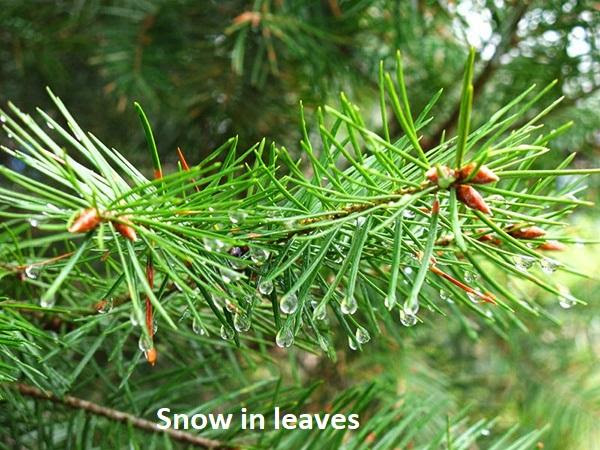
Fig: Pine Leaves
Since the coniferous forests are found to be closer to the poles of the Earth, there are more nights than the sunlight days. The leaves are always evergreen and dark green since they require a greater amount of chlorophyll for the extraction of a lot of energy from the sun.
Since the sunlight does not last long, the leaves require to make good use of what they have been grasping the light for photosynthesis.
The leaves are pointed due to two reasons:
1. To aid the snow and rainfall, which is higher in hilly areas to slide off the leaves.
2. To limit the water loss from the leaf itself.
3. Leaves require water for photosynthesis in their cells. Since cold weather can be extremely dry at times, they possess a tough waxy material on them for the prevention of water loss. 4. The waxy coating guards against freezing and water loss. In addition, it waterproofs the leaves. It protects the photosynthetic cells, which are present below the mesophyll layer.
Note:
It is always cold and slightly cool in summer in the area. The needle-like adaptation aids in survival in harsher and colder conditions, compared to broad leaves. Further, it lowers the wind resistance, compared to broad leaves, so chances are slim for a tree falling during a big storm. More water is retained and seeds are hung out until there is enough moisture to take root.
Complete answer:
Fig: Pine Leaves
Since the coniferous forests are found to be closer to the poles of the Earth, there are more nights than the sunlight days. The leaves are always evergreen and dark green since they require a greater amount of chlorophyll for the extraction of a lot of energy from the sun.
Since the sunlight does not last long, the leaves require to make good use of what they have been grasping the light for photosynthesis.
The leaves are pointed due to two reasons:
1. To aid the snow and rainfall, which is higher in hilly areas to slide off the leaves.
2. To limit the water loss from the leaf itself.
3. Leaves require water for photosynthesis in their cells. Since cold weather can be extremely dry at times, they possess a tough waxy material on them for the prevention of water loss. 4. The waxy coating guards against freezing and water loss. In addition, it waterproofs the leaves. It protects the photosynthetic cells, which are present below the mesophyll layer.
Note:
It is always cold and slightly cool in summer in the area. The needle-like adaptation aids in survival in harsher and colder conditions, compared to broad leaves. Further, it lowers the wind resistance, compared to broad leaves, so chances are slim for a tree falling during a big storm. More water is retained and seeds are hung out until there is enough moisture to take root.
Recently Updated Pages
Master Class 12 Economics: Engaging Questions & Answers for Success

Master Class 12 English: Engaging Questions & Answers for Success
Master Class 12 Social Science: Engaging Questions & Answers for Success
Master Class 12 Maths: Engaging Questions & Answers for Success
Master Class 12 Physics: Engaging Questions & Answers for Success
Master Class 11 Social Science: Engaging Questions & Answers for Success
Trending doubts
One Metric ton is equal to kg A 10000 B 1000 C 100 class 11 physics CBSE
Difference Between Prokaryotic Cells and Eukaryotic Cells
Two of the body parts which do not appear in MRI are class 11 biology CBSE
1 ton equals to A 100 kg B 1000 kg C 10 kg D 10000 class 11 physics CBSE
Draw a diagram of nephron and explain its structur class 11 biology CBSE
10 examples of friction in our daily life