




Identify the A and B in the following reaction:
$C{H_3} - CH = C{H_2}\xrightarrow{{HBr}}A\xrightarrow{{KOH{\text{ }}acl}}B$
Answer
 Verified
653.4k+ views
Hint: Markovnikov rule states that in addition of protic acid $\left( {HX} \right)$ to an unsymmetrical alkene, acidic hydrogen gets attached to that carbon atom of double bond which has more hydrogen atoms and halide group gets attached to that carbon atom of double bond which is attached with more alkene groups.
Complete step by step answer:
Reaction given in this question is $C{H_3} - CH = C{H_2}\xrightarrow{{HBr}}A\xrightarrow{{KOH{\text{ }}acl}}B$ and we have to identify A and B in this reaction.
In the first part of the reaction, that is, $C{H_3} - CH = C{H_2}\xrightarrow{{HBr}}A$ anti markovnikov rule will be followed. Markonikov rule states that in addition of protic acid $\left( {HX} \right)$ to an unsymmetrical alkene, acidic hydrogen gets attached to that carbon atom of double bond which has more hydrogen atoms and halide group $\left( X \right)$ gets attached to that carbon atom of double bond which is attached with more alkene groups. In this reactant, the carbon atom of $C{H_2}$ has more hydrogen atoms as compared to $CH$. So, according to anti markovnikov rule hydrogen atom will be attached to $C{H_2}$ group and bromine atom will be attached to $CH$ group. So, the resulting compound that is A will be:
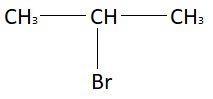
The chemical formula of this compound is ${C_3}{H_7}Br$.
So the first step of reaction is:
$C{H_3} - CH = C{H_2}\xrightarrow{{HBr}}C{H_3} - CHBr - C{H_3}$
Second step of reaction is:
$C{H_3} - CHBr - C{H_3}\xrightarrow{{KOH{\text{ }}acl}}B$
In this reaction halogen of the reactant will be replaced with $OH$ group of $KOH$ and $KBr$ will be released. So, B is ${C_3}{H_7}OH$ and the complete reaction is:
$C{H_3} - CH = C{H_2}\xrightarrow{{HBr}}C{H_3} - CHBr - C{H_3}\xrightarrow{{KOH{\text{ }}acl}}C{H_3} - CHOH - C{H_3}$
Hence A and B are ${C_3}{H_7}Br$ and ${C_3}{H_7}OH$ respectively.
Note:
Anti-markovnikov rule is opposite to the markovnikov rule. According to Anti-markovnikov rule hydrogen atom of $HX$ gets attached to that carbon atom of double bonded carbon which has less number of hydrogen atoms and halogen gets attached to that carbon atom of double bonded carbon atom which has more number of hydrogen atoms.
Complete step by step answer:
Reaction given in this question is $C{H_3} - CH = C{H_2}\xrightarrow{{HBr}}A\xrightarrow{{KOH{\text{ }}acl}}B$ and we have to identify A and B in this reaction.
In the first part of the reaction, that is, $C{H_3} - CH = C{H_2}\xrightarrow{{HBr}}A$ anti markovnikov rule will be followed. Markonikov rule states that in addition of protic acid $\left( {HX} \right)$ to an unsymmetrical alkene, acidic hydrogen gets attached to that carbon atom of double bond which has more hydrogen atoms and halide group $\left( X \right)$ gets attached to that carbon atom of double bond which is attached with more alkene groups. In this reactant, the carbon atom of $C{H_2}$ has more hydrogen atoms as compared to $CH$. So, according to anti markovnikov rule hydrogen atom will be attached to $C{H_2}$ group and bromine atom will be attached to $CH$ group. So, the resulting compound that is A will be:
The chemical formula of this compound is ${C_3}{H_7}Br$.
So the first step of reaction is:
$C{H_3} - CH = C{H_2}\xrightarrow{{HBr}}C{H_3} - CHBr - C{H_3}$
Second step of reaction is:
$C{H_3} - CHBr - C{H_3}\xrightarrow{{KOH{\text{ }}acl}}B$
In this reaction halogen of the reactant will be replaced with $OH$ group of $KOH$ and $KBr$ will be released. So, B is ${C_3}{H_7}OH$ and the complete reaction is:
$C{H_3} - CH = C{H_2}\xrightarrow{{HBr}}C{H_3} - CHBr - C{H_3}\xrightarrow{{KOH{\text{ }}acl}}C{H_3} - CHOH - C{H_3}$
Hence A and B are ${C_3}{H_7}Br$ and ${C_3}{H_7}OH$ respectively.
Note:
Anti-markovnikov rule is opposite to the markovnikov rule. According to Anti-markovnikov rule hydrogen atom of $HX$ gets attached to that carbon atom of double bonded carbon which has less number of hydrogen atoms and halogen gets attached to that carbon atom of double bonded carbon atom which has more number of hydrogen atoms.
Recently Updated Pages
Which of the following graphs shows the variation of class 12 physics CBSE

Draw a labelled diagram of the human male reproductive class 12 biology CBSE
Describe the experiment to compare the emf of two cells class 12 physics CBSE
What is standard hydrogen electrode
What is conventional current and electric current class 12 physics CBSE
2Bromopentane is treated with an alcoholic KOH solution class 12 chemistry CBSE
Trending doubts
Draw a labelled sketch of the human eye class 12 physics CBSE
Which are the Top 10 Largest Countries of the World?
Differentiate between homogeneous and heterogeneous class 12 chemistry CBSE
Draw ray diagrams each showing i myopic eye and ii class 12 physics CBSE
Which is the correct genotypic ratio of mendel dihybrid class 12 biology CBSE
What is the Full Form of PVC, PET, HDPE, LDPE, PP and PS ?