




How can you identify the $5$ and $3$ ends of DNA?
Answer
 Verified
516.3k+ views
Hint: A base pair refers to two bases that constitute a rung of the DNA ladder. A DNA nucleotide is constituted by a molecule of the base, a molecule of sugar, and a molecule of phosphoric acid. The bases are the letters, which spell out the genetic code. The code letters are C, G, T, and A, representing cytosine, guanine, thymine, and adenine respectively. The guanine base always pairs with a cytosine base, while adenine always forms a pair with a thymine base.
Complete answer:
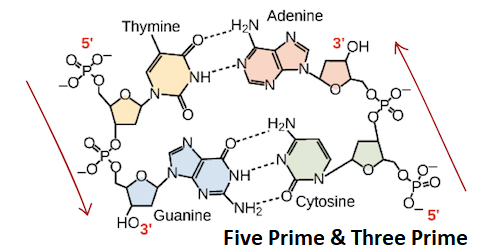
Fig: Representation of the ends of DNA
Just like letters and words in English are read from left to right, DNA is ‘read’ in a particular direction. Besides, each end of DNA is represented by a number. One end of the DNA is named as $5'$ (five prime), and another end of the molecule is named as $3'$ (three prime). The $3'$ and $5'$ designations refer to the number of carbon atoms in a deoxyribose sugar molecule, to which a phosphate group binds.
Carbons of the sugar are numbered in the clockwise direction, beginning from the oxygen atom. This asymmetry provides the DNA strand a ‘direction’ and the bases in the DNA are read in the $5'$ to $3'$ direction. This directionality and proceeding of the synthesis in the $5' \to 3'$direction have led to the convention that polynucleotide sequences are read and written in the $5' \to 3'$ direction.
Nucleic acid possesses an end-to-end chemical orientation like a polypeptide. The $5'$ end features a free hydroxyl or phosphate group on the $5'$ carbon of its terminal sugar. Five prime end is the end of a DNA strand that possesses the fifth carbon within the sugar ring at its terminus. The $3'$ end possesses a free hydroxyl group on the $3'$ carbon of its terminal sugar. The three prime end is the end of a molecule that terminates in a $3'$ phosphate group. The phosphate group at $5'$ end of one nucleotide and a hydroxyl group at $3'$ end of another nucleotide can establish phosphodiester bonds, thus linking adjacent molecules. This linkage offers the structural rigidity of DNA, providing the sugar-phosphate backbone.
Note:
The orientation of the two strands is opposite, that’s they are antiparallel. A single strand of DNA has an unbound $5'$ phosphate at one end. Besides, an unbound $3'$ hydroxyl group at the alternative end. Since DNA is generally read in the $5' \to 3'$ direction, reading starts from the free phosphate group and ends at the free hydroxyl group. For instance, the AUG sequence is assumed to be ($5'$) AUG ($3'$).
Complete answer:
Fig: Representation of the ends of DNA
Just like letters and words in English are read from left to right, DNA is ‘read’ in a particular direction. Besides, each end of DNA is represented by a number. One end of the DNA is named as $5'$ (five prime), and another end of the molecule is named as $3'$ (three prime). The $3'$ and $5'$ designations refer to the number of carbon atoms in a deoxyribose sugar molecule, to which a phosphate group binds.
Carbons of the sugar are numbered in the clockwise direction, beginning from the oxygen atom. This asymmetry provides the DNA strand a ‘direction’ and the bases in the DNA are read in the $5'$ to $3'$ direction. This directionality and proceeding of the synthesis in the $5' \to 3'$direction have led to the convention that polynucleotide sequences are read and written in the $5' \to 3'$ direction.
Nucleic acid possesses an end-to-end chemical orientation like a polypeptide. The $5'$ end features a free hydroxyl or phosphate group on the $5'$ carbon of its terminal sugar. Five prime end is the end of a DNA strand that possesses the fifth carbon within the sugar ring at its terminus. The $3'$ end possesses a free hydroxyl group on the $3'$ carbon of its terminal sugar. The three prime end is the end of a molecule that terminates in a $3'$ phosphate group. The phosphate group at $5'$ end of one nucleotide and a hydroxyl group at $3'$ end of another nucleotide can establish phosphodiester bonds, thus linking adjacent molecules. This linkage offers the structural rigidity of DNA, providing the sugar-phosphate backbone.
Note:
The orientation of the two strands is opposite, that’s they are antiparallel. A single strand of DNA has an unbound $5'$ phosphate at one end. Besides, an unbound $3'$ hydroxyl group at the alternative end. Since DNA is generally read in the $5' \to 3'$ direction, reading starts from the free phosphate group and ends at the free hydroxyl group. For instance, the AUG sequence is assumed to be ($5'$) AUG ($3'$).
Recently Updated Pages
Master Class 12 Business Studies: Engaging Questions & Answers for Success

Master Class 12 Chemistry: Engaging Questions & Answers for Success
Master Class 12 Biology: Engaging Questions & Answers for Success
Class 12 Question and Answer - Your Ultimate Solutions Guide
Master Class 11 English: Engaging Questions & Answers for Success
Master Class 11 Social Science: Engaging Questions & Answers for Success
Trending doubts
In order to find out the different types of gametes class 12 biology NEET_UG
Draw ray diagrams each showing i myopic eye and ii class 12 physics CBSE
Yeast reproduces by A Spore formation B Multiple fission class 12 biology CBSE
Draw a well labelled diagram of LS of the human ki class 12 biology CBSE
Write any five applications of photoelectric cells class 12 physics CBSE
Suicide bags of cells are aEndoplasmic reticulum bLysosome class 12 biology CBSE