



Identify D.
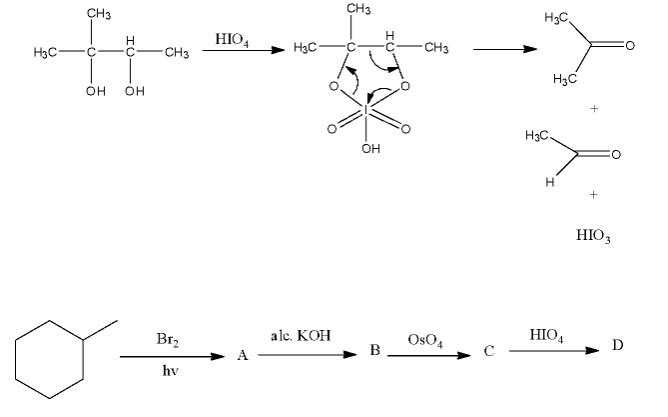
1,2-diols are oxidized to ketones or aldehydes by periodic acid $HI{{O}_{4}}$. Periodic acid reacts with diol to form a cyclic intermediate. The reaction takes place because iodine is in a highly positive oxidation state, so it readily accepts electrons. When the intermediate breaks down, the bond between the two carbons bonded to the –OH groups break.
Answer
 Verified
603.3k+ views
Hint: Acyclic 1,2-doilos reacts with periodic acid (an oxidizing agent) and generally produces a ketone and an aldehyde compound as the products. Periodic acid is a good oxidizing agent and reacts with compounds having 1-2-diols in their structures.
Complete step by step solution:
- In the question it is given that 1,2-diols are oxidized to ketones or aldehydes by periodic acid.
- But as per the question we can say that the product C in the question will be a diol and it produces ketone or aldehydes as the product and we have to identify what C forms on reaction with periodic acid.
- The given chemical reaction is as follows.

- First we have to identify A, B and C products in the above reaction.
- Reaction of methyl cyclohexane with bromine in sunlight is as follows.
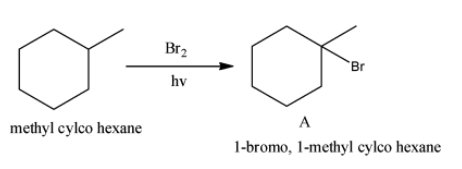
- Methyl cyclohexane reacts with bromine in presence of sunlight and produces 1-bromo, 1-methyl cyclohexane as the product.
- The product A reacts with alcoholic KOH and it is as follows.
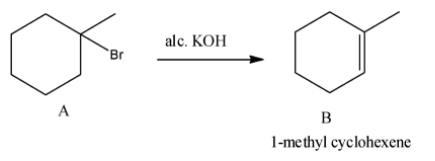
- 1-bromo, 1-methyl cyclohexane undergoes dehydrohalogenation in presence of alcoholic KOH and produces 1-methyl cyclohexene (B).
- 1-methyl cyclohexene (B) reacts with osmium tetroxide.
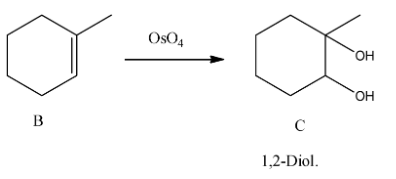
- Compound B reacts with osmium tetroxide and forms a 1,2-diol compound (C) as the product.
- Now compound C (1,2-diol) reacts with periodic acid.
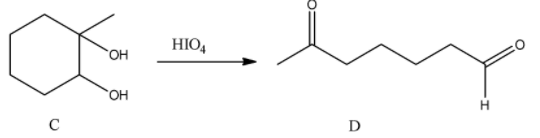
- Compound C reacts with periodic acid and produces a single product containing aldehyde functional group and ketone functional group in it.
Note: Aliphatic 1,2-doil compounds give more than one product (aldehydes and ketones) on reaction with periodic acid. But cyclic compounds give only one product having aldehyde and ketone functional groups in it.
Complete step by step solution:
- In the question it is given that 1,2-diols are oxidized to ketones or aldehydes by periodic acid.
- But as per the question we can say that the product C in the question will be a diol and it produces ketone or aldehydes as the product and we have to identify what C forms on reaction with periodic acid.
- The given chemical reaction is as follows.
- First we have to identify A, B and C products in the above reaction.
- Reaction of methyl cyclohexane with bromine in sunlight is as follows.
- Methyl cyclohexane reacts with bromine in presence of sunlight and produces 1-bromo, 1-methyl cyclohexane as the product.
- The product A reacts with alcoholic KOH and it is as follows.
- 1-bromo, 1-methyl cyclohexane undergoes dehydrohalogenation in presence of alcoholic KOH and produces 1-methyl cyclohexene (B).
- 1-methyl cyclohexene (B) reacts with osmium tetroxide.
- Compound B reacts with osmium tetroxide and forms a 1,2-diol compound (C) as the product.
- Now compound C (1,2-diol) reacts with periodic acid.
- Compound C reacts with periodic acid and produces a single product containing aldehyde functional group and ketone functional group in it.
Note: Aliphatic 1,2-doil compounds give more than one product (aldehydes and ketones) on reaction with periodic acid. But cyclic compounds give only one product having aldehyde and ketone functional groups in it.
Recently Updated Pages
Master Class 12 Business Studies: Engaging Questions & Answers for Success

Master Class 12 Biology: Engaging Questions & Answers for Success
Master Class 12 Chemistry: Engaging Questions & Answers for Success
Class 12 Question and Answer - Your Ultimate Solutions Guide
Master Class 11 Social Science: Engaging Questions & Answers for Success
Master Class 11 English: Engaging Questions & Answers for Success
Trending doubts
Which is more stable and why class 12 chemistry CBSE
Which are the Top 10 Largest Countries of the World?
Draw a labelled sketch of the human eye class 12 physics CBSE
Differentiate between homogeneous and heterogeneous class 12 chemistry CBSE
What are the major means of transport Explain each class 12 social science CBSE
Sulphuric acid is known as the king of acids State class 12 chemistry CBSE