



How do you identify corresponding angles?
Answer
 Verified
597k+ views
Hint: The angles formed when the transversal line cuts across two straight lines and the straight lines can be parallel to each other or cannot be parallel to each other then the angles are known as corresponding angles. Corresponding angles are located in the same relative position of an intersection of transversal which can be intersecting two or more straight lines.
Complete step-by-step answer:
For identifying the corresponding angles. Let us consider two straight lines passing in a plane and also consider a transversal line which passes through these two straight lines.
As the corresponding angles are located in the same relative position of an intersection of transversal. The diagram below illustrates the corresponding angle formed when transversal line crosses two parallel lines.
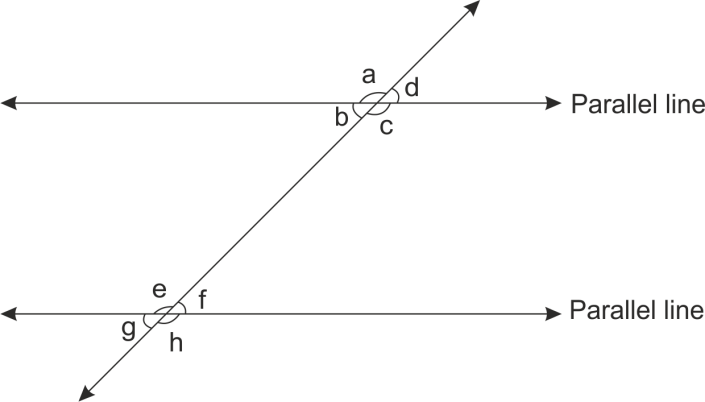
From the above diagram, the pair of corresponding angles are:
(1) $\angle a$ and $\angle e$
(2) $\angle b$ and $\angle gg$
(3) $\angle d$ and $\angle f$
(4) $\angle c$ and $\angle h$
As above we can identify the corresponding angles.
Additional Information:
In geometry an angle is composed of three parts. Namely vertex and two arms or sides. The vertex of an angle is the point where two sides or lines of the angle meet to each other while arms of an angle are simply the sides of the angles.
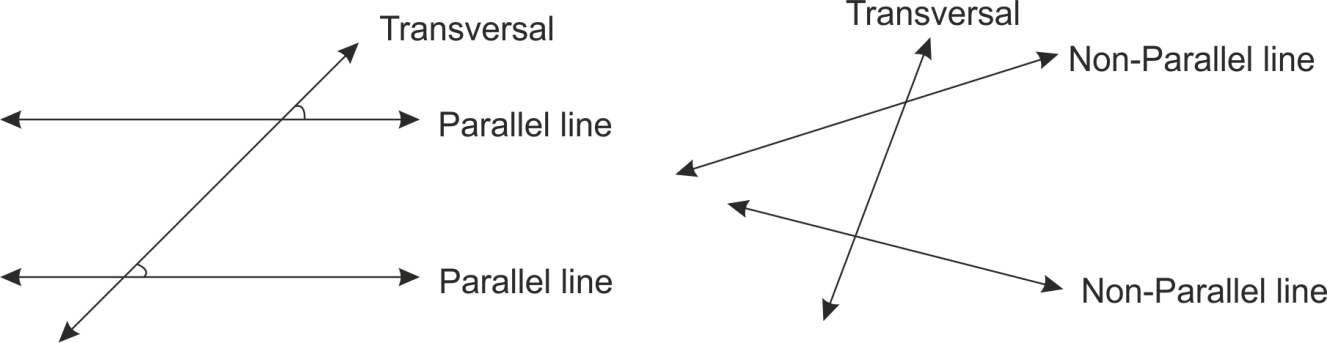
Also, the parallel lines are two or more lines on a two-dimensional plane that never cross or meet with each other. On the other hand, the non-parallel lines are two or more lines which intersect or will be intersecting at some point. Lines which intersect or will be intersecting at some point. And transversal line that crosses or passes through two other lines. A transverse line can pass through two or more parallel or non-parallel lines.
Note:
The angle rule of corresponding angles or the corresponding angles states that the corresponding angles are equal if a transversal cuts two parallel lines. Or at least two parallel lines. Such angles are called congruent and are called non-congruent angles.
Complete step-by-step answer:
For identifying the corresponding angles. Let us consider two straight lines passing in a plane and also consider a transversal line which passes through these two straight lines.
As the corresponding angles are located in the same relative position of an intersection of transversal. The diagram below illustrates the corresponding angle formed when transversal line crosses two parallel lines.
From the above diagram, the pair of corresponding angles are:
(1) $\angle a$ and $\angle e$
(2) $\angle b$ and $\angle gg$
(3) $\angle d$ and $\angle f$
(4) $\angle c$ and $\angle h$
As above we can identify the corresponding angles.
Additional Information:
In geometry an angle is composed of three parts. Namely vertex and two arms or sides. The vertex of an angle is the point where two sides or lines of the angle meet to each other while arms of an angle are simply the sides of the angles.
Also, the parallel lines are two or more lines on a two-dimensional plane that never cross or meet with each other. On the other hand, the non-parallel lines are two or more lines which intersect or will be intersecting at some point. Lines which intersect or will be intersecting at some point. And transversal line that crosses or passes through two other lines. A transverse line can pass through two or more parallel or non-parallel lines.
Note:
The angle rule of corresponding angles or the corresponding angles states that the corresponding angles are equal if a transversal cuts two parallel lines. Or at least two parallel lines. Such angles are called congruent and are called non-congruent angles.
Recently Updated Pages
Master Class 11 English: Engaging Questions & Answers for Success

Master Class 11 Social Science: Engaging Questions & Answers for Success
Master Class 11 Maths: Engaging Questions & Answers for Success
Master Class 11 Biology: Engaging Questions & Answers for Success
Master Class 11 Physics: Engaging Questions & Answers for Success
Master Class 11 Chemistry: Engaging Questions & Answers for Success
Trending doubts