



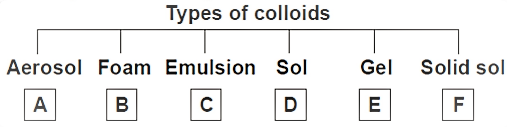
Identify A-F in the given flow chart.
A) A: Jelly B: Shaving Cream C: Milk D: Fog E: Cheese F: Gemstones
B) A: Milk of Magnesia B: Shaving Cream C: Mud D: Cloud E: Butter F: Gemstones
C) A: Cloud B: Shaving Cream C: Jelly D: Fog E: Rubber F: Gemstones
D) A: Fog B: Shaving Cream C: Milk D: Mud E: Jelly F: Gemstones
Answer
 Verified
642k+ views
Hint: Colloids are very small particles of any substance, dispersed throughout other substances. They do not settle when left undisturbed. They come under heterogeneous mixtures. Colloidal particles will have enormous surface area per unit mass due to their small size.
Complete Solution:
Before moving onto colloids, let’s first get some idea about what a mixture is. Mixture is the physical combination of two or more substances without undergoing any chemical changes. Mixtures are the blending of chemical substances such as elements and compounds.
There are two types of mixtures:
- Homogeneous mixture
- Heterogeneous mixture
Colloids are very small particles of any substance, dispersed throughout other substances. They do not settle when left undisturbed. They come under heterogeneous mixtures.
Colloids are classified based on the physical states of components: This type of classification is based on the physical state of the dispersed phase and dispersion medium. Based on whether the dispersed phase and dispersion medium is solid, liquid or gases, we can classify the colloids into eight types.
-Now, let us discuss the options that are given to us.
-Fog is an aerosol. Fogs are formed in the atmosphere where the gas and liquid mix as dispersion medium and dispersed phase respectively.
-Shaving cream is a foam.
-Milk is Emulsion.
-Mud is a Sol.
-Jelly is a gel.
-Gemstones are Solid sols.
So, the correct answer is “Option D”.
Note: A gas mixed with other gas forms a homogeneous mixture; hence this system is not a colloidal system. The hydrophilic sols are more stable than hydrophobic sols because the stability of hydrophobic sols is due to charge only and hydrophilic sols are stable due to charge and solvation.
Complete Solution:
Before moving onto colloids, let’s first get some idea about what a mixture is. Mixture is the physical combination of two or more substances without undergoing any chemical changes. Mixtures are the blending of chemical substances such as elements and compounds.
There are two types of mixtures:
- Homogeneous mixture
- Heterogeneous mixture
Colloids are very small particles of any substance, dispersed throughout other substances. They do not settle when left undisturbed. They come under heterogeneous mixtures.
Colloids are classified based on the physical states of components: This type of classification is based on the physical state of the dispersed phase and dispersion medium. Based on whether the dispersed phase and dispersion medium is solid, liquid or gases, we can classify the colloids into eight types.
| Dispersion phase | Dispersion medium | Types of colloid | Examples |
| Solid | Solid | Solid sol | Some colored glasses and gemstones |
| Solid | Liquid | Sol | Paints, cell fluids |
| Solid | Gas | Aerosol | Smoke, dust |
| Liquid | Solid | Gel | Cheese, butter |
| Liquid | Liquid | Emulsion | Milk, hair cream |
| Liquid | Gas | Aerosol | Fog, cloud |
| Gas | Solid | Solid sol | Foam rubber |
| Gas | Liquid | Foam | Froth, soap lather |
-Now, let us discuss the options that are given to us.
-Fog is an aerosol. Fogs are formed in the atmosphere where the gas and liquid mix as dispersion medium and dispersed phase respectively.
-Shaving cream is a foam.
-Milk is Emulsion.
-Mud is a Sol.
-Jelly is a gel.
-Gemstones are Solid sols.
So, the correct answer is “Option D”.
Note: A gas mixed with other gas forms a homogeneous mixture; hence this system is not a colloidal system. The hydrophilic sols are more stable than hydrophobic sols because the stability of hydrophobic sols is due to charge only and hydrophilic sols are stable due to charge and solvation.
Recently Updated Pages
What are the two major island groups in India class 9 social science CBSE

What is Jhum cultivation class 9 biology CBSE
Write an Article on Save Earth Save Life
Silk is obtained from of the silk moth APupa BLarva class 9 chemistry CBSE
Write chemical formulas of the following compounds class 9 chemistry CBSE
The Indo Gangetic Plains of India are fertile due to class 9 social science CBSE
Trending doubts
Fill the blanks with the suitable prepositions 1 The class 9 english CBSE
Difference Between Plant Cell and Animal Cell
What is the full form of pH?
What is pollution? How many types of pollution? Define it
On an outline map of India show its neighbouring c class 9 social science CBSE
What is momentum with examples class 9 physics CBSE