




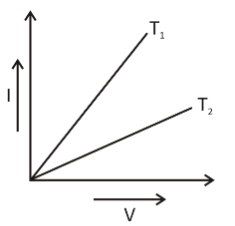
$I - V$ graph for a metallic wire at two different temperatures ${T_1}$ and ${T_2}$ is as shown in the figure. Which of the two temperatures is lower and why?
Answer
 Verified
636.9k+ views
Hint:Here we have to apply the concepts of temperature dependence on resistance. In metal conductors, owing to the interaction of electrons between atoms, electrical current flows. Some collide with gases, other electrons or impurities, as electrons pass through a metal conductor. Such collisions cause resistance and heat generation. It allows atoms to vibrate further by heating the metal conductor, which in turn makes it more difficult for the electrons to flow, raising resistance.
Complete answer:
The resistance of all pure metals increases linearly over a small temperature range with increases in temperature. The ions are virtually stationary at a low temperature. The ions within the metal gain energy as the temperature increases and continue to oscillate across their mean locations. These vibrating ions collide with the electrons, but with elevated temperatures, resistance increases.
From the figure we can observe that the slope of ${T_1}$ is greater than ${T_2}$.
Since, it is a $V - I$ graph; its slope gives conductance i.e. $\dfrac{1}{R}$.
Hence,
$
\dfrac{1}{{{R_1}}} > \dfrac{1}{{{R_2}}} \\
\therefore{R_2} > {R_1} \\
$
Since, we know that resistance of metal increases with increase in temperature
Therefore, ${T_2} > {T_1}$
So, temperature ${T_1}$ is lower as the resistance is smaller.
Additional information:
Ohm's Law teaches us that the current passing through the conductor is directly proportional to the voltage through it while a conductor is at a steady temperature. The gradient of the straight-line graph is aligned with the conductor’s resistance as $V = I \times R$. Conductivity is a calculation of the capacity of the material to conduct electrical current, which is equal to the reciprocal resistance of the material.
Note:For the change in temperature, the electrical resistance alters. Not only does the resistance rise with the increase in temperature, but in certain situations, it also decreases. In fact, the amount of change in resistance due to temperature variations is different for the various types of materials.
Complete answer:
The resistance of all pure metals increases linearly over a small temperature range with increases in temperature. The ions are virtually stationary at a low temperature. The ions within the metal gain energy as the temperature increases and continue to oscillate across their mean locations. These vibrating ions collide with the electrons, but with elevated temperatures, resistance increases.
From the figure we can observe that the slope of ${T_1}$ is greater than ${T_2}$.
Since, it is a $V - I$ graph; its slope gives conductance i.e. $\dfrac{1}{R}$.
Hence,
$
\dfrac{1}{{{R_1}}} > \dfrac{1}{{{R_2}}} \\
\therefore{R_2} > {R_1} \\
$
Since, we know that resistance of metal increases with increase in temperature
Therefore, ${T_2} > {T_1}$
So, temperature ${T_1}$ is lower as the resistance is smaller.
Additional information:
Ohm's Law teaches us that the current passing through the conductor is directly proportional to the voltage through it while a conductor is at a steady temperature. The gradient of the straight-line graph is aligned with the conductor’s resistance as $V = I \times R$. Conductivity is a calculation of the capacity of the material to conduct electrical current, which is equal to the reciprocal resistance of the material.
Note:For the change in temperature, the electrical resistance alters. Not only does the resistance rise with the increase in temperature, but in certain situations, it also decreases. In fact, the amount of change in resistance due to temperature variations is different for the various types of materials.
Recently Updated Pages
Which of the following graphs shows the variation of class 12 physics CBSE

Draw a labelled diagram of the human male reproductive class 12 biology CBSE
Describe the experiment to compare the emf of two cells class 12 physics CBSE
What is standard hydrogen electrode
What is conventional current and electric current class 12 physics CBSE
2Bromopentane is treated with an alcoholic KOH solution class 12 chemistry CBSE
Trending doubts
Draw a labelled sketch of the human eye class 12 physics CBSE
Which are the Top 10 Largest Countries of the World?
Differentiate between homogeneous and heterogeneous class 12 chemistry CBSE
Draw ray diagrams each showing i myopic eye and ii class 12 physics CBSE
Which is the correct genotypic ratio of mendel dihybrid class 12 biology CBSE
What is the Full Form of PVC, PET, HDPE, LDPE, PP and PS ?