




(i) Name the phenomena on which the working of an optical fiber is based.
(ii) What are the necessary conditions for this phenomenon to occur?
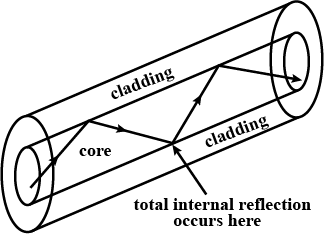
(iii) Draw a labelled diagram of an optical fiber and show how light propagates through the optical fiber using the phenomenon.
Answer
 Verified
553.5k+ views
Hint: Reflection is the change in direction of a wave front at an interface between two different media so that the wave front returns into the medium from which it originated. Common examples include the reflection of light, sound and water waves.
Complete step-by-step solution:
(i) The optical fiber is based on total internal reflection. Total internal reflection is the phenomenon which occurs when the light rays travel from a more optically denser medium to a less optically denser medium.
Total internal reflection, \[\dfrac{{{n_1}}}{{{n_2}}} = \dfrac{{\sin i}}{{\sin r}}\]
Critical angle, $\theta = \dfrac{{{n_1}}}{{{n_2}}}$
r=the angle of refraction
i=the angle of incidence
${n_1}$=the refractive index in medium 1
${n_2}$=the refractive index in medium 2
$\theta $= the critical angle
(ii) There are two conditions for total internal reflection.
The light ray moves from a denser medium to a less dense medium.
The angle of incidence must be greater than the critical angle.
(iii)
Additional information:
When a primary rainbow is formed, it is due to one total reflection in water droplets. A secondary rainbow is formed by light that underwent two internal reflections, and that is what changes the ordering of the colors.
Note: Mirage is caused due to total Internal Reflection of light by the various layers of air. It is an optical illusion which is responsible for the appearance of the water layer at short distances in a desert or on the road. Mirage is an example of total internal reflection which occurs due to atmospheric refraction.
Complete step-by-step solution:
(i) The optical fiber is based on total internal reflection. Total internal reflection is the phenomenon which occurs when the light rays travel from a more optically denser medium to a less optically denser medium.
Total internal reflection, \[\dfrac{{{n_1}}}{{{n_2}}} = \dfrac{{\sin i}}{{\sin r}}\]
Critical angle, $\theta = \dfrac{{{n_1}}}{{{n_2}}}$
r=the angle of refraction
i=the angle of incidence
${n_1}$=the refractive index in medium 1
${n_2}$=the refractive index in medium 2
$\theta $= the critical angle
(ii) There are two conditions for total internal reflection.
The light ray moves from a denser medium to a less dense medium.
The angle of incidence must be greater than the critical angle.
(iii)
Additional information:
When a primary rainbow is formed, it is due to one total reflection in water droplets. A secondary rainbow is formed by light that underwent two internal reflections, and that is what changes the ordering of the colors.
Note: Mirage is caused due to total Internal Reflection of light by the various layers of air. It is an optical illusion which is responsible for the appearance of the water layer at short distances in a desert or on the road. Mirage is an example of total internal reflection which occurs due to atmospheric refraction.
Recently Updated Pages
Master Class 12 Business Studies: Engaging Questions & Answers for Success

Master Class 12 Chemistry: Engaging Questions & Answers for Success
Master Class 12 Biology: Engaging Questions & Answers for Success
Class 12 Question and Answer - Your Ultimate Solutions Guide
Master Class 11 English: Engaging Questions & Answers for Success
Master Class 11 Social Science: Engaging Questions & Answers for Success
Trending doubts
Which are the Top 10 Largest Countries of the World?
Draw a labelled sketch of the human eye class 12 physics CBSE
Differentiate between homogeneous and heterogeneous class 12 chemistry CBSE
In order to find out the different types of gametes class 12 biology NEET_UG
Why is the cell called the structural and functional class 12 biology CBSE
Draw ray diagrams each showing i myopic eye and ii class 12 physics CBSE