




Human blood type is determined by codominant alleles. There are three different alleles, known as \[{{\text{I}}^{\text{A}}}\], \[{{\text{I}}^{\text{B}}}\], and i. the \[{{\text{I}}^{\text{A}}}\] and \[{{\text{I}}^{\text{B}}}\], alleles are codominant, and the i allele is recessive.
The possible human phenotypes for blood group are type A, type B, type AB, and type O. type A and B individuals can be either homozygous (\[{{\text{I}}^{\text{A}}}\]\[{{\text{I}}^{\text{A}}}\]or \[{{\text{I}}^{\text{B}}}\]\[{{\text{I}}^{\text{B}}}\], respectively), or heterozygous (\[{{\text{I}}^{\text{A}}}\]i or \[{{\text{I}}^{\text{B}}}\]i, respectively).
A woman with type A blood and a man with type B blood could potentially have offspring with which of the following blood types?
A. Type A
B. Type B
C. Type AB
D. All of the above
Answer
 Verified
588.6k+ views
Hint: The human blood grouping system, known as ABO blood grouping, is based upon the presence or absence of two antigens, namely A and B, which are present on the surface of RBCs. In response to these antigens, antibodies are also present in the plasma.
Complete answer:
There are four types of blood groups, A, B, AB, and O. Three major alleles for determining the blood groups are \[{{\text{I}}^{\text{A}}}\], \[{{\text{I}}^{\text{B}}}\], and i. The genotype of blood group A could be either \[{{\text{I}}^{\text{A}}}\]\[{{\text{I}}^{\text{A}}}\] or \[{{\text{I}}^{\text{A}}}\]i and similarly, blood group B could have genotype either of \[{{\text{I}}^{\text{B}}}\]\[{{\text{I}}^{\text{B}}}\] or \[{{\text{I}}^{\text{B}}}\]i. Blood group O is present if neither \[{{\text{I}}^{\text{A}}}\]nor \[{{\text{I}}^{\text{B}}}\]is present and in AB blood group both \[{{\text{I}}^{\text{A}}}\] and \[{{\text{I}}^{\text{B}}}\] are present. For blood group A, the antigen on the surface of RBC is A and the antibody would be anti-B. For blood group B, the antigen would be B and antibody, anti-A. For AB blood type, antigens on the surface of RBCs are both A and B and no antibody is present. For O blood type, there would be no antigen, but antibodies would be of both A and B types.
If a woman has a blood group of type A then it could be either in the form of homozygous alleles or heterozygous alleles, \[{{\text{I}}^{\text{A}}}\] or \[{{\text{I}}^{\text{A}}}\]i, respectively. Similarly, if the man has a blood type of B then the alleles could be homozygous or heterozygous.
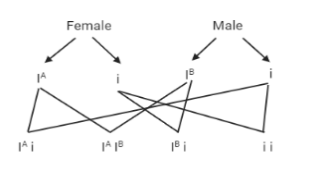
In the homozygous condition, \[{{\text{I}}^{\text{A}}}\] from the female combines with \[{{\text{I}}^{\text{B}}}\] from the male to form AB blood type having genotype \[{{\text{I}}^{\text{A}}}\]\[{{\text{I}}^{\text{B}}}\]. But in the heterozygous condition, either \[{{\text{I}}^{\text{A}}}\] or i from the female could combine with either \[{{\text{I}}^{\text{B}}}\] or i from the male. Thus, the blood types that could be formed are A (\[{{\text{I}}^{\text{A}}}\]i), B (\[{{\text{I}}^{\text{B}}}\]i), AB (\[{{\text{I}}^{\text{A}}}\]\[{{\text{I}}^{\text{B}}}\]), or O (ii) as shown in the figure below.
Hence, the correct answer is option (D)
Note: Apart from ABO blood grouping, Rh type of blood group determination is also very important. If the Rh antigen is present, then the individual is called Rh-positive, and if the antigen is absent, the individual is called Rh-negative.
Complete answer:
There are four types of blood groups, A, B, AB, and O. Three major alleles for determining the blood groups are \[{{\text{I}}^{\text{A}}}\], \[{{\text{I}}^{\text{B}}}\], and i. The genotype of blood group A could be either \[{{\text{I}}^{\text{A}}}\]\[{{\text{I}}^{\text{A}}}\] or \[{{\text{I}}^{\text{A}}}\]i and similarly, blood group B could have genotype either of \[{{\text{I}}^{\text{B}}}\]\[{{\text{I}}^{\text{B}}}\] or \[{{\text{I}}^{\text{B}}}\]i. Blood group O is present if neither \[{{\text{I}}^{\text{A}}}\]nor \[{{\text{I}}^{\text{B}}}\]is present and in AB blood group both \[{{\text{I}}^{\text{A}}}\] and \[{{\text{I}}^{\text{B}}}\] are present. For blood group A, the antigen on the surface of RBC is A and the antibody would be anti-B. For blood group B, the antigen would be B and antibody, anti-A. For AB blood type, antigens on the surface of RBCs are both A and B and no antibody is present. For O blood type, there would be no antigen, but antibodies would be of both A and B types.
If a woman has a blood group of type A then it could be either in the form of homozygous alleles or heterozygous alleles, \[{{\text{I}}^{\text{A}}}\] or \[{{\text{I}}^{\text{A}}}\]i, respectively. Similarly, if the man has a blood type of B then the alleles could be homozygous or heterozygous.
In the homozygous condition, \[{{\text{I}}^{\text{A}}}\] from the female combines with \[{{\text{I}}^{\text{B}}}\] from the male to form AB blood type having genotype \[{{\text{I}}^{\text{A}}}\]\[{{\text{I}}^{\text{B}}}\]. But in the heterozygous condition, either \[{{\text{I}}^{\text{A}}}\] or i from the female could combine with either \[{{\text{I}}^{\text{B}}}\] or i from the male. Thus, the blood types that could be formed are A (\[{{\text{I}}^{\text{A}}}\]i), B (\[{{\text{I}}^{\text{B}}}\]i), AB (\[{{\text{I}}^{\text{A}}}\]\[{{\text{I}}^{\text{B}}}\]), or O (ii) as shown in the figure below.
Hence, the correct answer is option (D)
Note: Apart from ABO blood grouping, Rh type of blood group determination is also very important. If the Rh antigen is present, then the individual is called Rh-positive, and if the antigen is absent, the individual is called Rh-negative.
Recently Updated Pages
Master Class 12 Business Studies: Engaging Questions & Answers for Success

Master Class 12 Chemistry: Engaging Questions & Answers for Success
Master Class 12 Biology: Engaging Questions & Answers for Success
Class 12 Question and Answer - Your Ultimate Solutions Guide
Master Class 11 English: Engaging Questions & Answers for Success
Master Class 11 Social Science: Engaging Questions & Answers for Success
Trending doubts
Differentiate between Pyramid of energy and pyramid class 12 biology CBSE
Draw the diagram of the pyramid of energy Explain In class 12 biology CBSE
When was the first election held in India a 194748 class 12 sst CBSE
The first microscope was invented by A Leeuwenhoek class 12 biology CBSE
Suicide bags of cells are aEndoplasmic reticulum bLysosome class 12 biology CBSE
The first general election of Lok Sabha was held in class 12 social science CBSE