




How would you graph the line $x=3$? \[\]
Answer
 Verified
583.5k+ views
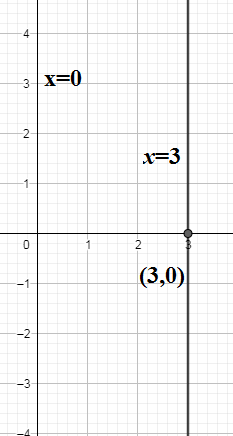
Hint: We recall the definition of $x$ and $y-$ coordinate of the point. We use the fact that that the locus of all points equidistant from a line will be a line parallel to the original line and deduce that $x=3$ is a line parallel to $y-$ axis at a distance 3 from $y-$ axis passing through point $\left( 3,0 \right)$.\[\]
Complete step by step answer:
We know that all points in plane are represented as the ordered pair $\left( a,b \right)$ where $\left| a \right|$ is the distance from $y-$axis (called as abscissa or $x-$coordinate) and $\left| b \right|$ is the distance of the point from the $y-$axis (called as ordinate or $y-$coordinate).
We are given the line $x=3$ in the question. Here $x=3$ means all the points on the line $x=3$the $x-$coordinate of the points will remain same irrespective of the $y-$ordinate which means $x=3$ is the locus points of the type $\left( 3,b \right)$ where $b\in R$. \[\]
We know that locus of all points equidistant from a line will be a line parallel to the original line. Since $x-$coordinate which is also the distance $\left( \left| 3 \right|=3 \right)$ from $y-$axis is constant, all the points from $y-$axis will be equidistant. So the distance between $y-$axis and $x=3$ is constant and hence $x=3$is line parallel to $y-$axis . So the line $x=3$ will also pass through $\left( 3,0 \right)$ where it will cut $x-$axis for the value $y=0$ in $\left( 3,b \right)$.
Note:
We know that the general equation of line is $ax+by+c=0$ and the line parallel to it is given by $ax=by+k=0,k\ne c$. Since the equation of the $y-$axis is $x=0$ line parallel to it will be $x=k,k\ne 0$. We can alternatively find the slope of the line $ax+by+c=0$ as $\dfrac{-a}{b}$ from $0\cdot y+1\cdot x-3=0$ as $\dfrac{-1}{0}=\infty $ that is undefined and we know that a lien with undefined slope is perpendicular to $x-$axis and we get point $\left( 3,0 \right)$ to draw the perpendicular line.
Complete step by step answer:
We know that all points in plane are represented as the ordered pair $\left( a,b \right)$ where $\left| a \right|$ is the distance from $y-$axis (called as abscissa or $x-$coordinate) and $\left| b \right|$ is the distance of the point from the $y-$axis (called as ordinate or $y-$coordinate).
We are given the line $x=3$ in the question. Here $x=3$ means all the points on the line $x=3$the $x-$coordinate of the points will remain same irrespective of the $y-$ordinate which means $x=3$ is the locus points of the type $\left( 3,b \right)$ where $b\in R$. \[\]
We know that locus of all points equidistant from a line will be a line parallel to the original line. Since $x-$coordinate which is also the distance $\left( \left| 3 \right|=3 \right)$ from $y-$axis is constant, all the points from $y-$axis will be equidistant. So the distance between $y-$axis and $x=3$ is constant and hence $x=3$is line parallel to $y-$axis . So the line $x=3$ will also pass through $\left( 3,0 \right)$ where it will cut $x-$axis for the value $y=0$ in $\left( 3,b \right)$.
Note:
We know that the general equation of line is $ax+by+c=0$ and the line parallel to it is given by $ax=by+k=0,k\ne c$. Since the equation of the $y-$axis is $x=0$ line parallel to it will be $x=k,k\ne 0$. We can alternatively find the slope of the line $ax+by+c=0$ as $\dfrac{-a}{b}$ from $0\cdot y+1\cdot x-3=0$ as $\dfrac{-1}{0}=\infty $ that is undefined and we know that a lien with undefined slope is perpendicular to $x-$axis and we get point $\left( 3,0 \right)$ to draw the perpendicular line.
Recently Updated Pages
Three beakers labelled as A B and C each containing 25 mL of water were taken A small amount of NaOH anhydrous CuSO4 and NaCl were added to the beakers A B and C respectively It was observed that there was an increase in the temperature of the solutions contained in beakers A and B whereas in case of beaker C the temperature of the solution falls Which one of the following statements isarecorrect i In beakers A and B exothermic process has occurred ii In beakers A and B endothermic process has occurred iii In beaker C exothermic process has occurred iv In beaker C endothermic process has occurred

Master Class 11 Social Science: Engaging Questions & Answers for Success
Master Class 11 Physics: Engaging Questions & Answers for Success
Master Class 11 Maths: Engaging Questions & Answers for Success
Master Class 11 Economics: Engaging Questions & Answers for Success
Master Class 11 Computer Science: Engaging Questions & Answers for Success
Three beakers labelled as A B and C each containing 25 mL of water were taken A small amount of NaOH anhydrous CuSO4 and NaCl were added to the beakers A B and C respectively It was observed that there was an increase in the temperature of the solutions contained in beakers A and B whereas in case of beaker C the temperature of the solution falls Which one of the following statements isarecorrect i In beakers A and B exothermic process has occurred ii In beakers A and B endothermic process has occurred iii In beaker C exothermic process has occurred iv In beaker C endothermic process has occurred
Master Class 11 Social Science: Engaging Questions & Answers for Success
Master Class 11 Physics: Engaging Questions & Answers for Success
Trending doubts
One Metric ton is equal to kg A 10000 B 1000 C 100 class 11 physics CBSE
There are 720 permutations of the digits 1 2 3 4 5 class 11 maths CBSE
State and prove Bernoullis theorem class 11 physics CBSE
Draw a diagram of a plant cell and label at least eight class 11 biology CBSE
Difference Between Prokaryotic Cells and Eukaryotic Cells
1 Quintal is equal to a 110 kg b 10 kg c 100kg d 1000 class 11 physics CBSE