




How many volts can a diode handle?
Answer
 Verified
478.2k+ views
Hint:We know that diodes (PN junctions) in associate electric circuits permits current to flow a lot more simply in one direction than another. Forward biasing means that swing a voltage across a diode that enables current to flow simply, whereas reverse biasing means that swing a voltage across a diode within the other way. The Forward bias decreases the resistance of the diode whereas the reversed bias will increase the resistance of the diode. In forward biasing this is definitely flowing through the circuit whereas reverse bias doesn't enable this to flow through it.
Complete answer:
A diode could be a two-terminal electronic element that features a low resistance to the flow of current in one direction therefore permitting the passage of current in one direction whereas there'll be a high resistance within the alternative, therefore proscribing the flow of current in this direction. Semiconductor diodes square measure two-terminal devices that include a tangency and aluminous contacts at their two ends.
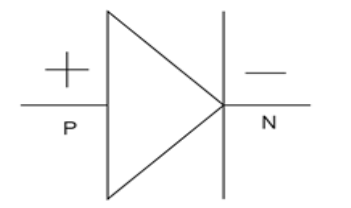
The P-N junction in physics is represented as shown in the above diagram. The forward voltage of a chemical element silicon diode is close to $0.7V$ volts and for a Ge diode, it is $0.3V$ volts. The highest peak inverse voltage is that the most voltage that the diode can allow in a reverse diode while not breakdown.
The forward fall for the Ge junction is a smaller amount, whereas for chemical element diodes the forward fall is low. A Ge diode generally begins to conduct current once voltage properly applied across the diode reaches $0.3$ volts. chemical element diodes need a lot of voltage to conduct current; it takes $0.7V$ volts to make a forward-bias scenario in a silicon element diode.
Note:It ought to be remembered that a silicon chemical element diode could be a semiconductor device that has positive and charge polarity and permits this to flow in precisely one direction. Ge diodes additionally work equally to Si diodes, however the distinction is Ge has low forward voltage, which ends up in it being a very low power loss and a very efficient diode.
Complete answer:
A diode could be a two-terminal electronic element that features a low resistance to the flow of current in one direction therefore permitting the passage of current in one direction whereas there'll be a high resistance within the alternative, therefore proscribing the flow of current in this direction. Semiconductor diodes square measure two-terminal devices that include a tangency and aluminous contacts at their two ends.
The P-N junction in physics is represented as shown in the above diagram. The forward voltage of a chemical element silicon diode is close to $0.7V$ volts and for a Ge diode, it is $0.3V$ volts. The highest peak inverse voltage is that the most voltage that the diode can allow in a reverse diode while not breakdown.
The forward fall for the Ge junction is a smaller amount, whereas for chemical element diodes the forward fall is low. A Ge diode generally begins to conduct current once voltage properly applied across the diode reaches $0.3$ volts. chemical element diodes need a lot of voltage to conduct current; it takes $0.7V$ volts to make a forward-bias scenario in a silicon element diode.
Note:It ought to be remembered that a silicon chemical element diode could be a semiconductor device that has positive and charge polarity and permits this to flow in precisely one direction. Ge diodes additionally work equally to Si diodes, however the distinction is Ge has low forward voltage, which ends up in it being a very low power loss and a very efficient diode.
Recently Updated Pages
Master Class 12 Economics: Engaging Questions & Answers for Success

Master Class 12 Physics: Engaging Questions & Answers for Success
Master Class 12 English: Engaging Questions & Answers for Success
Master Class 12 Social Science: Engaging Questions & Answers for Success
Master Class 12 Maths: Engaging Questions & Answers for Success
Master Class 12 Business Studies: Engaging Questions & Answers for Success
Trending doubts
Which are the Top 10 Largest Countries of the World?
What are the major means of transport Explain each class 12 social science CBSE
Draw a labelled sketch of the human eye class 12 physics CBSE
Why cannot DNA pass through cell membranes class 12 biology CBSE
Differentiate between insitu conservation and exsitu class 12 biology CBSE
Draw a neat and well labeled diagram of TS of ovary class 12 biology CBSE