



How is ethylene glycol made?
Answer
 Verified
549.3k+ views
Hint: Catalytic oxidation of alkenes with silver oxide produces compounds that contain a hydroxyl group on their neighboring or adjacent atoms are known as diols. Ethylene glycol is a type of a diol.
Complete answer:
Ethylene glycol has the IUPAC name of ethane-1,2-diol. It is a type of glycol, organic compounds that have neighboring hydroxyl groups. Ethylene glycol has an empirical formula ${{C}_{2}}{{H}_{6}}{{O}_{2}}$.
Ethylene glycol can be made from the reaction of ethylene when exposed to catalytic oxidation in the presence of an oxidizing agent, produces ethylene oxide, which on hydrolysis in the presence of a dilute acid or a base, produces ethane-1,2-diol or ethylene glycol. The reaction is as follows:
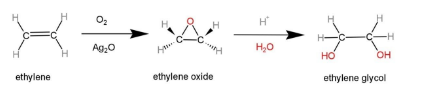
Silver oxide is used as an oxidizing agent here, which forms a tricyclic state of ethylene oxide, that is treated with a dilute acid.
Hence, ethylene glycol is prepared by the above reactions.
Additional information:
Ethylene glycol is of great importance as it is used as an anti-freezing agent for vehicle engines; in air conditioner; it is used in solvents of paints, shoe polish, printing inks; also it is used as a raw material for making various polymers (like polyester). Other uses include in explosives and resins, also in synthetic wax. It is considered as highly poisonous and its consumption by humans or animals can cause fetal illnesses or even death.
Note: Apart from oxidation of ethylene, ethylene glycol can also be prepared from oxalic esters. Oxalic esters, when reduced in presence of alcohol and sodium will form ethylene glycol as a product.
Complete answer:
Ethylene glycol has the IUPAC name of ethane-1,2-diol. It is a type of glycol, organic compounds that have neighboring hydroxyl groups. Ethylene glycol has an empirical formula ${{C}_{2}}{{H}_{6}}{{O}_{2}}$.
Ethylene glycol can be made from the reaction of ethylene when exposed to catalytic oxidation in the presence of an oxidizing agent, produces ethylene oxide, which on hydrolysis in the presence of a dilute acid or a base, produces ethane-1,2-diol or ethylene glycol. The reaction is as follows:
Silver oxide is used as an oxidizing agent here, which forms a tricyclic state of ethylene oxide, that is treated with a dilute acid.
Hence, ethylene glycol is prepared by the above reactions.
Additional information:
Ethylene glycol is of great importance as it is used as an anti-freezing agent for vehicle engines; in air conditioner; it is used in solvents of paints, shoe polish, printing inks; also it is used as a raw material for making various polymers (like polyester). Other uses include in explosives and resins, also in synthetic wax. It is considered as highly poisonous and its consumption by humans or animals can cause fetal illnesses or even death.
Note: Apart from oxidation of ethylene, ethylene glycol can also be prepared from oxalic esters. Oxalic esters, when reduced in presence of alcohol and sodium will form ethylene glycol as a product.
Recently Updated Pages
Master Class 12 Social Science: Engaging Questions & Answers for Success

Master Class 12 Physics: Engaging Questions & Answers for Success
Master Class 12 Maths: Engaging Questions & Answers for Success
Master Class 12 Economics: Engaging Questions & Answers for Success
Master Class 12 Chemistry: Engaging Questions & Answers for Success
Master Class 12 Business Studies: Engaging Questions & Answers for Success
Trending doubts
Which are the Top 10 Largest Countries of the World?
Draw a labelled sketch of the human eye class 12 physics CBSE
Explain the structure of megasporangium class 12 biology CBSE
What are the major means of transport Explain each class 12 social science CBSE
How many chromosomes are found in human ovum a 46 b class 12 biology CBSE
The diagram of the section of a maize grain is given class 12 biology CBSE