




How do you solve $ \tan x=2.5 $ ?
Answer
 Verified
574.8k+ views
Hint: We explain the function $ {{\tan }^{-1}}x $ . We express the inverse function of tan in the form of $ arc\tan \left( x \right)={{\tan }^{-1}}x $ . We draw the graph of $ arc\tan \left( x \right) $ and the line $ x=2.5 $ to find the intersection point. We can also solve it as $ y=\tan x=2.5 $ and find their intersection.
Complete step-by-step answer:
The given expression is the inverse function of trigonometric ratio tan. We need to find $ {{\tan }^{-1}}\left( 2.5 \right) $ .
The arcus function represents the angle which on ratio tan gives the value.
Each of the trigonometric functions is periodic in the real part of its argument, running through all its values twice in each interval of $ 2\pi $ .
The general solution for that value where $ \tan \alpha =x $ will be $ n\pi +\alpha ,n\in \mathbb{Z} $ .
But for $ {{\tan }^{-1}}x $ , we won’t find the general solution. We use the principal value. For ratio tan we have $ -\dfrac{\pi }{2}\le {{\tan }^{-1}}x\le \dfrac{\pi }{2} $ .
The graph of the function is
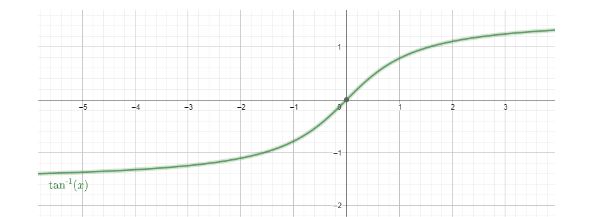
We now place the value of $ x=2.5 $ in the function of $ {{\tan }^{-1}}x $ .
Let the angle be $ \theta $ for which $ {{\tan }^{-1}}\left( 2.5 \right)=\theta $ . This gives $ \tan \theta =2.5 $ .
For this we take the line of $ x=2.5 $ and see the intersection of the line with the graph $ {{\tan }^{-1}}x $ .
Putting the value in the graph of $ {{\tan }^{-1}}x $ , we get $ \theta =68.2 $ . (approx.)
We get the value of y coordinates as $ {{68.2}^{\circ }} $ .
So, the correct answer is “ $ {{68.2}^{\circ }} $ ”.
Note: We can also apply the trigonometric identity where $ \tan \theta =2.5=\dfrac{5}{2} $ . We express it in a right-angle triangle whose height will be 5 and the base will be 2.
In that case the hypotenuse will be $ \sqrt{{{5}^{2}}+{{2}^{2}}}=\sqrt{29} $ .
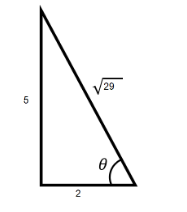
Also, in the exact solution domain of $ -\dfrac{\pi }{2}\le \theta \le \dfrac{\pi }{2} $ , the solution is $ \theta =68.2 $ .
Complete step-by-step answer:
The given expression is the inverse function of trigonometric ratio tan. We need to find $ {{\tan }^{-1}}\left( 2.5 \right) $ .
The arcus function represents the angle which on ratio tan gives the value.
Each of the trigonometric functions is periodic in the real part of its argument, running through all its values twice in each interval of $ 2\pi $ .
The general solution for that value where $ \tan \alpha =x $ will be $ n\pi +\alpha ,n\in \mathbb{Z} $ .
But for $ {{\tan }^{-1}}x $ , we won’t find the general solution. We use the principal value. For ratio tan we have $ -\dfrac{\pi }{2}\le {{\tan }^{-1}}x\le \dfrac{\pi }{2} $ .
The graph of the function is
We now place the value of $ x=2.5 $ in the function of $ {{\tan }^{-1}}x $ .
Let the angle be $ \theta $ for which $ {{\tan }^{-1}}\left( 2.5 \right)=\theta $ . This gives $ \tan \theta =2.5 $ .
For this we take the line of $ x=2.5 $ and see the intersection of the line with the graph $ {{\tan }^{-1}}x $ .
Putting the value in the graph of $ {{\tan }^{-1}}x $ , we get $ \theta =68.2 $ . (approx.)
We get the value of y coordinates as $ {{68.2}^{\circ }} $ .
So, the correct answer is “ $ {{68.2}^{\circ }} $ ”.
Note: We can also apply the trigonometric identity where $ \tan \theta =2.5=\dfrac{5}{2} $ . We express it in a right-angle triangle whose height will be 5 and the base will be 2.
In that case the hypotenuse will be $ \sqrt{{{5}^{2}}+{{2}^{2}}}=\sqrt{29} $ .
Also, in the exact solution domain of $ -\dfrac{\pi }{2}\le \theta \le \dfrac{\pi }{2} $ , the solution is $ \theta =68.2 $ .
Recently Updated Pages
Master Class 11 Social Science: Engaging Questions & Answers for Success

Master Class 11 Physics: Engaging Questions & Answers for Success
Master Class 11 Maths: Engaging Questions & Answers for Success
Master Class 11 Economics: Engaging Questions & Answers for Success
Master Class 11 Computer Science: Engaging Questions & Answers for Success
Master Class 11 Chemistry: Engaging Questions & Answers for Success
Trending doubts
One Metric ton is equal to kg A 10000 B 1000 C 100 class 11 physics CBSE
There are 720 permutations of the digits 1 2 3 4 5 class 11 maths CBSE
1 Quintal is equal to a 110 kg b 10 kg c 100kg d 1000 class 11 physics CBSE
State and prove Bernoullis theorem class 11 physics CBSE
Difference Between Prokaryotic Cells and Eukaryotic Cells
Which among the following are examples of coming together class 11 social science CBSE