




How do you graph $ r = 2\sin \theta $ ?
Answer
 Verified
601.2k+ views
Hint: The given equation is in the polar form of a conic section. To graph this equation on a cartesian plane we have to convert this equation into standard form or rectangular form. To convert this equation we can use the following conversions,
$
x = r\cos \theta \\
y = r\sin \theta \;
$
where $ \theta $ is the angle that the line joining origin and the general point makes with the x-axis and $ r $ is the magnitude or the distance of the point from origin given as $ {r^2} = {x^2} + {y^2} $ .
Complete step by step solution:
We have been given to graph the equation $ r = 2\sin \theta $ .
Since this equation includes the angle $ \theta $ and the magnitude $ r $ , this is in the polar form. To graph this equation we will first convert it into standard form or rectangular form such that we get an equation in terms of $ x $ and $ y $ . We can use $ x = r\cos \theta ,\;\;y = r\sin \theta \;\;and\;\;{r^2} = {x^2} + {y^2} $ .
From $ y = r\sin \theta $ , we have $ \sin \theta = \dfrac{y}{r} $ .
From $ {r^2} = {x^2} + {y^2} $ , we have $ r = \sqrt {{x^2} + {y^2}} $
Thus the given equation becomes,
$
r = 2\sin \theta \\
\Rightarrow \sqrt {{x^2} + {y^2}} = 2\dfrac{y}{r} = \dfrac{{2y}}{{\sqrt {{x^2} + {y^2}} }} \\
\Rightarrow {x^2} + {y^2} = 2y \;
$
We have the coefficient of \[{x^2}\] is equal to the coefficient of \[{y^2}\]. So this equation will represent a circle in the cartesian plane.
We can simplify the equation as,
$
{x^2} + {y^2} = 2y \\
\Rightarrow {x^2} + {y^2} - 2y = 0 \\
\Rightarrow {x^2} + {y^2} - 2y + 1 = 1 \\
\Rightarrow {x^2} + {\left( {y - 1} \right)^2} = {1^2} \;
$
Thus the circle is centered at the point $ \left( {0,1} \right) $ and the radius is $ 1 $ .
This can be drawn on the graph as follows,
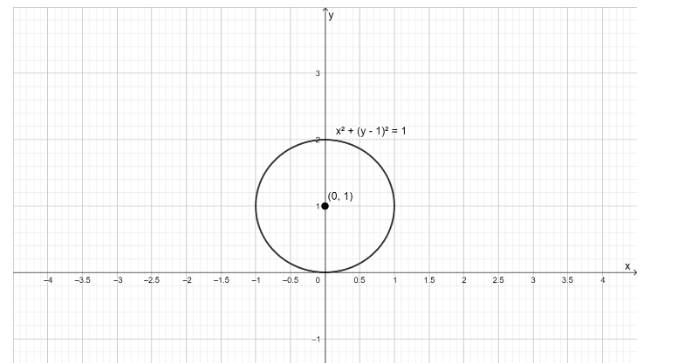
Hence, this is the graph of the given equation. Here $ r $ is the distance of the general point on the curve from origin and $ \theta $ is the angle that the line joining the origin and the general point will make with the x-axis.
Note: We converted the given polar form of the equation into the rectangular form to graph the equation in a cartesian plane. The rectangular form is given in terms of $ x $ and $ y $ . After the conversion we have to determine what type of curve this equation represents or else we have to find the critical points using the derivatives.
$
x = r\cos \theta \\
y = r\sin \theta \;
$
where $ \theta $ is the angle that the line joining origin and the general point makes with the x-axis and $ r $ is the magnitude or the distance of the point from origin given as $ {r^2} = {x^2} + {y^2} $ .
Complete step by step solution:
We have been given to graph the equation $ r = 2\sin \theta $ .
Since this equation includes the angle $ \theta $ and the magnitude $ r $ , this is in the polar form. To graph this equation we will first convert it into standard form or rectangular form such that we get an equation in terms of $ x $ and $ y $ . We can use $ x = r\cos \theta ,\;\;y = r\sin \theta \;\;and\;\;{r^2} = {x^2} + {y^2} $ .
From $ y = r\sin \theta $ , we have $ \sin \theta = \dfrac{y}{r} $ .
From $ {r^2} = {x^2} + {y^2} $ , we have $ r = \sqrt {{x^2} + {y^2}} $
Thus the given equation becomes,
$
r = 2\sin \theta \\
\Rightarrow \sqrt {{x^2} + {y^2}} = 2\dfrac{y}{r} = \dfrac{{2y}}{{\sqrt {{x^2} + {y^2}} }} \\
\Rightarrow {x^2} + {y^2} = 2y \;
$
We have the coefficient of \[{x^2}\] is equal to the coefficient of \[{y^2}\]. So this equation will represent a circle in the cartesian plane.
We can simplify the equation as,
$
{x^2} + {y^2} = 2y \\
\Rightarrow {x^2} + {y^2} - 2y = 0 \\
\Rightarrow {x^2} + {y^2} - 2y + 1 = 1 \\
\Rightarrow {x^2} + {\left( {y - 1} \right)^2} = {1^2} \;
$
Thus the circle is centered at the point $ \left( {0,1} \right) $ and the radius is $ 1 $ .
This can be drawn on the graph as follows,
Hence, this is the graph of the given equation. Here $ r $ is the distance of the general point on the curve from origin and $ \theta $ is the angle that the line joining the origin and the general point will make with the x-axis.
Note: We converted the given polar form of the equation into the rectangular form to graph the equation in a cartesian plane. The rectangular form is given in terms of $ x $ and $ y $ . After the conversion we have to determine what type of curve this equation represents or else we have to find the critical points using the derivatives.
Recently Updated Pages
Write structures of the following compounds i 2 Chloro3methylpentane class 11 chemistry CBSE

What is BLO What is the full form of BLO class 8 social science CBSE
Explain the Treaty of Vienna of 1815 class 10 social science CBSE
A Paragraph on Pollution in about 100-150 Words
XIX+XXX A 49 B 51 C 55 D 44 class 5 maths CBSE
If x a + bt + ct2 where x is in meters and t is in class 11 physics CBSE
Trending doubts
One Metric ton is equal to kg A 10000 B 1000 C 100 class 11 physics CBSE
Find the value of the expression given below sin 30circ class 11 maths CBSE
What do you mean by retardation What is its SI uni class 11 physics CBSE
Draw a diagram of nephron and explain its structur class 11 biology CBSE
10 examples of friction in our daily life
Difference between physical and chemical change class 11 chemistry CBSE