




Hirudinaria is
(a)Marine aquatic
(b)Terrestrial annelid
(c)Endoparasite
(d)Ectoparasite
Answer
 Verified
607.5k+ views
Hint: They are parasites that live on the external surface of hosts, from which they derive their nutrition. They do not live within the body. Fleas and lice are the best examples.
Complete answer:
Hirudinaria is commonly known as Indian Leech. They are found in freshwater tanks, ponds, lakes, swamps, and slow streams. It favors shallow water and remains concealed under weeds, logs, and stones. It is sanguivorous (blood-sucking) sucking the blood of fishes and frogs, and also of cattle or human beings when they enter the pond. Leeches show a great diversity in their habits and habitat. Some species are marine, some are freshwater, while others are terrestrial. Though many species are blood-suckers (ectoparasitic) yet a large number are not ectoparasitic but are predatory and feed on worms, snails, and insect larvae.
Additional Information: The features of leech are-
-Leech is bisexual.
-Their body is elongated and dorsoventrally flattened.
-It is found in freshwater ponds and sluggish streams.
-They are also known as Indian cattle leech, it is a temporary ectoparasite that feeds on cattle and blood.
-They are metamerically segmented. Their body contains 33 segments.
-Exhibits powerful organ attachments and locomotion.
-There are 5 pairs of small eyes situated dorsally in the 5 segments.
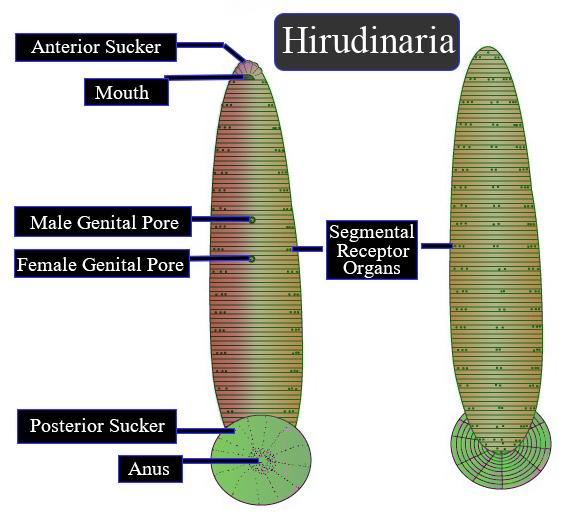
-The anus is present at the bottom of the posterior sucker.
-The anterior end has an anterior sucker that is cup-shaped, turned downwards, and ventral, wherein the mouth is centrally located. The posterior side contains a posterior sucker, which is circular and is highly muscular.
So, the correct answer is ‘Ectoparasite’.
Note: Leeches have been used in medicine from ancient times until the 19th century to draw blood from patients. In modern times, leeches find medical use in the treatment of joint diseases such as epicondylitis and osteoarthritis, extremity vein diseases, and microsurgery, while hirudin is used as an anticoagulant drug to treat blood-clotting disorders.
Complete answer:
Hirudinaria is commonly known as Indian Leech. They are found in freshwater tanks, ponds, lakes, swamps, and slow streams. It favors shallow water and remains concealed under weeds, logs, and stones. It is sanguivorous (blood-sucking) sucking the blood of fishes and frogs, and also of cattle or human beings when they enter the pond. Leeches show a great diversity in their habits and habitat. Some species are marine, some are freshwater, while others are terrestrial. Though many species are blood-suckers (ectoparasitic) yet a large number are not ectoparasitic but are predatory and feed on worms, snails, and insect larvae.
Additional Information: The features of leech are-
-Leech is bisexual.
-Their body is elongated and dorsoventrally flattened.
-It is found in freshwater ponds and sluggish streams.
-They are also known as Indian cattle leech, it is a temporary ectoparasite that feeds on cattle and blood.
-They are metamerically segmented. Their body contains 33 segments.
-Exhibits powerful organ attachments and locomotion.
-There are 5 pairs of small eyes situated dorsally in the 5 segments.
-The anus is present at the bottom of the posterior sucker.
-The anterior end has an anterior sucker that is cup-shaped, turned downwards, and ventral, wherein the mouth is centrally located. The posterior side contains a posterior sucker, which is circular and is highly muscular.
So, the correct answer is ‘Ectoparasite’.
Note: Leeches have been used in medicine from ancient times until the 19th century to draw blood from patients. In modern times, leeches find medical use in the treatment of joint diseases such as epicondylitis and osteoarthritis, extremity vein diseases, and microsurgery, while hirudin is used as an anticoagulant drug to treat blood-clotting disorders.
Recently Updated Pages
Master Class 11 Social Science: Engaging Questions & Answers for Success

Master Class 11 Physics: Engaging Questions & Answers for Success
Master Class 11 Maths: Engaging Questions & Answers for Success
Master Class 11 Economics: Engaging Questions & Answers for Success
Master Class 11 Computer Science: Engaging Questions & Answers for Success
Master Class 11 Chemistry: Engaging Questions & Answers for Success
Trending doubts
There are 720 permutations of the digits 1 2 3 4 5 class 11 maths CBSE
1 Quintal is equal to a 110 kg b 10 kg c 100kg d 1000 class 11 physics CBSE
Which among the following are examples of coming together class 11 social science CBSE
Discuss the various forms of bacteria class 11 biology CBSE
What organs are located on the left side of your body class 11 biology CBSE
Draw a labelled diagram showing structure of LS of class 11 biology CBSE