




Haversian canal occurs in
(a)Humerus
(b)Pubis
(c)Scapula
(d)Nerves
Answer
 Verified
648.3k+ views
Hint: This bone is found in mainly long bones of mammals that permit blood vessels and nerves to travel through them. The Haversian system helps in the passage of nutrients between the blood and bone.
Complete answer:
The Haversian canal occurs in the humerus bone whose outer side is made up of cortical bones. These bones are generally known as compact bones. The Haversian system is an elongated cylindrical structure that is organized parallel to the surface of the bone, along the long axis. Each haversian canal mainly comprises one or two capillaries and nerve fibers.
Structure of the haversian canal:
The osteon contains a central canal which is called a haversian canal. This canal is surrounded by concentric rings of the matrix. In between the rings of the matrix, the bone cells are located in dense spaces called lacunae. Small channels also known as canaliculi radiate from the lacunae to the haversian canal to communicate with bone cells. This unique arrangement facilitates the deposit and storage of mineral salts that gives bones their strength.
Additional information:
-Haversian canal comprises approximately 45% of the cortical bone.
-It also transports the oxygenated blood to the bone.
-The structural unit of a compact bone is known as the osteon or Haversian system.
-Haversian canals are a series of microscopic tubes.
So, the correct answer is ‘humerus’.
Note: -Osteoblasts are new bone-forming cells that contain a single nucleus. These cells come from bone marrow.
-Osteoclasts are the cells that break down the bone tissues. The main function of the cells is to resorb mineralized bone, dentine, and calcified cartilage.
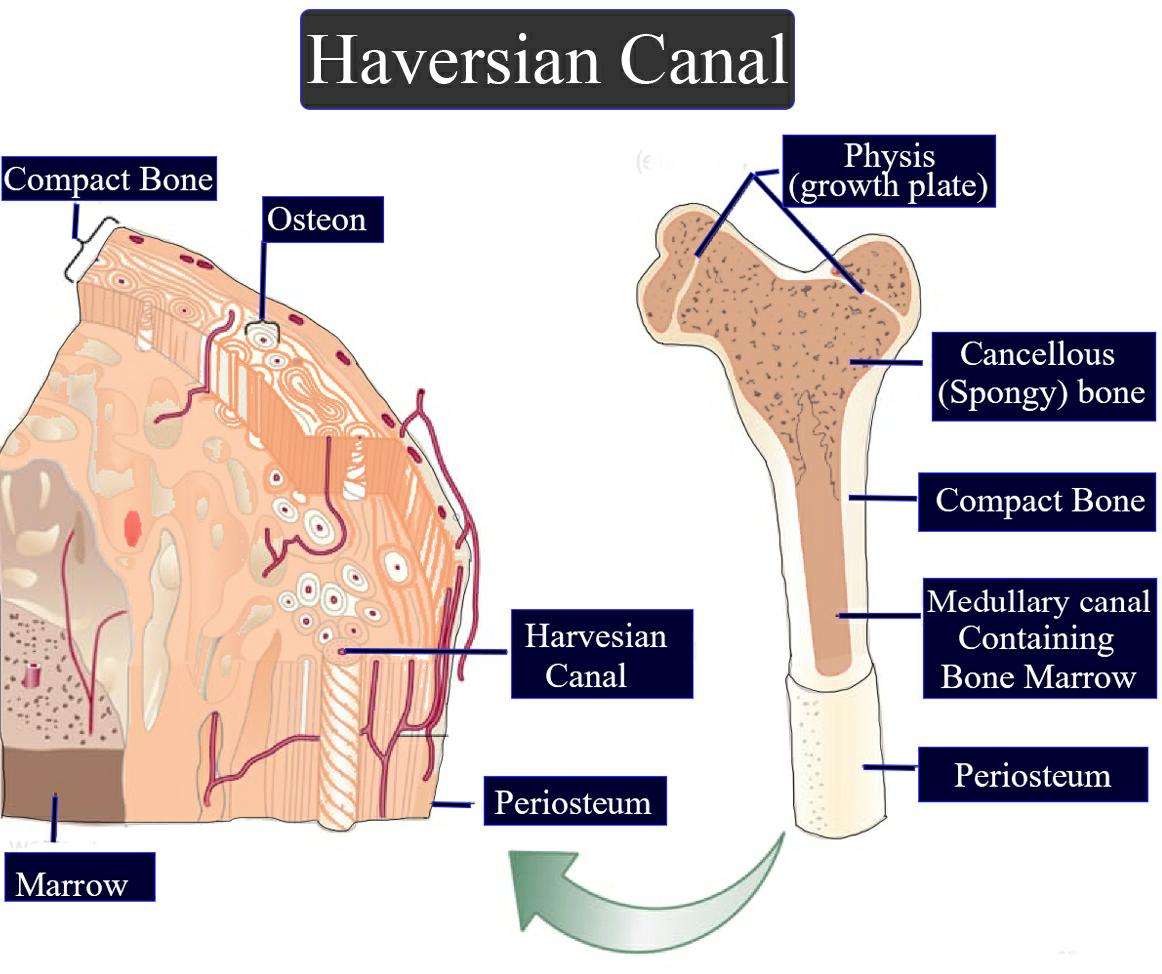
Complete answer:
The Haversian canal occurs in the humerus bone whose outer side is made up of cortical bones. These bones are generally known as compact bones. The Haversian system is an elongated cylindrical structure that is organized parallel to the surface of the bone, along the long axis. Each haversian canal mainly comprises one or two capillaries and nerve fibers.
Structure of the haversian canal:
The osteon contains a central canal which is called a haversian canal. This canal is surrounded by concentric rings of the matrix. In between the rings of the matrix, the bone cells are located in dense spaces called lacunae. Small channels also known as canaliculi radiate from the lacunae to the haversian canal to communicate with bone cells. This unique arrangement facilitates the deposit and storage of mineral salts that gives bones their strength.
Additional information:
-Haversian canal comprises approximately 45% of the cortical bone.
-It also transports the oxygenated blood to the bone.
-The structural unit of a compact bone is known as the osteon or Haversian system.
-Haversian canals are a series of microscopic tubes.
So, the correct answer is ‘humerus’.
Note: -Osteoblasts are new bone-forming cells that contain a single nucleus. These cells come from bone marrow.
-Osteoclasts are the cells that break down the bone tissues. The main function of the cells is to resorb mineralized bone, dentine, and calcified cartilage.
Recently Updated Pages
Master Class 11 Social Science: Engaging Questions & Answers for Success

Master Class 11 English: Engaging Questions & Answers for Success
Master Class 11 Accountancy: Engaging Questions & Answers for Success
Master Class 11 Physics: Engaging Questions & Answers for Success
Master Class 11 Computer Science: Engaging Questions & Answers for Success
Master Class 11 Business Studies: Engaging Questions & Answers for Success
Trending doubts
Find the value of the expression given below sin 30circ class 11 maths CBSE
The teeth used for biting and cutting food are called class 11 biology CBSE
Bond order ofO2 O2+ O2 and O22 is in order A O2 langle class 11 chemistry CBSE
Frogs heart when taken out of the body continues to class 11 biology CBSE
10 examples of diffusion in everyday life
Can anyone list 10 advantages and disadvantages of friction