



What happens to the image distance in the eye when we increase the distance of an object from the eye?
Answer
 Verified
675.9k+ views
Hint: Human eyes have a special ability to adjust the focal length by changing its shape. By changing the shape, we can vary the refractive power of the eye. So, we can see the object even if it is moving away from our eye. But the size of the object will get reduced as the object is moving away from the viewer. Even though that doesn’t mean we can’t see the object. To make a clear image our eye will adjust itself by making contraction or expansion of the eye lens.
Complete step-by-step answer:
Even though we have increased the distance of the object from the eyes, still we can see that object. Accommodation of the eye will change accordingly for the distant visions. Accommodation of the eye is the ability of some muscles (ciliary muscles) to adjust the focal length of the eye lens according to the distance of the objects from our eye.
The human eye is multifunctional rather than the normal camera. For projecting a clear image of an object, the eye performs many functions. Adjusting the focal length of the eye lens is one of the many processes. Depending on the position of an object that is either near or far, the ciliary muscle contract or expands to change the focal length such that a clear image can be formed on the retina.
The following images are showing the contraction or expansion of eyes according to the distance between the object and eyes.
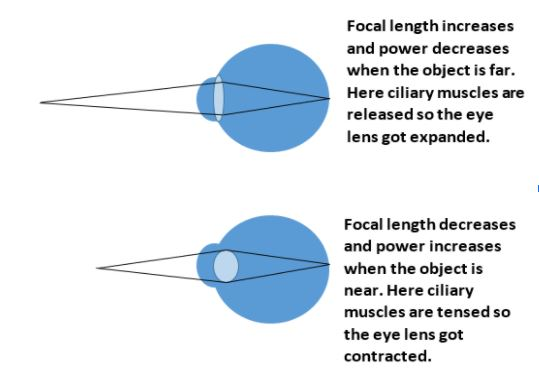
The ability of the eye lens to adjust its focal length, to focus rays coming from a distant object as well a near object on the retina, is called the power of accommodation of the eye
Additional Information: Amplitude of accommodation can be determined in terms of dioptric power.
$A=P-R$, where A is the amplitude of accommodation, P is the dioptric value of near point and R is the dioptric value of the far point. The farthest distance at which an object can be seen clearly to our eye is known as a far point. The nearest point at which the eye can see an object is known as a near point.
Note: The power of accommodation related to the lens in the eye is not related to the power of ciliary muscles. The lens in our eyes may don’t look like the ordinary lens that we are using in other fields. But working is almost similar. One is purely biological and the latter is technical. This power of accommodation is a biological phenomenon. So there will be variation. To avoid the problems due to this, we can use spectacles according to our vision.
Complete step-by-step answer:
Even though we have increased the distance of the object from the eyes, still we can see that object. Accommodation of the eye will change accordingly for the distant visions. Accommodation of the eye is the ability of some muscles (ciliary muscles) to adjust the focal length of the eye lens according to the distance of the objects from our eye.
The human eye is multifunctional rather than the normal camera. For projecting a clear image of an object, the eye performs many functions. Adjusting the focal length of the eye lens is one of the many processes. Depending on the position of an object that is either near or far, the ciliary muscle contract or expands to change the focal length such that a clear image can be formed on the retina.
The following images are showing the contraction or expansion of eyes according to the distance between the object and eyes.
The ability of the eye lens to adjust its focal length, to focus rays coming from a distant object as well a near object on the retina, is called the power of accommodation of the eye
Additional Information: Amplitude of accommodation can be determined in terms of dioptric power.
$A=P-R$, where A is the amplitude of accommodation, P is the dioptric value of near point and R is the dioptric value of the far point. The farthest distance at which an object can be seen clearly to our eye is known as a far point. The nearest point at which the eye can see an object is known as a near point.
Note: The power of accommodation related to the lens in the eye is not related to the power of ciliary muscles. The lens in our eyes may don’t look like the ordinary lens that we are using in other fields. But working is almost similar. One is purely biological and the latter is technical. This power of accommodation is a biological phenomenon. So there will be variation. To avoid the problems due to this, we can use spectacles according to our vision.
Recently Updated Pages
Master Class 12 Physics: Engaging Questions & Answers for Success

Master Class 12 Social Science: Engaging Questions & Answers for Success
Master Class 12 English: Engaging Questions & Answers for Success
Master Class 12 Maths: Engaging Questions & Answers for Success
Master Class 12 Business Studies: Engaging Questions & Answers for Success
Master Class 12 Chemistry: Engaging Questions & Answers for Success
Trending doubts
Draw a labelled sketch of the human eye class 12 physics CBSE
Which are the Top 10 Largest Countries of the World?
Draw ray diagrams each showing i myopic eye and ii class 12 physics CBSE
One megawatt is equal to how many units of electri class 12 physics CBSE
Which is the correct genotypic ratio of mendel dihybrid class 12 biology CBSE
Give 10 examples of unisexual and bisexual flowers