




What happens to Synergids after fertilization?
Answer
 Verified
512.1k+ views
Hint: Synergids are embryo sac cells that are found near the micropylar end. Their key role is to control pollen through the pollen tube. The pollen grain's male gametes are discharged into the synergids' cytoplasm, where they reach the egg cell and fertilization occurs.
Complete explanation
Synergids are present inside a mature embryo sac. Numerous plastids, mitochondria, ribosomes and ER can be found in the synergids. A huge vacuole that forms a barrier, a nucleus with a single nucleolus, and a membrane surround each synergid. The micropyle end of the cell, where it continues to spread into the filiform structure, has the thickest wall.
There are seven cells in a fully grown embryo sac. After the first three nucleate stages, all of them are generated. It causes the usual female gametophyte or embryo sac to emerge. The egg apparatus is organized into three cells grouped in at the micropylar end. Two synergids and one egg cell make up the egg apparatus. After fertilization, synergids degenerate.
Additional information:
The cells present in the embryo sac at the moment of fertilization are known as synergids and antipodals. The zygote is created when the male gamete and the egg fertilize each other. After that, along with the synergids, the antipodal cells also disintegrate, and the ovary becomes a fruit.
Note:
After the process of fertilization, the synergids disintegrate. Synergids are a type of cell that exists only for a short duration and are found around the egg in a flowering plant's fully developed embryo sac. Soon after the fertilisation of the egg, these cells become disordered and perish.
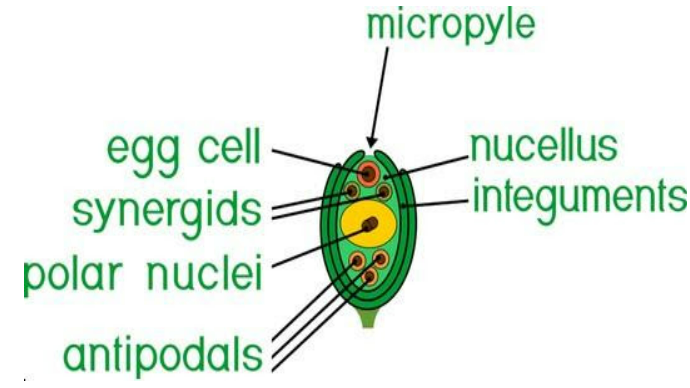
Complete explanation
Synergids are present inside a mature embryo sac. Numerous plastids, mitochondria, ribosomes and ER can be found in the synergids. A huge vacuole that forms a barrier, a nucleus with a single nucleolus, and a membrane surround each synergid. The micropyle end of the cell, where it continues to spread into the filiform structure, has the thickest wall.
There are seven cells in a fully grown embryo sac. After the first three nucleate stages, all of them are generated. It causes the usual female gametophyte or embryo sac to emerge. The egg apparatus is organized into three cells grouped in at the micropylar end. Two synergids and one egg cell make up the egg apparatus. After fertilization, synergids degenerate.
Additional information:
The cells present in the embryo sac at the moment of fertilization are known as synergids and antipodals. The zygote is created when the male gamete and the egg fertilize each other. After that, along with the synergids, the antipodal cells also disintegrate, and the ovary becomes a fruit.
Note:
After the process of fertilization, the synergids disintegrate. Synergids are a type of cell that exists only for a short duration and are found around the egg in a flowering plant's fully developed embryo sac. Soon after the fertilisation of the egg, these cells become disordered and perish.
Recently Updated Pages
Master Class 12 Economics: Engaging Questions & Answers for Success

Master Class 12 English: Engaging Questions & Answers for Success
Master Class 12 Social Science: Engaging Questions & Answers for Success
Master Class 12 Maths: Engaging Questions & Answers for Success
Master Class 12 Physics: Engaging Questions & Answers for Success
Master Class 9 General Knowledge: Engaging Questions & Answers for Success
Trending doubts
Which are the Top 10 Largest Countries of the World?
Draw a labelled sketch of the human eye class 12 physics CBSE
Differentiate between homogeneous and heterogeneous class 12 chemistry CBSE
Sulphuric acid is known as the king of acids State class 12 chemistry CBSE
Why is the cell called the structural and functional class 12 biology CBSE
A dentist uses a small mirror that gives a magnification class 12 physics CBSE