




What happens to cells if they lose too much water?
Answer
 Verified
558.9k+ views
Hint: Mammalian cells are composed of various organelles. Cellular division has functions like- they can generate cellular reproduction from only one cell, entire unicellular organisms. Cell division is the splitting of a parent cell into the formation of two daughter cells. Different stages of cell division involve- meiosis and mitosis in an animal life cycle where the mother cell divides into genetically identical two daughter cells.
Complete answer-
As cells have water inside them and cells are protected by a covering known as plasma membrane which acts as a barrier and it contains channels which only allow certain ions for the cell's benefit. Also, cells contain water as a mode of nutrition so that cells do not dry off and organelles can continue to function in a regular manner.
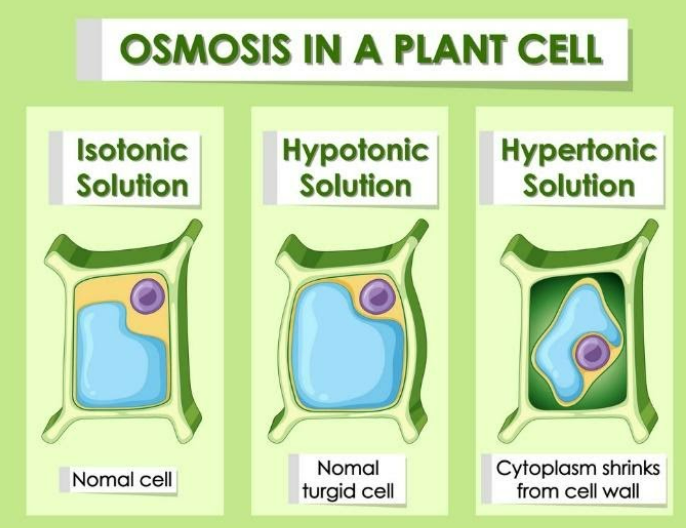
Cells have cytoplasm which also act as a shock absorber and protect the cells from unfavorable anaphylactic conditions. If cells lose water, then, it becomes hard because of the osmosis. The cell becomes stiff and tends to shrink from the cell wall.
The cell contents start to move out from the cell through the cell wall and push the membrane away from the cell. This condition of the cell is called plasmolysis. The plasmolyzed cell does not survive and die. There are two solutions – hypertonic solution and hypotonic solution. Cells react to both the conditions.
In hypertonic solution cells possess water inside and swells, when the outer membrane cannot cross outside and the water remain swells, the solutes are salt and water hence it is called as hypertonic solution and in hypotonic solution occurs due to endosmosis.
Note:
Isotonic solution is a solution which has osmolarity or solute concentration. Hypotonic as we discussed is when a cell swells and hypertonic is when a cell shrinks. A cell contains gated channels so that it controls the outflow and inflow of nutrients across a semipermeable membrane. In Endosmosis the water cannot go inside from the plasma membrane into the cell membrane where the cell swells.
Complete answer-
As cells have water inside them and cells are protected by a covering known as plasma membrane which acts as a barrier and it contains channels which only allow certain ions for the cell's benefit. Also, cells contain water as a mode of nutrition so that cells do not dry off and organelles can continue to function in a regular manner.
Cells have cytoplasm which also act as a shock absorber and protect the cells from unfavorable anaphylactic conditions. If cells lose water, then, it becomes hard because of the osmosis. The cell becomes stiff and tends to shrink from the cell wall.
The cell contents start to move out from the cell through the cell wall and push the membrane away from the cell. This condition of the cell is called plasmolysis. The plasmolyzed cell does not survive and die. There are two solutions – hypertonic solution and hypotonic solution. Cells react to both the conditions.
In hypertonic solution cells possess water inside and swells, when the outer membrane cannot cross outside and the water remain swells, the solutes are salt and water hence it is called as hypertonic solution and in hypotonic solution occurs due to endosmosis.
Note:
Isotonic solution is a solution which has osmolarity or solute concentration. Hypotonic as we discussed is when a cell swells and hypertonic is when a cell shrinks. A cell contains gated channels so that it controls the outflow and inflow of nutrients across a semipermeable membrane. In Endosmosis the water cannot go inside from the plasma membrane into the cell membrane where the cell swells.
Recently Updated Pages
If x a + bt + ct2 where x is in meters and t is in class 11 physics CBSE

A car covers the first half distance between two places class 11 physics CBSE
The resultant of two vectors overrightarrow P and overrightarrow class 11 physics CBSE
Find the value of cos 135 class 11 maths CBSE
A mass M is held in place by an applied force F and class 11 physics CBSE
A solution of glucose in water is labelled as 10 dfracwv class 11 chemistry CBSE
Trending doubts
One Metric ton is equal to kg A 10000 B 1000 C 100 class 11 physics CBSE
Find the value of the expression given below sin 30circ class 11 maths CBSE
What do you mean by retardation What is its SI uni class 11 physics CBSE
Draw a diagram of nephron and explain its structur class 11 biology CBSE
10 examples of friction in our daily life
Difference between physical and chemical change class 11 chemistry CBSE