




What happens to an electric dipole placed in a uniform electric field .Drive necessary expression.
Answer
 Verified
538.8k+ views
Hint: In order to answer this question, first we will find the uniform electric field equation and then dipole moment in an uniform electric field we observe the situation. Now, consider a dipole with charges $ + q$ and $ - q$ forming a dipole since they are a distance d away from each other. Let it be placed in a uniform electric field of strength E such that the axis of the dipole forms an angle $\theta $ with the electric field. $F = m \times a$
Formula used:
$
\overline E = E \circ \hat i \\
\tau = \bar r \times \bar F \\
F = qE \\
$
Complete step by step solution:
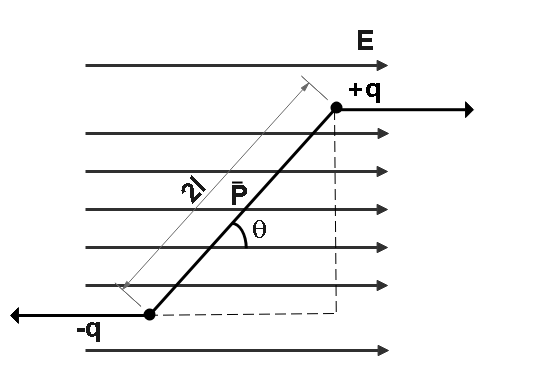
As we know that In an uniform electric field, the field lines are parallel to each other and is given by
$\overline E = E \circ \hat i$
Where $\overline E $ is an electric vector field with $E \circ $ as magnitude.
And dipole moment $\overline P = q(2l)\hat i$.
Here $\overline P $ is the dipole moment and $\hat i$ represents the direction.
And the distance between the two charges is $2l$.
Here we keep a dipole in a uniform electric field $\overline E $ which makes an angle $\theta $ with electric field lines.
Here force acts on both $ + q$ and $ - q$ charges.
So,
$F = \pm qE\hat i$
Here force is able to rotate the dipole which causes torque to generate which is:-
$
rsin\theta = 2l\sin \theta \\
{\text{and}} \\
F = qE \\
$
Additional Information:
In mechanics, a pair of equal parallel forces that are opposite in direction. The only effect of a couple is to produce or prevent the turning of a body. The turning effect, or moment, of a couple is measured by the product of the magnitude of either force and the perpendicular distance between the action lines of the forces.
Note:
In an uniform electric field, the net force on a dipole will always be zero but torque is zero for $\theta = {0^ \circ }$ and maximum when $\theta = {90^ \circ }$. We should use the formula and concept correctly without any confusion and also remember the important points.
Formula used:
$
\overline E = E \circ \hat i \\
\tau = \bar r \times \bar F \\
F = qE \\
$
Complete step by step solution:
As we know that In an uniform electric field, the field lines are parallel to each other and is given by
$\overline E = E \circ \hat i$
Where $\overline E $ is an electric vector field with $E \circ $ as magnitude.
And dipole moment $\overline P = q(2l)\hat i$.
Here $\overline P $ is the dipole moment and $\hat i$ represents the direction.
And the distance between the two charges is $2l$.
Here we keep a dipole in a uniform electric field $\overline E $ which makes an angle $\theta $ with electric field lines.
Here force acts on both $ + q$ and $ - q$ charges.
So,
$F = \pm qE\hat i$
Here force is able to rotate the dipole which causes torque to generate which is:-
$
rsin\theta = 2l\sin \theta \\
{\text{and}} \\
F = qE \\
$
Additional Information:
In mechanics, a pair of equal parallel forces that are opposite in direction. The only effect of a couple is to produce or prevent the turning of a body. The turning effect, or moment, of a couple is measured by the product of the magnitude of either force and the perpendicular distance between the action lines of the forces.
Note:
In an uniform electric field, the net force on a dipole will always be zero but torque is zero for $\theta = {0^ \circ }$ and maximum when $\theta = {90^ \circ }$. We should use the formula and concept correctly without any confusion and also remember the important points.
Recently Updated Pages
Master Class 12 Business Studies: Engaging Questions & Answers for Success

Master Class 12 Chemistry: Engaging Questions & Answers for Success
Master Class 12 Biology: Engaging Questions & Answers for Success
Class 12 Question and Answer - Your Ultimate Solutions Guide
Master Class 11 English: Engaging Questions & Answers for Success
Master Class 11 Social Science: Engaging Questions & Answers for Success
Trending doubts
Which are the Top 10 Largest Countries of the World?
The total number of vertebrae in man is a30 b31 c32 class 12 biology CBSE
Draw a labelled sketch of the human eye class 12 physics CBSE
The number of cranial nerves in a frog is A 10 pairs class 12 biology CBSE
Differentiate between homogeneous and heterogeneous class 12 chemistry CBSE
Differentiate between Pyramid of energy and pyramid class 12 biology CBSE