




What happens in meiosis during oogenesis?
Answer
 Verified
539.4k+ views
Hint: Oogenesis is defined as the process of formation of a mature female gamete by reductional division. It is different from the meiosis that occurs in spermatogenesis at one basic feature, i.e., in spermatogenesis all the 4 cells formed get transformed into gametes; but in oogenesis, there is formation of polar bodies.
Complete answer:
The meiosis in case of oogenesis is described as follows:
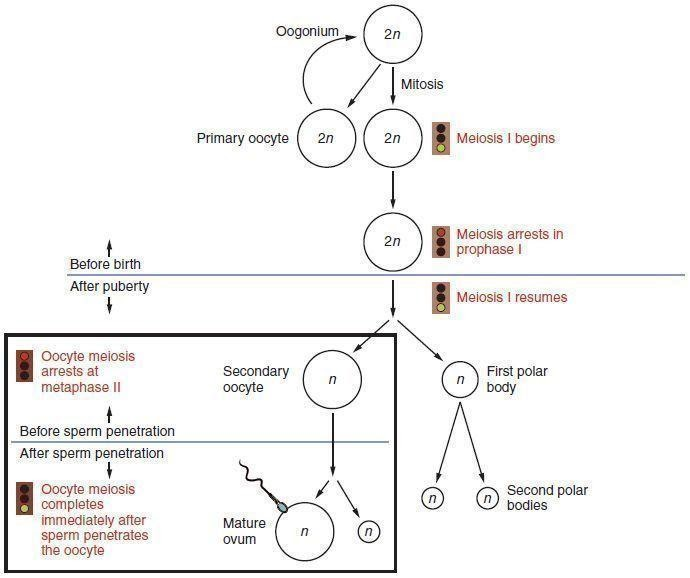
The oogonial cells undergo the first meiotic division to form the primary oocyte and the first polar body. This is actually a kind of cell division where unequal cytokinesis is observed. One cell gets a larger fraction of the cytoplasm and gets converted into a primary oocyte, and the other one gets converted into a polar body, which later degenerates.
This typical unequal cytokinesis occurs due to the fact that the ovum needs to retain much of the cytoplasm in order to have enough nutrients to nourish the ovum during the early stages of development.
The primary oocyte then undergoes the second meiotic division to release the secondary oocyte and another polar body (2nd polar body). The first polar body also undergoes meiosis-II to release another two small polar bodies.
All the polar bodies eventually degenerate. Thus, from oogenesis, a mature oogonium releases a mature egg or ovum and three polar bodies.
Note:
The point to be noted here is that oogenesis starts itself during birth but gets arrested during the diplotene phase of meiosis-I. Later during puberty, the cycle is again released and continues further. Thus, it is evident that no more oogonium formation occurs after birth.
In human beings from one primary oocyte, a single ovum and two polar bodies are formed. The ovum is released from the ovary in the secondary oocyte stage after the release of the 1st polar body.
Complete answer:
The meiosis in case of oogenesis is described as follows:
The oogonial cells undergo the first meiotic division to form the primary oocyte and the first polar body. This is actually a kind of cell division where unequal cytokinesis is observed. One cell gets a larger fraction of the cytoplasm and gets converted into a primary oocyte, and the other one gets converted into a polar body, which later degenerates.
This typical unequal cytokinesis occurs due to the fact that the ovum needs to retain much of the cytoplasm in order to have enough nutrients to nourish the ovum during the early stages of development.
The primary oocyte then undergoes the second meiotic division to release the secondary oocyte and another polar body (2nd polar body). The first polar body also undergoes meiosis-II to release another two small polar bodies.
All the polar bodies eventually degenerate. Thus, from oogenesis, a mature oogonium releases a mature egg or ovum and three polar bodies.
Note:
The point to be noted here is that oogenesis starts itself during birth but gets arrested during the diplotene phase of meiosis-I. Later during puberty, the cycle is again released and continues further. Thus, it is evident that no more oogonium formation occurs after birth.
In human beings from one primary oocyte, a single ovum and two polar bodies are formed. The ovum is released from the ovary in the secondary oocyte stage after the release of the 1st polar body.
Recently Updated Pages
Master Class 12 Business Studies: Engaging Questions & Answers for Success

Master Class 12 Chemistry: Engaging Questions & Answers for Success
Master Class 12 Biology: Engaging Questions & Answers for Success
Class 12 Question and Answer - Your Ultimate Solutions Guide
Master Class 11 English: Engaging Questions & Answers for Success
Master Class 11 Social Science: Engaging Questions & Answers for Success
Trending doubts
Which are the Top 10 Largest Countries of the World?
Draw a labelled sketch of the human eye class 12 physics CBSE
The end of compass needle which points towards north class 12 physics CBSE
Differentiate between homogeneous and heterogeneous class 12 chemistry CBSE
In order to find out the different types of gametes class 12 biology NEET_UG
Why is the cell called the structural and functional class 12 biology CBSE