




How will you graph \[f(x) = \dfrac{{{x^2} - 2x}}{{{x^2} - 4}}\] by the use of holes, vertical and horizontal asymptotes, \[x\] and \[y\] intercepts?
Answer
 Verified
605.4k+ views
Hint:
The basic key that is helpful in solving the above problem is that we can list the basic information. Remember that x intercept occurs when \[y = 0\] and the equation can go to zero due to the numerator only while \[y\] intercept occurs when \[x = 0\]. Later on by picking some \[x\] values \[f(x)\] can be calculated in order to determine coordinates \[(x,f(x))\] though which graph can be passed.
Complete step by step solution:
Firstly we can factorize \[f(x)\]
\[
\Rightarrow f(x) = \dfrac{{x(x - 2)}}{{(x + 2)(x - 2)}} \\
\Rightarrow f(x) = \dfrac{x}{{x + 2}} \\
\]
As we know that we can find vertical asymptotes of a rational function by examining the factors of the denominator to the factors in the numerator that are not common.
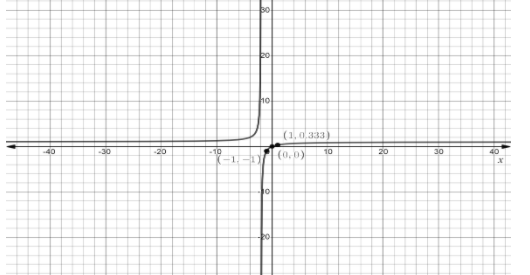
So it means that there will be a hole at \[x = 2\] and at \[x = - 2\] there will be a vertical asymptote.
Therefore at \[y = \dfrac{1}{1} = 1\] there will be a horizontal asymptote.
In order to find x intercept, we need to substitute \[y = 0\]and solve for \[x\]and \[y\] intercept occurs when\[x = 0\]
So x intercept \[(0,0)\] and y intercept is \[(0,0)\]
Vertical asymptote will be \[x = - 2\] and Horizontal asymptote will be \[y = 1\]
Hence the graph for \[\{ \left( {\dfrac{{{x^2} - 2x}}{{{x^2} - 4}}} \right)[ - 10,10, - 5,5]\} \] is as followed.
Formula:
In order to find horizontal asymptote let \[f(x) = \dfrac{{p(x)}}{{q(x)}}\]where \[p(x)\] stands for polynomial with degree m and leading coefficient. So if \[m\]is greater than \[n\] then \[f\] has no horizontal asymptote, if \[m\]is equal to \[n\]then \[y = \dfrac{a}{b}\]and lastly if \[m\]is smaller than \[n\]then \[y = 0\] is the horizontal asymptote.
Additional Information:
The lines that a particular function can get close to but do not intersect are referred to as asymptotes.
Note:
In the above equation remember the graph will pass through the origin as well ass \[x\] and \[y\] intercept will be served by origin. Lastly remember that only if the powers are equal then at the ratio between highest power in the numerator and denominator horizontal asymptote occurs and while solving vertical asymptote which is \[x\] find whether there are any common factors in numerator and denominator then cancel all term by setting denominator equal to zero.
The basic key that is helpful in solving the above problem is that we can list the basic information. Remember that x intercept occurs when \[y = 0\] and the equation can go to zero due to the numerator only while \[y\] intercept occurs when \[x = 0\]. Later on by picking some \[x\] values \[f(x)\] can be calculated in order to determine coordinates \[(x,f(x))\] though which graph can be passed.
Complete step by step solution:
Firstly we can factorize \[f(x)\]
\[
\Rightarrow f(x) = \dfrac{{x(x - 2)}}{{(x + 2)(x - 2)}} \\
\Rightarrow f(x) = \dfrac{x}{{x + 2}} \\
\]
As we know that we can find vertical asymptotes of a rational function by examining the factors of the denominator to the factors in the numerator that are not common.
So it means that there will be a hole at \[x = 2\] and at \[x = - 2\] there will be a vertical asymptote.
Therefore at \[y = \dfrac{1}{1} = 1\] there will be a horizontal asymptote.
In order to find x intercept, we need to substitute \[y = 0\]and solve for \[x\]and \[y\] intercept occurs when\[x = 0\]
So x intercept \[(0,0)\] and y intercept is \[(0,0)\]
Vertical asymptote will be \[x = - 2\] and Horizontal asymptote will be \[y = 1\]
Hence the graph for \[\{ \left( {\dfrac{{{x^2} - 2x}}{{{x^2} - 4}}} \right)[ - 10,10, - 5,5]\} \] is as followed.
Formula:
In order to find horizontal asymptote let \[f(x) = \dfrac{{p(x)}}{{q(x)}}\]where \[p(x)\] stands for polynomial with degree m and leading coefficient. So if \[m\]is greater than \[n\] then \[f\] has no horizontal asymptote, if \[m\]is equal to \[n\]then \[y = \dfrac{a}{b}\]and lastly if \[m\]is smaller than \[n\]then \[y = 0\] is the horizontal asymptote.
Additional Information:
The lines that a particular function can get close to but do not intersect are referred to as asymptotes.
Note:
In the above equation remember the graph will pass through the origin as well ass \[x\] and \[y\] intercept will be served by origin. Lastly remember that only if the powers are equal then at the ratio between highest power in the numerator and denominator horizontal asymptote occurs and while solving vertical asymptote which is \[x\] find whether there are any common factors in numerator and denominator then cancel all term by setting denominator equal to zero.
Recently Updated Pages
Explain the structure of megasporangium class 12 biology CBSE

Why is chloroform kept in dark coloured bottles class 12 chemistry CBSE
Derive the balancing condition of a Wheatstone bri class 12 physics CBSE
Draw VI characteristics of a pn junction diode Explain class 12 physics CBSE
Is it possible to carry pride in ones language too class 12 english CBSE
In a population at Hardy Weinberg equilibrium the allele class 12 biology CBSE
Trending doubts
Draw a labelled sketch of the human eye class 12 physics CBSE
Which are the Top 10 Largest Countries of the World?
Draw ray diagrams each showing i myopic eye and ii class 12 physics CBSE
Which is the correct genotypic ratio of mendel dihybrid class 12 biology CBSE
Differentiate between homogeneous and heterogeneous class 12 chemistry CBSE
Which animal never drinks water in its entire life class 12 biology CBSE