




Golgi apparatus
(a) Modifies and packages proteins
(b) Occurs in animals
(c) Found in prokaryotes
(d) Site for rapid ATP synthesis
Answer
 Verified
611.4k+ views
Hint: Golgi apparatus was discovered in the nerve cell of a Barn owl. It is a cell organelle that lies close to the endoplasmic reticulum and releases products that are essential for stabilizing the structure of the plasma membrane.
Complete step by step answer:
Golgi apparatus is named so in the honor of its discoverer Camillo Golgi. They are found in all the eukaryotes. It performs a variety of functions like cell wall formation, synthesis and secretion of glycoproteins, absorbing lipids, and synthesizing glycolipids. Proteins synthesized by the rough endoplasmic reticulum are modified and repackaged as various types of glycoproteins in the cell. Glycolipids and glycoproteins help in membrane stability while working as receptors molecules.
- Three major components can be observed in the Golgi Apparatus. These are flattened sacs and cisternae, clusters of tubules and vesicles, and lastly, large vacuoles filled with amorphous or glandular content.
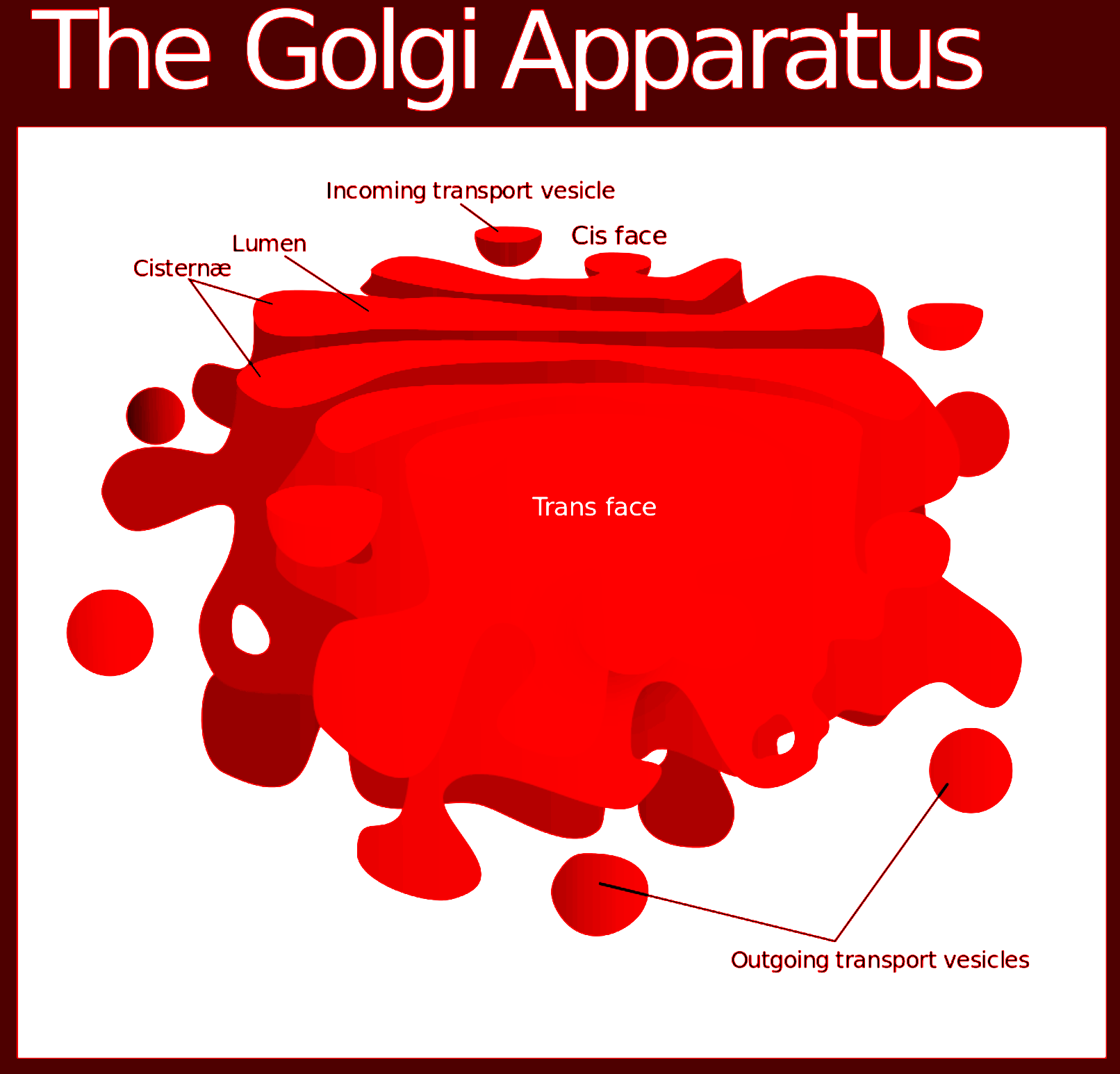
- These components, when viewed on a larger scale, make three separate regions i.e the cis, the medial, and the trans region.
- The rough endoplasmic reticulum releases vesicles filled with proteins. These vesicles fuse with the cis region of the Golgi complex.
- These proteins progresses from the cis region to the medial and finally to the trans region. The protein undergoes modification through its journey from the cis region to the trans region. The proteins are modified into glycoproteins and budded off as secretory vesicles from the trans region into the cytoplasm.
- Mitochondria is the cell organelle for the site of ATP synthesis in any cell.
So, the correct answer is ‘(a) Modifies and packages proteins.’
Note:
- In plants, Golgi Apparatus is known as dictyosomes whose number is usually in the hundreds. This term was coined by Perroncito in 1910.
- Protists have one or few Golgi bodies while in animal cells, it can go up to 20 in number.
Complete step by step answer:
Golgi apparatus is named so in the honor of its discoverer Camillo Golgi. They are found in all the eukaryotes. It performs a variety of functions like cell wall formation, synthesis and secretion of glycoproteins, absorbing lipids, and synthesizing glycolipids. Proteins synthesized by the rough endoplasmic reticulum are modified and repackaged as various types of glycoproteins in the cell. Glycolipids and glycoproteins help in membrane stability while working as receptors molecules.
- Three major components can be observed in the Golgi Apparatus. These are flattened sacs and cisternae, clusters of tubules and vesicles, and lastly, large vacuoles filled with amorphous or glandular content.
- These components, when viewed on a larger scale, make three separate regions i.e the cis, the medial, and the trans region.
- The rough endoplasmic reticulum releases vesicles filled with proteins. These vesicles fuse with the cis region of the Golgi complex.
- These proteins progresses from the cis region to the medial and finally to the trans region. The protein undergoes modification through its journey from the cis region to the trans region. The proteins are modified into glycoproteins and budded off as secretory vesicles from the trans region into the cytoplasm.
- Mitochondria is the cell organelle for the site of ATP synthesis in any cell.
So, the correct answer is ‘(a) Modifies and packages proteins.’
Note:
- In plants, Golgi Apparatus is known as dictyosomes whose number is usually in the hundreds. This term was coined by Perroncito in 1910.
- Protists have one or few Golgi bodies while in animal cells, it can go up to 20 in number.
Recently Updated Pages
Master Class 11 English: Engaging Questions & Answers for Success

Master Class 11 Maths: Engaging Questions & Answers for Success
Class 11 Question and Answer - Your Ultimate Solutions Guide
Master Class 11 Biology: Engaging Questions & Answers for Success
Master Class 11 Physics: Engaging Questions & Answers for Success
Master Class 11 Accountancy: Engaging Questions & Answers for Success
Trending doubts
Differentiate between an exothermic and an endothermic class 11 chemistry CBSE
One Metric ton is equal to kg A 10000 B 1000 C 100 class 11 physics CBSE
Difference Between Prokaryotic Cells and Eukaryotic Cells
There are 720 permutations of the digits 1 2 3 4 5 class 11 maths CBSE
Draw a diagram of a plant cell and label at least eight class 11 biology CBSE
1 Quintal is equal to a 110 kg b 10 kg c 100kg d 1000 class 11 physics CBSE