




Glucose has _________ optical isomers.
(A) 4
(B) 8
(C) 16
(D) 10
Answer
 Verified
614.4k+ views
Hint: To answer this question, you must know the structure of glucose. Glucose is an aldohexose sugar-containing two chiral centres and other centres are chiral. A general formula for obtaining the maximum number of optical isomers is ${2^n}$, where n is the number of chiral centres.
Complete step by step solution:
Molecular formula of glucose is ${C_6}{H_{12}}{O_6}$. Structure of glucose is:
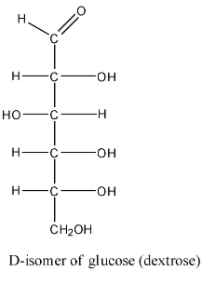
As you can see in the above structure of glucose there are six carbon atoms, hence it is an aldohexose. We usually consider glucose as D-glucose (dextrose). The D-isomer of glucose is the one whose carbon 2 is in the R configuration or has OH in the right-hand side. The mirror image of dextrose is L-glucose, having S configuration of carbon 2. Glucose contains one aldehydic carbon and five alcoholic carbons. It contains four chiral centres. A chiral centre is the one that has four different groups bonded to it in such a manner that it has a non-superimposable mirror image. Thus, in glucose, carbon 2, 3, 4 and 5 are chiral centres and carbon 1 and 6 are achiral. Now, the formula to obtain the maximum number of possible optical isomers is ${2^n}$, where n is the total number of chiral centres. Since, glucose has four chiral centres, n=4 and we get,
${2^4} = 16{\text{ }}$ optical isomers.
Hence, option (C) is correct.
Note: The 16 optical isomers of glucose are allose, altrose, galactose, glucose, gulose, idose, mannose, and tallose. The various conformations of glucopyranose rings are not considered since they are anomers rather than optical isomers.
Complete step by step solution:
Molecular formula of glucose is ${C_6}{H_{12}}{O_6}$. Structure of glucose is:
As you can see in the above structure of glucose there are six carbon atoms, hence it is an aldohexose. We usually consider glucose as D-glucose (dextrose). The D-isomer of glucose is the one whose carbon 2 is in the R configuration or has OH in the right-hand side. The mirror image of dextrose is L-glucose, having S configuration of carbon 2. Glucose contains one aldehydic carbon and five alcoholic carbons. It contains four chiral centres. A chiral centre is the one that has four different groups bonded to it in such a manner that it has a non-superimposable mirror image. Thus, in glucose, carbon 2, 3, 4 and 5 are chiral centres and carbon 1 and 6 are achiral. Now, the formula to obtain the maximum number of possible optical isomers is ${2^n}$, where n is the total number of chiral centres. Since, glucose has four chiral centres, n=4 and we get,
${2^4} = 16{\text{ }}$ optical isomers.
Hence, option (C) is correct.
Note: The 16 optical isomers of glucose are allose, altrose, galactose, glucose, gulose, idose, mannose, and tallose. The various conformations of glucopyranose rings are not considered since they are anomers rather than optical isomers.
Recently Updated Pages
Master Class 12 Business Studies: Engaging Questions & Answers for Success

Master Class 12 Chemistry: Engaging Questions & Answers for Success
Master Class 12 Biology: Engaging Questions & Answers for Success
Class 12 Question and Answer - Your Ultimate Solutions Guide
Master Class 9 General Knowledge: Engaging Questions & Answers for Success
Master Class 9 Maths: Engaging Questions & Answers for Success
Trending doubts
Which are the Top 10 Largest Countries of the World?
Draw a labelled sketch of the human eye class 12 physics CBSE
Differentiate between homogeneous and heterogeneous class 12 chemistry CBSE
Sulphuric acid is known as the king of acids State class 12 chemistry CBSE
Why is the cell called the structural and functional class 12 biology CBSE
A dentist uses a small mirror that gives a magnification class 12 physics CBSE