




Given ${V_{CM}} = 2\;{\rm{m/s}}$ $m = 2\;{\rm{kg}}$, $R = {\rm{4}}\;{\rm{m}}$.
Find angular momentum of the ring about the origin if it is in pure rolling.
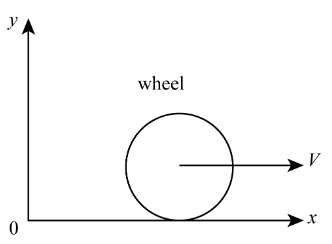
A. \[32\;{\rm{kg}}{{\rm{m}}^2}/{\rm{s}}\]
B. $24\;{\rm{kg}}{{\rm{m}}^2}/{\rm{s}}$
C. $16\;{\rm{kg}}{{\rm{m}}^2}/{\rm{s}}$
D. $8\;{\rm{kg}}{{\rm{m}}^2}/{\rm{s}}$
Answer
 Verified
606.6k+ views
Hint:We all know about the phenomenon of linear momentum, which is the multiplication of mass and velocity. Its harmonious form in angular motion is called angular momentum.So, it is the product of mass, speed, and radius of rotation. It is a conserved type of quantity.
Complete step by step answer:
We know that in the pure rolling condition, there is no sliding and slipping and hence the velocity of the center of mass for the body is represented as,
${V_{cm}} = R\omega $
Here ${V_{cm}}$ is the linear velocity of the center of mass of the body, and R is the radius of the body and $\omega $ is the angular velocity of the body.
We know that the angular momentum for a body about the origin is given as,
$L = m{V_{CM}}R + I\omega $
We will now substitute $\omega = \dfrac{{{V_{CM}}}}{R}$ , and $I = m{R^2}$ as this is the moment of inertia of the ring about the center, so we will get the result as,
\[
L = m{V_{CM}}R + m{R^2}\dfrac{{{V_{CM}}}}{R}\\
\Rightarrow L = m{V_{CM}}R + m{V_{CM}}R\\
\Rightarrow L = 2m{V_{CM}}R\\
\]
We will now substitute ${V_{CM}} = 2\;{\rm{m/s}}$ $m = 2\;{\rm{kg}}$, $R = {\rm{4}}\;{\rm{m}}$ to get the value of L.
\[
L = 2 \times \left( {2\;{\rm{kg}}} \right)\left( {2\;{\rm{m/s}}} \right)\left( {4\;{\rm{m}}} \right)\\
\therefore L{\rm{ = 32}}\;{\rm{kg - }}{{\rm{m}}^2}
\]
Here L is the angular momentum about the origin, v is the linear velocity of the body, and R is the radius of the body, and $\omega $ is the angular velocity of the body. Here ${V_{cm}}$ is the linear velocity of the center of mass of the body; R is the radius of the body and $\omega $ is the angular velocity of the body.
Therefore, the correct option is A.
Note:As we all have studied that linear momentum is a vector quantity, and its directions are the same towards the velocity vector; in the same way, angular momentum is also a vector quantity, and its direction is towards the direction of the angular velocity vector. If the linear momentum remains to conserve, then External forces acting on the body are zero. Still, if angular momentum is conserved, then external torque working on the body is zero.
Complete step by step answer:
We know that in the pure rolling condition, there is no sliding and slipping and hence the velocity of the center of mass for the body is represented as,
${V_{cm}} = R\omega $
Here ${V_{cm}}$ is the linear velocity of the center of mass of the body, and R is the radius of the body and $\omega $ is the angular velocity of the body.
We know that the angular momentum for a body about the origin is given as,
$L = m{V_{CM}}R + I\omega $
We will now substitute $\omega = \dfrac{{{V_{CM}}}}{R}$ , and $I = m{R^2}$ as this is the moment of inertia of the ring about the center, so we will get the result as,
\[
L = m{V_{CM}}R + m{R^2}\dfrac{{{V_{CM}}}}{R}\\
\Rightarrow L = m{V_{CM}}R + m{V_{CM}}R\\
\Rightarrow L = 2m{V_{CM}}R\\
\]
We will now substitute ${V_{CM}} = 2\;{\rm{m/s}}$ $m = 2\;{\rm{kg}}$, $R = {\rm{4}}\;{\rm{m}}$ to get the value of L.
\[
L = 2 \times \left( {2\;{\rm{kg}}} \right)\left( {2\;{\rm{m/s}}} \right)\left( {4\;{\rm{m}}} \right)\\
\therefore L{\rm{ = 32}}\;{\rm{kg - }}{{\rm{m}}^2}
\]
Here L is the angular momentum about the origin, v is the linear velocity of the body, and R is the radius of the body, and $\omega $ is the angular velocity of the body. Here ${V_{cm}}$ is the linear velocity of the center of mass of the body; R is the radius of the body and $\omega $ is the angular velocity of the body.
Therefore, the correct option is A.
Note:As we all have studied that linear momentum is a vector quantity, and its directions are the same towards the velocity vector; in the same way, angular momentum is also a vector quantity, and its direction is towards the direction of the angular velocity vector. If the linear momentum remains to conserve, then External forces acting on the body are zero. Still, if angular momentum is conserved, then external torque working on the body is zero.
Recently Updated Pages
Master Class 12 Business Studies: Engaging Questions & Answers for Success

Master Class 12 Chemistry: Engaging Questions & Answers for Success
Master Class 12 Biology: Engaging Questions & Answers for Success
Class 12 Question and Answer - Your Ultimate Solutions Guide
Master Class 11 English: Engaging Questions & Answers for Success
Master Class 11 Social Science: Engaging Questions & Answers for Success
Trending doubts
Which are the Top 10 Largest Countries of the World?
Draw a labelled sketch of the human eye class 12 physics CBSE
Differentiate between homogeneous and heterogeneous class 12 chemistry CBSE
Differentiate between Pyramid of energy and pyramid class 12 biology CBSE
Why is the cell called the structural and functional class 12 biology CBSE
Draw the diagram of the pyramid of energy Explain In class 12 biology CBSE