



Given $F{e_3}{O_4}$ is ferrimagnetic at room temperature but at $850K$ , it becomes which of the following:
A.Diamagnetic
B.Ferrimagnetic
C.Paramagnetic
D.Anti-ferromagnetic.
Answer
 Verified
620.7k+ views
Hint:
Some materials have the property to transform from one type of magnetic material to another above a certain temperature. By studying the properties of $F{e_3}{O_4}$ we can see what happens .
Complete step by step answer:
Let us first understand what are diamagnetic, paramagnetic, ferromagnetic and antiferromagnetic substances.
A.Diamagnetic: when all the electrons are paired then the substance is said to be diamagnetic.
It does not get attracted to the magnetic field.
To consider it to be a diamagnetic the only property it should exhibit is that it should not have any unpaired electrons.
Examples: water, wood, $N{H_3}$ ,superconductors .
B.Paramagnetic: when there are unpaired electrons present in a compound or substance then it is said to be paramagnetic.
It gets weakly attracted to the magnetic field.
It loses its magnetic once removed from the magnetic field.
Examples: transition metal complex, oxygen, iron oxide.
C.Ferromagnetic: it has the property to get attracted to the magnets and getting easily converted into permanent magnets itself.
It shows magnetism even in the absence of magnetic fields.
Curie temperature: It is the temperature at which there is a sharp change observed in their magnetic properties where it can lose its magnetism.
Curie temperature is high in ferromagnetic substances.
If the curie temperature is above then the material is paramagnetic because above curie temperature it loses its magnetism.
Ferromagnetic are mostly metal alloys and metals for example: iron, nickel.
D.Ferrimagnetic: It has the property in which the materials have atomic moments align itself in the opposite direction.
Even the curie temperature is low as compared to ferromagnetic materials.
Examples of ferrimagnetic substance: iron oxide such as magnetite.
E.Anti-ferromagnetic: It has property in which the magnetic moments are aligned in the opposite direction.
These magnetic moments get cancelled out and become equal thus having its net moment to become zero.
Neel temperature: it is the temperature at which antiferromagnetic materials get converted to paramagnetic.
Examples: transition metal oxides such as manganese oxide.
F.$F{e_3}{O_4}$
It is an iron oxide and is named as ferrosoferric oxide.
It consists of both $F{e^{ + 2}}$and$F{e^{3 + }}$ ions.
It is a black ore of iron.
It shows strong magnetism.
The structure of $F{e_3}{O_4}$ is given below:
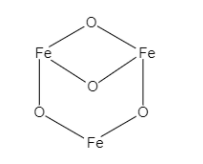
It is a ferrimagnetic magnetic which means it is magnetic even in the absence of magnetic field and also magnetic moments are aligned in the opposite direction.
So, when it is heated at the temperature of $870K$ , the magnetic moment changes its direction thereby losing its magnetism and turns into induced magnetism where it shows magnetism only in the presence of magnetic field.
Once it loses its magnetism it turns paramagnetic.
So, the correct answer is option C) paramagnetic.
Note:It is very important to know that there are two different forms of ions of iron in $F{e_3}{O_4}$ . The magnetic moments of both ions are in the opposite direction and are of different magnitudes. Because it shows magnetism at room temperature and loses magnetism at high temperatures.
Some materials have the property to transform from one type of magnetic material to another above a certain temperature. By studying the properties of $F{e_3}{O_4}$ we can see what happens .
Complete step by step answer:
Let us first understand what are diamagnetic, paramagnetic, ferromagnetic and antiferromagnetic substances.
A.Diamagnetic: when all the electrons are paired then the substance is said to be diamagnetic.
It does not get attracted to the magnetic field.
To consider it to be a diamagnetic the only property it should exhibit is that it should not have any unpaired electrons.
Examples: water, wood, $N{H_3}$ ,superconductors .
B.Paramagnetic: when there are unpaired electrons present in a compound or substance then it is said to be paramagnetic.
It gets weakly attracted to the magnetic field.
It loses its magnetic once removed from the magnetic field.
Examples: transition metal complex, oxygen, iron oxide.
C.Ferromagnetic: it has the property to get attracted to the magnets and getting easily converted into permanent magnets itself.
It shows magnetism even in the absence of magnetic fields.
Curie temperature: It is the temperature at which there is a sharp change observed in their magnetic properties where it can lose its magnetism.
Curie temperature is high in ferromagnetic substances.
If the curie temperature is above then the material is paramagnetic because above curie temperature it loses its magnetism.
Ferromagnetic are mostly metal alloys and metals for example: iron, nickel.
D.Ferrimagnetic: It has the property in which the materials have atomic moments align itself in the opposite direction.
Even the curie temperature is low as compared to ferromagnetic materials.
Examples of ferrimagnetic substance: iron oxide such as magnetite.
E.Anti-ferromagnetic: It has property in which the magnetic moments are aligned in the opposite direction.
These magnetic moments get cancelled out and become equal thus having its net moment to become zero.
Neel temperature: it is the temperature at which antiferromagnetic materials get converted to paramagnetic.
Examples: transition metal oxides such as manganese oxide.
F.$F{e_3}{O_4}$
It is an iron oxide and is named as ferrosoferric oxide.
It consists of both $F{e^{ + 2}}$and$F{e^{3 + }}$ ions.
It is a black ore of iron.
It shows strong magnetism.
The structure of $F{e_3}{O_4}$ is given below:
It is a ferrimagnetic magnetic which means it is magnetic even in the absence of magnetic field and also magnetic moments are aligned in the opposite direction.
So, when it is heated at the temperature of $870K$ , the magnetic moment changes its direction thereby losing its magnetism and turns into induced magnetism where it shows magnetism only in the presence of magnetic field.
Once it loses its magnetism it turns paramagnetic.
So, the correct answer is option C) paramagnetic.
Note:It is very important to know that there are two different forms of ions of iron in $F{e_3}{O_4}$ . The magnetic moments of both ions are in the opposite direction and are of different magnitudes. Because it shows magnetism at room temperature and loses magnetism at high temperatures.
Recently Updated Pages
Basicity of sulphurous acid and sulphuric acid are

Master Class 12 Economics: Engaging Questions & Answers for Success
Master Class 12 Biology: Engaging Questions & Answers for Success
Master Class 11 English: Engaging Questions & Answers for Success
Master Class 11 Physics: Engaging Questions & Answers for Success
Master Class 11 Computer Science: Engaging Questions & Answers for Success
Trending doubts
Draw a labelled sketch of the human eye class 12 physics CBSE
The chemical formula of tear gas is A CO Cl 2 B C 10 class 12 chemistry CBSE
Draw ray diagrams each showing i myopic eye and ii class 12 physics CBSE
Which are the Top 10 Largest Countries of the World?
Differentiate between homogeneous and heterogeneous class 12 chemistry CBSE
Which is the correct genotypic ratio of mendel dihybrid class 12 biology CBSE