




Given diagram shows the bone of the left human hindlimb as seen from the front. It has certain mistakes in labelling. Which of the following pairs contains both wrongly labelled bones?
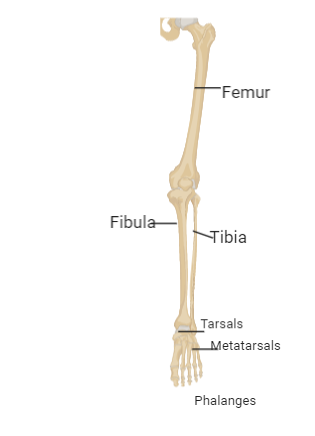
A. Tibia and tarsals
B. Femur and fibula
C. Fibula and phalanges
D. Tarsals and femur
Answer
 Verified
628.5k+ views
Hint: Legs comprise the lower limbs of human beings. In most of the organisms, legs are composed of 30 bones. Just the foot comprises 26 bones.
Complete answer: There are 30 bones in each leg, namely the femur of the thigh region, the patella of the knee, the tibia and fibula of the lower leg, 7 tarsals of the foot, 5 metatarsals of the sole and 14 phalanges of the toes. The human foot phalangeal formula is 2,3,3,3,3. So, fibula and phalanges are numbered incorrectly.
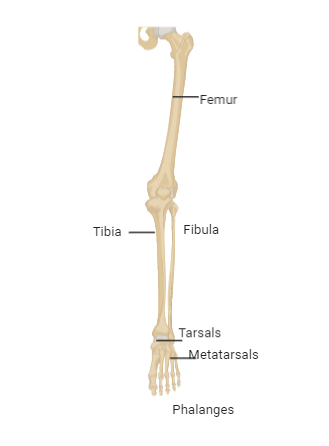
The four lower limb bones are:
a) The femur is the largest lower limb bone in the body. It is generally referred to as the bone of the thigh. It is connected to the hip bone by a ball and a socket joint. The femur is a long, curved, robust bone. The compression forces of 800-1100 kg can withstand this.
b) The tibia is the second largest bone in the body and is vital for the body weight. The upper part of the tibia is connected to the joint of the knee, while the lower part is connected to the joint of the ankle. The tibia can be divided into the proximal, shaft and distal sections.
c) The fibula is the bone located in the lower leg. The tibia is parallel to it. It doesn't help with weight-bearing, but it does with muscle attachment. It also gives the joint ankle flexibility. It is divided into three sections: proximal, shaft and distal.
d) Tarsals along with metatarsals and phalanges, are a combination of seven bones found in the foot. Tarsals are located in the region of the foot ankle. Tarsal bones can be divided into proximal, intermediate and distal parts. Calcaneus is the largest tarsal bone present. The pair of fibula and phalanges is incorrectly labelled, based on the proper labelling shown.
So, the correct answer is option C.
Note: Femur, patella, tibia, fibula, tarsals, metatarsals and phalanges are present in the lower limb bones. The tarsals are composed of seven bones, the metatarsals are composed of five bones for each digit and the phalanges are composed of the bones of the toes. Tarsal and phalanges are connected to a metatarsal.
Complete answer: There are 30 bones in each leg, namely the femur of the thigh region, the patella of the knee, the tibia and fibula of the lower leg, 7 tarsals of the foot, 5 metatarsals of the sole and 14 phalanges of the toes. The human foot phalangeal formula is 2,3,3,3,3. So, fibula and phalanges are numbered incorrectly.
The four lower limb bones are:
a) The femur is the largest lower limb bone in the body. It is generally referred to as the bone of the thigh. It is connected to the hip bone by a ball and a socket joint. The femur is a long, curved, robust bone. The compression forces of 800-1100 kg can withstand this.
b) The tibia is the second largest bone in the body and is vital for the body weight. The upper part of the tibia is connected to the joint of the knee, while the lower part is connected to the joint of the ankle. The tibia can be divided into the proximal, shaft and distal sections.
c) The fibula is the bone located in the lower leg. The tibia is parallel to it. It doesn't help with weight-bearing, but it does with muscle attachment. It also gives the joint ankle flexibility. It is divided into three sections: proximal, shaft and distal.
d) Tarsals along with metatarsals and phalanges, are a combination of seven bones found in the foot. Tarsals are located in the region of the foot ankle. Tarsal bones can be divided into proximal, intermediate and distal parts. Calcaneus is the largest tarsal bone present. The pair of fibula and phalanges is incorrectly labelled, based on the proper labelling shown.
So, the correct answer is option C.
Note: Femur, patella, tibia, fibula, tarsals, metatarsals and phalanges are present in the lower limb bones. The tarsals are composed of seven bones, the metatarsals are composed of five bones for each digit and the phalanges are composed of the bones of the toes. Tarsal and phalanges are connected to a metatarsal.
Recently Updated Pages
If x a + bt + ct2 where x is in meters and t is in class 11 physics CBSE

A car covers the first half distance between two places class 11 physics CBSE
The resultant of two vectors overrightarrow P and overrightarrow class 11 physics CBSE
Find the value of cos 135 class 11 maths CBSE
A mass M is held in place by an applied force F and class 11 physics CBSE
A solution of glucose in water is labelled as 10 dfracwv class 11 chemistry CBSE
Trending doubts
One Metric ton is equal to kg A 10000 B 1000 C 100 class 11 physics CBSE
Find the value of the expression given below sin 30circ class 11 maths CBSE
What do you mean by retardation What is its SI uni class 11 physics CBSE
Draw a diagram of nephron and explain its structur class 11 biology CBSE
10 examples of friction in our daily life
Difference between physical and chemical change class 11 chemistry CBSE