




Give three examples of materials that refract light rays. What happens to the speed of light when they enter these materials?
Answer
 Verified
538.2k+ views
Hint: Refractive index is the ratio of sine of angle of incidence to the sine of angle of refraction. The mathematical expression is $\mu = \dfrac{{\sin i}}{{\sin r}}$ .
Refractive index can also be given as the ratio of speed of light in vacuum to the speed of light in the medium. The mathematical expression is given as $\mu = \dfrac{c}{v}$ where c is the speed of light in air and v is the velocity of the light in the medium.
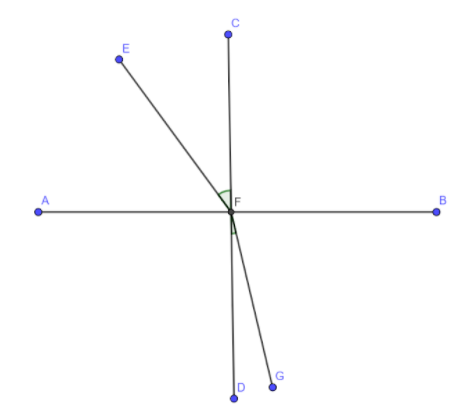
Here EF is the incident ray and FG is the refracted ray while CD is the normal.
Complete step by step solution:
We know that the refractive index is given as the ratio of speed of light in vacuum to the speed of light in the medium. The mathematical expression is given as $\mu = \dfrac{c}{v}$ where c is the speed of light in air and v is the velocity of the light in the medium.
Now since the refractive indices of different materials are different and are never equal to 1 except when the medium is air itself, the light would refract in all mediums.
Some examples of such mediums are: Glass, Water, Oil.
The speed of light changes when it enters these mediums.
This depends on the refractive index of the medium. If the medium is denser than the previous medium, then the rays would refract towards the normal. Else the rays would bend away from the normal.
Note:
When we mention the term denser here, it has a different meaning than the mass density of materials and must be carefully noted for sound concepts. Here denser means that the material is optically denser than the other medium. It has more ability to bend the incident rays towards the normal.
Refractive index can also be given as the ratio of speed of light in vacuum to the speed of light in the medium. The mathematical expression is given as $\mu = \dfrac{c}{v}$ where c is the speed of light in air and v is the velocity of the light in the medium.
Here EF is the incident ray and FG is the refracted ray while CD is the normal.
Complete step by step solution:
We know that the refractive index is given as the ratio of speed of light in vacuum to the speed of light in the medium. The mathematical expression is given as $\mu = \dfrac{c}{v}$ where c is the speed of light in air and v is the velocity of the light in the medium.
Now since the refractive indices of different materials are different and are never equal to 1 except when the medium is air itself, the light would refract in all mediums.
Some examples of such mediums are: Glass, Water, Oil.
The speed of light changes when it enters these mediums.
This depends on the refractive index of the medium. If the medium is denser than the previous medium, then the rays would refract towards the normal. Else the rays would bend away from the normal.
Note:
When we mention the term denser here, it has a different meaning than the mass density of materials and must be carefully noted for sound concepts. Here denser means that the material is optically denser than the other medium. It has more ability to bend the incident rays towards the normal.
Recently Updated Pages
Master Class 12 Business Studies: Engaging Questions & Answers for Success

Master Class 12 Chemistry: Engaging Questions & Answers for Success
Master Class 12 Biology: Engaging Questions & Answers for Success
Class 12 Question and Answer - Your Ultimate Solutions Guide
Master Class 11 English: Engaging Questions & Answers for Success
Master Class 11 Social Science: Engaging Questions & Answers for Success
Trending doubts
Which are the Top 10 Largest Countries of the World?
Draw a labelled sketch of the human eye class 12 physics CBSE
Differentiate between homogeneous and heterogeneous class 12 chemistry CBSE
Differentiate between Pyramid of energy and pyramid class 12 biology CBSE
Why is the cell called the structural and functional class 12 biology CBSE
Draw the diagram of the pyramid of energy Explain In class 12 biology CBSE