




Give the definition of acid anhydride.
Answer
 Verified
597.3k+ views
Hint: A corrosive is an atom or particle equipped for giving a proton (hydrogen particle $H^+$) (a Bronsted–Lowry corrosive), or, then again, fit for shaping a covalent bond with an electron pair (a Lewis corrosive). The primary classification of acids is the proton givers, or Bronsted–Lowry acids.
Complete step by step answer:
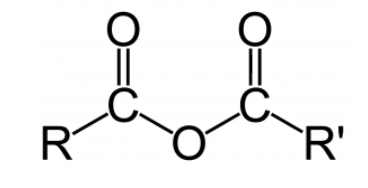
A corrosive anhydride is a sort of synthetic compound got from the expulsion of water particles from a corrosive. Inorganic science, natural corrosive anhydrides contain the useful gathering\[R\left( {CO} \right)O\left( {CO} \right)R'\]. Natural corrosive anhydrides regularly structure when one likeness water is eliminated from two reciprocals of a natural corrosive in a drying out response. In inorganic science, a corrosive anhydride alludes to an acidic oxide, an oxide that responds with water to frame an oxyacid (an inorganic corrosive that contains oxygen or carbonic corrosive), or with a base to shape a salt.
Nomenclature:
The terminology of natural corrosive anhydrides is gotten from the names of the constituent carboxylic acids which went through parchedness to frame the compound. In balanced corrosive anhydrides, where just a single constituent carboxylic corrosive was utilized to shape the compound, (for example, the drying out of propanoic corrosive, \[2C{H_3}C{H_2}COOH{\text{ }} \to {\text{ }}C{H_3}C{H_2}C\left( O \right)OC\left( O \right)C{H_2}C{H_3}\; + {\text{ }}{H_2}O)\]just the prefix of the first carboxylic corrosive is utilized and the addition "anhydride" is added. In lopsided corrosive anhydrides, where two distinctive carboxylic acids were utilized to give the anhydride (for instance, the drying out between benzoic corrosive and propanoic corrosive, \[{C_6}{H_5}COOH{\text{ }} + {\text{ }}C{H_3}C{H_2}COOH{\text{ }} \to {\text{ }}{C_6}{H_5}C\left( O \right)OC\left( O \right)C{H_2}C{H_3}\; + {\text{ }}{H_2}O)\], the prefixes from the two acids responded are recorded before the postfix, for this situation giving benzoic propanoic anhydride, which may then again be alluded to as benzene carboxylic ethanoic anhydride.
Note: It was first set up by French scientific expert Charles Frederic Gerhardt in 1852 through warming potassium acetic acid derivation with benzoyl chloride. Acidic anhydride is set up via carbonylation of methyl acetic acid derivation.
Complete step by step answer:
A corrosive anhydride is a sort of synthetic compound got from the expulsion of water particles from a corrosive. Inorganic science, natural corrosive anhydrides contain the useful gathering\[R\left( {CO} \right)O\left( {CO} \right)R'\]. Natural corrosive anhydrides regularly structure when one likeness water is eliminated from two reciprocals of a natural corrosive in a drying out response. In inorganic science, a corrosive anhydride alludes to an acidic oxide, an oxide that responds with water to frame an oxyacid (an inorganic corrosive that contains oxygen or carbonic corrosive), or with a base to shape a salt.
Nomenclature:
The terminology of natural corrosive anhydrides is gotten from the names of the constituent carboxylic acids which went through parchedness to frame the compound. In balanced corrosive anhydrides, where just a single constituent carboxylic corrosive was utilized to shape the compound, (for example, the drying out of propanoic corrosive, \[2C{H_3}C{H_2}COOH{\text{ }} \to {\text{ }}C{H_3}C{H_2}C\left( O \right)OC\left( O \right)C{H_2}C{H_3}\; + {\text{ }}{H_2}O)\]just the prefix of the first carboxylic corrosive is utilized and the addition "anhydride" is added. In lopsided corrosive anhydrides, where two distinctive carboxylic acids were utilized to give the anhydride (for instance, the drying out between benzoic corrosive and propanoic corrosive, \[{C_6}{H_5}COOH{\text{ }} + {\text{ }}C{H_3}C{H_2}COOH{\text{ }} \to {\text{ }}{C_6}{H_5}C\left( O \right)OC\left( O \right)C{H_2}C{H_3}\; + {\text{ }}{H_2}O)\], the prefixes from the two acids responded are recorded before the postfix, for this situation giving benzoic propanoic anhydride, which may then again be alluded to as benzene carboxylic ethanoic anhydride.
Note: It was first set up by French scientific expert Charles Frederic Gerhardt in 1852 through warming potassium acetic acid derivation with benzoyl chloride. Acidic anhydride is set up via carbonylation of methyl acetic acid derivation.
Recently Updated Pages
Master Class 12 Economics: Engaging Questions & Answers for Success

Master Class 12 English: Engaging Questions & Answers for Success
Master Class 12 Social Science: Engaging Questions & Answers for Success
Master Class 12 Maths: Engaging Questions & Answers for Success
Master Class 12 Physics: Engaging Questions & Answers for Success
Master Class 12 Business Studies: Engaging Questions & Answers for Success
Trending doubts
Which are the Top 10 Largest Countries of the World?
Draw a labelled sketch of the human eye class 12 physics CBSE
Differentiate between homogeneous and heterogeneous class 12 chemistry CBSE
Why is the cell called the structural and functional class 12 biology CBSE
Draw ray diagrams each showing i myopic eye and ii class 12 physics CBSE
Which is the correct genotypic ratio of mendel dihybrid class 12 biology CBSE