




Give reasons for the following:
Answer
 Verified
551.4k+ views
Hint: The given compound is substituted benzene with a $C{{H}_{3}}$ group, so it becomes toluene. It has one halogen group and one Nitro group attached to it, which are at the ortho and para positions to each other. The compound reacts with aqueous NaOH, which suggests that the reaction is a Nucleophilic Substitution reaction. As this is taking place in an aromatic ring, recall the Nucleophilic Aromatic Substitution reaction.
Complete answer:
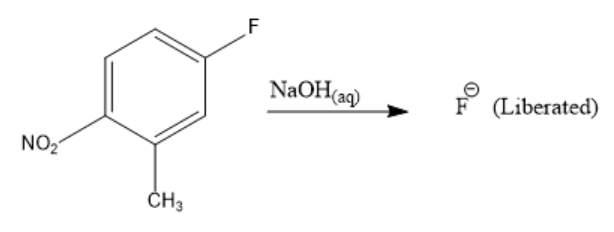
We have to find the answer to why fluorine leaves the aromatic ring when 5-fluoro-2-nitrotoluene reacts with aqueous NaOH.
The given reaction is an example of a Nucleophilic substitution reaction. For a Nucleophilic substitution reaction to take place the following conditions are necessary:
The Benzene ring should have an electron-withdrawing group. Here $N{{O}_{2}}$ is the Electron withdrawing group.
The Benzene ring should have a leaving group. Here Fluorine (F) is the leaving group.
The leaving group should be at ortho or para position to the Electron withdrawing group.
5-fluoro-2-nitrotoluene fulfills all the conditions and so it undergoes a Nucleophilic substitution reaction. The nucleophile here is $O{{H}^{-}}$ from the \[NaOH\] group. It attacks fluorine and gets substituted in its place in the benzene ring.
The reaction follows the Addition-Elimination mechanism. The $O{{H}^{-}}$ first gets attached with fluorine and alters the electron density of the ring. The negative charge is delocalized on the Oxygen atoms of the nitro group. Then the ${{F}^{-}}$ group is eliminated from the ring and the $O{{H}^{-}}$ group is substituted in its place.
The ${{F}^{-}}$ is liberated only because it forms a stable ion.
Note:
The Addition elimination mechanism won’t work if the nitro group and halogen are placed at meta positions to each other because the electron density on the oxygen cannot be shown properly. The electrons of the oxygen in the nitro group cannot be shown moving around as they do in the ortho or para positions to one another.
Complete answer:
We have to find the answer to why fluorine leaves the aromatic ring when 5-fluoro-2-nitrotoluene reacts with aqueous NaOH.
The given reaction is an example of a Nucleophilic substitution reaction. For a Nucleophilic substitution reaction to take place the following conditions are necessary:
The Benzene ring should have an electron-withdrawing group. Here $N{{O}_{2}}$ is the Electron withdrawing group.
The Benzene ring should have a leaving group. Here Fluorine (F) is the leaving group.
The leaving group should be at ortho or para position to the Electron withdrawing group.
5-fluoro-2-nitrotoluene fulfills all the conditions and so it undergoes a Nucleophilic substitution reaction. The nucleophile here is $O{{H}^{-}}$ from the \[NaOH\] group. It attacks fluorine and gets substituted in its place in the benzene ring.
The reaction follows the Addition-Elimination mechanism. The $O{{H}^{-}}$ first gets attached with fluorine and alters the electron density of the ring. The negative charge is delocalized on the Oxygen atoms of the nitro group. Then the ${{F}^{-}}$ group is eliminated from the ring and the $O{{H}^{-}}$ group is substituted in its place.
The ${{F}^{-}}$ is liberated only because it forms a stable ion.
Note:
The Addition elimination mechanism won’t work if the nitro group and halogen are placed at meta positions to each other because the electron density on the oxygen cannot be shown properly. The electrons of the oxygen in the nitro group cannot be shown moving around as they do in the ortho or para positions to one another.
Recently Updated Pages
Onehalf of a convex lens is covered with a black paper class 12 physics CBSE

Differentiate between lanthanoids and actinoids class 12 chemistry CBSE
An object 5 cm in length is held 25 cm away from a class 12 physics CBSE
Name the following halides according to the IUPAC system class 12 chemistry CBSE
An infinite ladder network of resistances is constructed class 12 physics CBSE
How will you bring about the following conversions class 12 chemistry CBSE
Trending doubts
Draw a labelled sketch of the human eye class 12 physics CBSE
Which are the Top 10 Largest Countries of the World?
Draw ray diagrams each showing i myopic eye and ii class 12 physics CBSE
Which is the correct genotypic ratio of mendel dihybrid class 12 biology CBSE
Differentiate between homogeneous and heterogeneous class 12 chemistry CBSE
What is the Full Form of PVC, PET, HDPE, LDPE, PP and PS ?