




Give reason for the following:
The band gap of the semiconductor used for fabrication of visible LEDs must at least be 1.8eV.
Answer
 Verified
645.3k+ views
Hint: We know that a light-emitting diode converts electrical energy into light energy and it is a semiconductor that emits monochromatic light as well as white light. LEDs begin to glow when a voltage is applied to it.
Complete step by step answer:
LEDs long-form is a Light-emitting diode. It is an especially heavily doped p-n junction diode of forwarding bias, which emits spontaneous radiation. As mentioned in the question we want to fabricate a p-n junction for this we have to remember some important points.
1. The reverse breakdown of LEDs should be very low
2. It should be a heavily doped p-n junction.
3. The reverse breakdown of LEDs should be typical around considered voltage.
Here, we want semiconductors used for the LED to emit light in the visible range should have a band gap of about 1.8eV to 3eV.
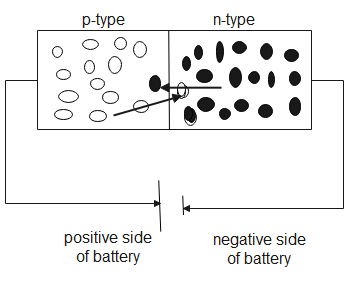
circuit diagram of the light-emitting diode.
As shown in the figure if the p-n junction is forward biased, the electrons injected to the p side of the junction diode from the conduction band to the valence band. There they will combine with the holes of the valence band. This process is equivalent to the jumping of electrons from the higher energy state to a lower energy state through this process energy will be released when electron-hole recombines in the form of visible light.
The spectral range of visible light is from 0.4µm to 0.7µm its correspondence to photon energy 1.8eV to 3eV. Hence for the fabrication of LED in the visible range, the band gap should be 1.8eV.
Note: We just remember the concept of V-I characteristics of LED will be the same as that of elemental semiconductor of a silicon diode. And, the knee voltage of the LED is greater than that of the Si diode but we have to be careful LEDs get damaged at low reverse voltage may be around 5V.
Complete step by step answer:
LEDs long-form is a Light-emitting diode. It is an especially heavily doped p-n junction diode of forwarding bias, which emits spontaneous radiation. As mentioned in the question we want to fabricate a p-n junction for this we have to remember some important points.
1. The reverse breakdown of LEDs should be very low
2. It should be a heavily doped p-n junction.
3. The reverse breakdown of LEDs should be typical around considered voltage.
Here, we want semiconductors used for the LED to emit light in the visible range should have a band gap of about 1.8eV to 3eV.
circuit diagram of the light-emitting diode.
As shown in the figure if the p-n junction is forward biased, the electrons injected to the p side of the junction diode from the conduction band to the valence band. There they will combine with the holes of the valence band. This process is equivalent to the jumping of electrons from the higher energy state to a lower energy state through this process energy will be released when electron-hole recombines in the form of visible light.
The spectral range of visible light is from 0.4µm to 0.7µm its correspondence to photon energy 1.8eV to 3eV. Hence for the fabrication of LED in the visible range, the band gap should be 1.8eV.
Note: We just remember the concept of V-I characteristics of LED will be the same as that of elemental semiconductor of a silicon diode. And, the knee voltage of the LED is greater than that of the Si diode but we have to be careful LEDs get damaged at low reverse voltage may be around 5V.
Recently Updated Pages
Master Class 12 Physics: Engaging Questions & Answers for Success

Master Class 12 Social Science: Engaging Questions & Answers for Success
Master Class 12 English: Engaging Questions & Answers for Success
Master Class 12 Maths: Engaging Questions & Answers for Success
Master Class 12 Business Studies: Engaging Questions & Answers for Success
Master Class 12 Chemistry: Engaging Questions & Answers for Success
Trending doubts
Draw a labelled sketch of the human eye class 12 physics CBSE
Which are the Top 10 Largest Countries of the World?
Draw ray diagrams each showing i myopic eye and ii class 12 physics CBSE
One megawatt is equal to how many units of electri class 12 physics CBSE
Which is the correct genotypic ratio of mendel dihybrid class 12 biology CBSE
Give 10 examples of unisexual and bisexual flowers