




Give examples of three plants that have Spiny stem
Answer
 Verified
533.4k+ views
Hint: As we know stems of many plants are modified in order to perform different functions like storage, protection, photosynthesis, support, propagation and also perennation. These modifications help in better adaptation and survival. Stems develop from the plumule of the germinating seed which bears leaves, fruits, flowers.
Complete answer:
Spiny stems or thorns are developed from the axillary buds. They are pointed, woody and hard, these spiny structures provide protection from the grazing animals. Three plants that possess a spiny stem are
Sago Palm, Cactus and Rose.
Features of stems are;
- It emerges from the plumule of the embryo.
- It is the ascending part of the plant and results in the formation of the axis.
- It is distinguished into the nodes and internodes
- At the nodes, the stem yields the branches and the leaves. The internodes are that section of the stem that is found between the two nodes.
- As they grow towards the light they are positively phototropic.
- As they grow away from gravity, they are negatively geotropic.
- The stem and the branches form the shoot of the plant and are green in colour, hence they are photosynthetic.
- The stem apex is known as the shoot tip which yields the apical bud that accounts for the plant elongation.
- They have trichomes or multicellular or unicellular hair.
- Their function is to render support to the branches and leaves and fix them in their position in order to receive light to the maximum. Hence, they are the main skeleton of the plants.
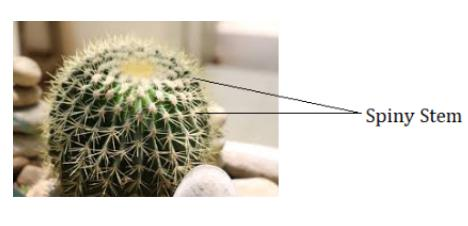
The diagram below shows cactus that has a spiny stem.
Note: The main function of the stem is to support other parts of the plant and also the transportation of food, water and minerals. In some plants, stems are modified, which can either be aerial, subaerial or underground modifications. They are modified in order to perform other functions, which are not usually associated with the stem.
Complete answer:
Spiny stems or thorns are developed from the axillary buds. They are pointed, woody and hard, these spiny structures provide protection from the grazing animals. Three plants that possess a spiny stem are
Sago Palm, Cactus and Rose.
Features of stems are;
- It emerges from the plumule of the embryo.
- It is the ascending part of the plant and results in the formation of the axis.
- It is distinguished into the nodes and internodes
- At the nodes, the stem yields the branches and the leaves. The internodes are that section of the stem that is found between the two nodes.
- As they grow towards the light they are positively phototropic.
- As they grow away from gravity, they are negatively geotropic.
- The stem and the branches form the shoot of the plant and are green in colour, hence they are photosynthetic.
- The stem apex is known as the shoot tip which yields the apical bud that accounts for the plant elongation.
- They have trichomes or multicellular or unicellular hair.
- Their function is to render support to the branches and leaves and fix them in their position in order to receive light to the maximum. Hence, they are the main skeleton of the plants.
The diagram below shows cactus that has a spiny stem.
Note: The main function of the stem is to support other parts of the plant and also the transportation of food, water and minerals. In some plants, stems are modified, which can either be aerial, subaerial or underground modifications. They are modified in order to perform other functions, which are not usually associated with the stem.
Recently Updated Pages
Three beakers labelled as A B and C each containing 25 mL of water were taken A small amount of NaOH anhydrous CuSO4 and NaCl were added to the beakers A B and C respectively It was observed that there was an increase in the temperature of the solutions contained in beakers A and B whereas in case of beaker C the temperature of the solution falls Which one of the following statements isarecorrect i In beakers A and B exothermic process has occurred ii In beakers A and B endothermic process has occurred iii In beaker C exothermic process has occurred iv In beaker C endothermic process has occurred

Master Class 11 Social Science: Engaging Questions & Answers for Success
Master Class 11 Physics: Engaging Questions & Answers for Success
Master Class 11 Maths: Engaging Questions & Answers for Success
Master Class 11 Economics: Engaging Questions & Answers for Success
Master Class 11 Computer Science: Engaging Questions & Answers for Success
Three beakers labelled as A B and C each containing 25 mL of water were taken A small amount of NaOH anhydrous CuSO4 and NaCl were added to the beakers A B and C respectively It was observed that there was an increase in the temperature of the solutions contained in beakers A and B whereas in case of beaker C the temperature of the solution falls Which one of the following statements isarecorrect i In beakers A and B exothermic process has occurred ii In beakers A and B endothermic process has occurred iii In beaker C exothermic process has occurred iv In beaker C endothermic process has occurred
Master Class 11 Social Science: Engaging Questions & Answers for Success
Master Class 11 Physics: Engaging Questions & Answers for Success
Trending doubts
One Metric ton is equal to kg A 10000 B 1000 C 100 class 11 physics CBSE
There are 720 permutations of the digits 1 2 3 4 5 class 11 maths CBSE
State and prove Bernoullis theorem class 11 physics CBSE
Draw a diagram of a plant cell and label at least eight class 11 biology CBSE
Difference Between Prokaryotic Cells and Eukaryotic Cells
Discuss the various forms of bacteria class 11 biology CBSE