




Who gave the double strand helix structure for DNA?
Answer
 Verified
556.5k+ views
Hint: A double-stranded DNA's molecular form is depicted by the double helix. Deoxyribonucleic acid, or DNA, is the component that houses an individual's genetic makeup. Individuals share their DNA from their parents. Watson and Crick gave the double strand helix structure of DNA.
Complete answer:
Francis Crick and James Watson published the first description of DNA's chemical structure, which they named a "double helix," in the magazine Nature in \[1953\]. Watson, Crick, and their colleague Maurice Wilkins were awarded the Nobel Prize in Physiology or Medicine in \[1962\] for this scientific breakthrough.
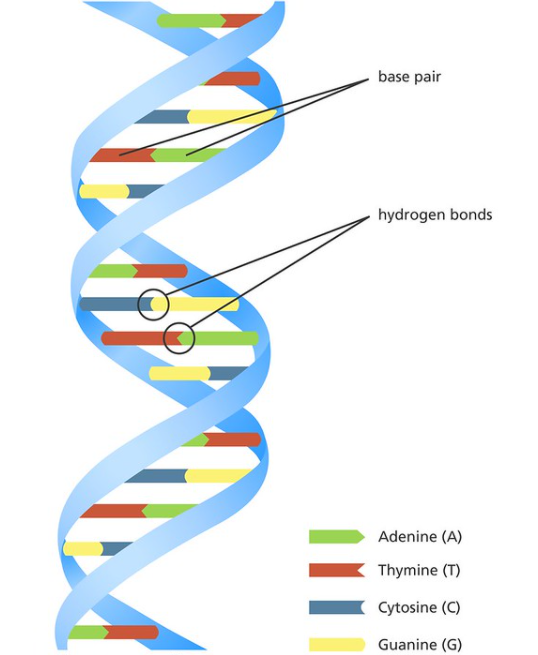
The aspect of double-stranded DNA is typified by the double helix, which is split into two linear strands that run in opposite directions, or anti-parallel, and coil intertwined. Within the double helix, each DNA is a lengthy, linear molecule composed of smaller units called nucleotides that link together to form a chain. Sugar and phosphate units are linked by chemical bonds to form the chemical backbones of the double helix, which are known as sugar-phosphate backbones.
Contacts between pairs of nucleotides, commonly known as base pairs, link the two helical strands. Base pairing happens in two ways: nucleotide A only combines with T, and nucleotide C combines only with G.
Note:
The double helix model is also known as the Watson and Crick model, named after the scientists who discovered them. Genetic data is stored via the nucleotide sequence in the chemical backbone. DNA holds all of an individual's blueprints for growth, survival, and procreation. DNA is required for heredity, protein translation, and imparting directions for life and its mechanisms in all living things.
Complete answer:
Francis Crick and James Watson published the first description of DNA's chemical structure, which they named a "double helix," in the magazine Nature in \[1953\]. Watson, Crick, and their colleague Maurice Wilkins were awarded the Nobel Prize in Physiology or Medicine in \[1962\] for this scientific breakthrough.
The aspect of double-stranded DNA is typified by the double helix, which is split into two linear strands that run in opposite directions, or anti-parallel, and coil intertwined. Within the double helix, each DNA is a lengthy, linear molecule composed of smaller units called nucleotides that link together to form a chain. Sugar and phosphate units are linked by chemical bonds to form the chemical backbones of the double helix, which are known as sugar-phosphate backbones.
Contacts between pairs of nucleotides, commonly known as base pairs, link the two helical strands. Base pairing happens in two ways: nucleotide A only combines with T, and nucleotide C combines only with G.
Note:
The double helix model is also known as the Watson and Crick model, named after the scientists who discovered them. Genetic data is stored via the nucleotide sequence in the chemical backbone. DNA holds all of an individual's blueprints for growth, survival, and procreation. DNA is required for heredity, protein translation, and imparting directions for life and its mechanisms in all living things.
Recently Updated Pages
Explain the structure of megasporangium class 12 biology CBSE

Why is chloroform kept in dark coloured bottles class 12 chemistry CBSE
Derive the balancing condition of a Wheatstone bri class 12 physics CBSE
Draw VI characteristics of a pn junction diode Explain class 12 physics CBSE
Is it possible to carry pride in ones language too class 12 english CBSE
In a population at Hardy Weinberg equilibrium the allele class 12 biology CBSE
Trending doubts
Draw a labelled sketch of the human eye class 12 physics CBSE
Which are the Top 10 Largest Countries of the World?
Draw ray diagrams each showing i myopic eye and ii class 12 physics CBSE
Which is the correct genotypic ratio of mendel dihybrid class 12 biology CBSE
Differentiate between homogeneous and heterogeneous class 12 chemistry CBSE
Which animal never drinks water in its entire life class 12 biology CBSE