




Gambia fever or sleeping sickness is caused by
(a) Plasmodium
(b) Entamoeba
(c) Giardia
(d) Trypanosoma
Answer
 Verified
583.8k+ views
Hint: This parasite belongs to the genus of kinetoplastids, a monophyletic group of unicellular parasitic flagellate protozoa. The name is derived from the Greek words and was given because of their corkscrew-like motion. The disease sleeping sickness is transmitted by the tsetse fly (Glossina genus) bites that have acquired their infection from human beings or animals harboring human pathogenic parasites.
Complete answer:
The human African trypanosomiasis which is also known as sleeping sickness is a vector-borne parasitic disease. A protozoan parasite belonging to the genus Trypanosoma causes this infection. The host flies which are called Tsetse flies are found just in sub-Saharan Africa though only certain species transmit the disease. In many regions where tsetse flies are found but not the sleeping sickness for some reasons that are so far unexplained.
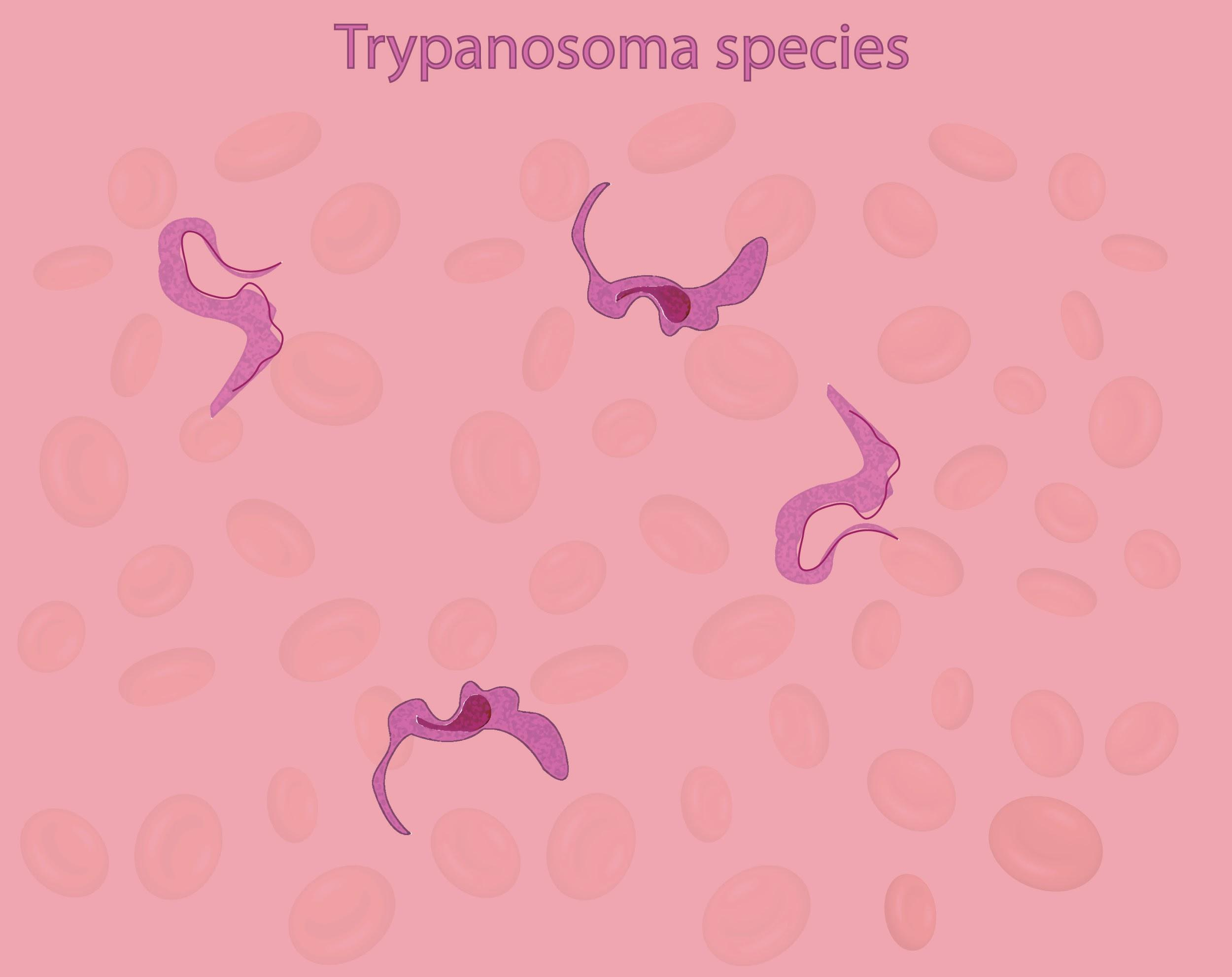
In rural populations, most exposure to the tsetse fly, and the disease is due to living in such regions where transmission occurs and which depend on agriculture, fishing, animal husbandry, or hunting are. The disease is seen to be developed in areas ranging from a single village to an entire region. The intensity of the disease can vary from one village to the next within an infected area.
So, the correct answer is, ‘Trypanosoma’.
Additional information:
1) In Gambia in 1901, a trypanosome infection was found in man by Forde for the first time. He observed and found the parasites in the blood of a European person suffering from recurrent fevers. After him, Dutton identified those parasites a few months later as trypanosomes. In 1902, in his publication, Dutton proposed the species name Trypanosoma gambiense.
2) The people most exposed to the tsetse fly and the disease live in rural areas and depend on agriculture, fishing, animal husbandry, or hunting.
3) Depending on the parasite involved, human African trypanosomiasis takes 2 forms. But Trypanosoma brucei gambiense accounts for more than 98% of reported cases.
4) Sustained control efforts have reduced the number of new cases. In 2009 the number reported dropped below 10 000 for the first time in 50 years, and in 2018 there were 977 cases recorded.
Note: Jacobs (1883–1967) and the American immunologist Michael Heidelberger (1888–1991) discovered the organo-arsenical tryparsamide which is the first drug to treat late-stage sleeping sickness alone, or in combination with suramin, and was also used in the treatment of animal trypanosomiasis.
Complete answer:
The human African trypanosomiasis which is also known as sleeping sickness is a vector-borne parasitic disease. A protozoan parasite belonging to the genus Trypanosoma causes this infection. The host flies which are called Tsetse flies are found just in sub-Saharan Africa though only certain species transmit the disease. In many regions where tsetse flies are found but not the sleeping sickness for some reasons that are so far unexplained.
In rural populations, most exposure to the tsetse fly, and the disease is due to living in such regions where transmission occurs and which depend on agriculture, fishing, animal husbandry, or hunting are. The disease is seen to be developed in areas ranging from a single village to an entire region. The intensity of the disease can vary from one village to the next within an infected area.
So, the correct answer is, ‘Trypanosoma’.
Additional information:
1) In Gambia in 1901, a trypanosome infection was found in man by Forde for the first time. He observed and found the parasites in the blood of a European person suffering from recurrent fevers. After him, Dutton identified those parasites a few months later as trypanosomes. In 1902, in his publication, Dutton proposed the species name Trypanosoma gambiense.
2) The people most exposed to the tsetse fly and the disease live in rural areas and depend on agriculture, fishing, animal husbandry, or hunting.
3) Depending on the parasite involved, human African trypanosomiasis takes 2 forms. But Trypanosoma brucei gambiense accounts for more than 98% of reported cases.
4) Sustained control efforts have reduced the number of new cases. In 2009 the number reported dropped below 10 000 for the first time in 50 years, and in 2018 there were 977 cases recorded.
Note: Jacobs (1883–1967) and the American immunologist Michael Heidelberger (1888–1991) discovered the organo-arsenical tryparsamide which is the first drug to treat late-stage sleeping sickness alone, or in combination with suramin, and was also used in the treatment of animal trypanosomiasis.
Recently Updated Pages
Master Class 12 Economics: Engaging Questions & Answers for Success

Master Class 12 Physics: Engaging Questions & Answers for Success
Master Class 12 English: Engaging Questions & Answers for Success
Master Class 12 Social Science: Engaging Questions & Answers for Success
Master Class 12 Maths: Engaging Questions & Answers for Success
Master Class 12 Business Studies: Engaging Questions & Answers for Success
Trending doubts
Which are the Top 10 Largest Countries of the World?
What are the major means of transport Explain each class 12 social science CBSE
Draw a labelled sketch of the human eye class 12 physics CBSE
Why cannot DNA pass through cell membranes class 12 biology CBSE
Differentiate between insitu conservation and exsitu class 12 biology CBSE
Draw a neat and well labeled diagram of TS of ovary class 12 biology CBSE