




What is the function of the spleen in the body?
Answer
 Verified
537.3k+ views
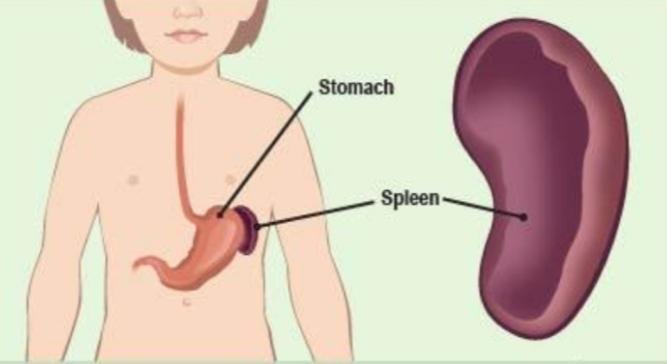
Hint: The spleen is a lymphoid organ that is situated in the left part of the abdomen. It is a purple colored organ that varies in size and shape among people. Usually, it is fish shaped and 4 inches long. The rig cage protects the spleen. It is present in all vertebrates.
Complete answer:
The spleen is a part of the lymphatic system that is located under the diaphragm. The lymphatic system helps in the removal of some substances, activating the white blood cells and generating an immune response. The spleen plays various important roles in the human body. It is primarily related to red blood cells and the lymphoid system. The functions of spleen are-
As a lymphoid organ, it is primarily involved in the filtration of blood and generates immune response. When foreign particles or pathogens enter the body, it activates the white blood cells to fight off with these pathogens. Thus, the spleen protects the body from a number of disease causing pathogens by detecting them.
The old and damaged red blood cells (RBCs) are destroyed in the spleen. For this reason, it is also called the graveyard of RBCs.
It also provides protection against some bacteria that cause pneumonia and meningitis.
It is involved in recycling of iron and acts as a blood reserve during hemorrhagic shock. The spleen stores RBCs, WBCs (white blood cells) and platelets.
In a foetus, it helps in the formation of all types of blood cells.
Note:
The spleen also has a clinical significance. It helps in the detection of certain diseases. For example- splenomegaly. Splenomegaly is a condition in which the spleen becomes enlarged. In children, viral infection is the most common cause of splenomegaly. In adults, it can be caused due to several diseases such as viral mononucleosis, leukemia, lymphoma etc.
Complete answer:
The spleen is a part of the lymphatic system that is located under the diaphragm. The lymphatic system helps in the removal of some substances, activating the white blood cells and generating an immune response. The spleen plays various important roles in the human body. It is primarily related to red blood cells and the lymphoid system. The functions of spleen are-
As a lymphoid organ, it is primarily involved in the filtration of blood and generates immune response. When foreign particles or pathogens enter the body, it activates the white blood cells to fight off with these pathogens. Thus, the spleen protects the body from a number of disease causing pathogens by detecting them.
The old and damaged red blood cells (RBCs) are destroyed in the spleen. For this reason, it is also called the graveyard of RBCs.
It also provides protection against some bacteria that cause pneumonia and meningitis.
It is involved in recycling of iron and acts as a blood reserve during hemorrhagic shock. The spleen stores RBCs, WBCs (white blood cells) and platelets.
In a foetus, it helps in the formation of all types of blood cells.
Note:
The spleen also has a clinical significance. It helps in the detection of certain diseases. For example- splenomegaly. Splenomegaly is a condition in which the spleen becomes enlarged. In children, viral infection is the most common cause of splenomegaly. In adults, it can be caused due to several diseases such as viral mononucleosis, leukemia, lymphoma etc.
Recently Updated Pages
Master Class 12 Business Studies: Engaging Questions & Answers for Success

Master Class 12 Biology: Engaging Questions & Answers for Success
Master Class 12 Chemistry: Engaging Questions & Answers for Success
Class 12 Question and Answer - Your Ultimate Solutions Guide
Master Class 11 English: Engaging Questions & Answers for Success
Master Class 11 Social Science: Engaging Questions & Answers for Success
Trending doubts
Differentiate between homogeneous and heterogeneous class 12 chemistry CBSE
What is the Full Form of PVC, PET, HDPE, LDPE, PP and PS ?
Sulphuric acid is known as the king of acids State class 12 chemistry CBSE
The electric field due to a uniformly charged nonconducting class 12 physics CBSE
In a halfwave rectifier the rms value of the ac component class 12 physics CBSE
What is apomixis and what is its importance class 12 biology CBSE