




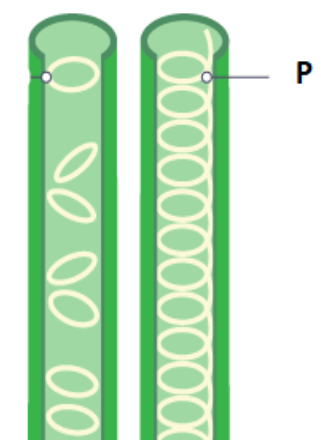
What is the function of the spiral structure P?
A. Absorption
B. Support
C. Photosynthesis
D. Transportation
Answer
 Verified
600.3k+ views
Hint: The plants consist of a tissue that helps in conducting water and nutrients through its long tracheary elements. This tissue is made of tracheid and vessel elements.
Complete step by step answer: The given structure is of xylem tissue of plants. The xylem consists of distinctive xylem cells that are long tracheary elements that transport water through the soil towards the plant. It also contains vessel elements that are shorter in size and thus connects in the form of long tubes that are called vessels. The xylem cells are cylindrical dead cells that have two walls. The primary wall is made of cellulose and the secondary wall is made of lignin. The spirals shown in the diagram are of lignin. Xylem is considered as water-conducting vessels in the Angiosperms or flower-bearing plants.
Option A is Absorption. The xylem does not absorb water or nutrients rather it sucks them up throughout the length of the plant by transpirational pull or pressure flow.
Option B is support. The secondary walls of xylem do function to provide mechanical support but not significantly.
Option C is Photosynthesis. This is incorrect as xylem tracheid cells are mostly non-living at maturity and thus cannot perform photosynthesis. The function of xylem is to provide water and nutrients to plant through soil.
Option D is Transportation. It is the right option as the tracheid or lignin surrounded secondary spiral walls of xylem are employed purely in transporting water and nutrients from soil towards the plant.
Thus, the correct option is Transportation.
Note: Xylem is made of tracheids, vessels, xylem fibers, and xylem parenchyma. Each of these components has different roles to play in the plant. The tracheid cells when die or become non-living at maturity they become devoid of protoplast. The secondary walls of tracheids are laid differently based on distinct materials forming annular thickening, spiral thickening as in diagram or scalariform thickening.
Complete step by step answer: The given structure is of xylem tissue of plants. The xylem consists of distinctive xylem cells that are long tracheary elements that transport water through the soil towards the plant. It also contains vessel elements that are shorter in size and thus connects in the form of long tubes that are called vessels. The xylem cells are cylindrical dead cells that have two walls. The primary wall is made of cellulose and the secondary wall is made of lignin. The spirals shown in the diagram are of lignin. Xylem is considered as water-conducting vessels in the Angiosperms or flower-bearing plants.
Option A is Absorption. The xylem does not absorb water or nutrients rather it sucks them up throughout the length of the plant by transpirational pull or pressure flow.
Option B is support. The secondary walls of xylem do function to provide mechanical support but not significantly.
Option C is Photosynthesis. This is incorrect as xylem tracheid cells are mostly non-living at maturity and thus cannot perform photosynthesis. The function of xylem is to provide water and nutrients to plant through soil.
Option D is Transportation. It is the right option as the tracheid or lignin surrounded secondary spiral walls of xylem are employed purely in transporting water and nutrients from soil towards the plant.
Thus, the correct option is Transportation.
Note: Xylem is made of tracheids, vessels, xylem fibers, and xylem parenchyma. Each of these components has different roles to play in the plant. The tracheid cells when die or become non-living at maturity they become devoid of protoplast. The secondary walls of tracheids are laid differently based on distinct materials forming annular thickening, spiral thickening as in diagram or scalariform thickening.
Recently Updated Pages
Master Class 11 English: Engaging Questions & Answers for Success

Master Class 11 Maths: Engaging Questions & Answers for Success
Class 11 Question and Answer - Your Ultimate Solutions Guide
Master Class 11 Biology: Engaging Questions & Answers for Success
Master Class 11 Physics: Engaging Questions & Answers for Success
Master Class 11 Accountancy: Engaging Questions & Answers for Success
Trending doubts
Differentiate between an exothermic and an endothermic class 11 chemistry CBSE
One Metric ton is equal to kg A 10000 B 1000 C 100 class 11 physics CBSE
There are 720 permutations of the digits 1 2 3 4 5 class 11 maths CBSE
In what year Guru Nanak Dev ji was born A15 April 1469 class 11 social science CBSE
Difference Between Prokaryotic Cells and Eukaryotic Cells
Draw a diagram of a plant cell and label at least eight class 11 biology CBSE