




From point P, \[10\] cm away from the centre of a circle, a tangent PT of length\[\;8\] cm is drawn. Find the radius of the circle.
Answer
 Verified
638.7k+ views
Hint: Form a right angle triangle, by joining the end with point T to the centre of the circle. Then use Pythagoras theorem which states that, “In a right angled triangle, the sum of the square of the hypotenuse side is equal to the sum of squares of the two other sides.” This can also be written as-
${H^2} = {P^2} + {B^2}$ Where H is the hypotenuse, P is the perpendicular of the triangle and B is the Base of the Triangle. Put the values to find the radius.
Complete step-by-step answer:
Given, Point P is \[10\]cm away from the centre of a circle and a tangent is drawn from this point of length \[\;8\] cm named PT.
We have to find the radius of the circle.
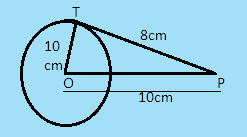
Let O be the centre of the given circle and P be such a point that OP=\[10\]cm
Then PT is the tangent with length=\[\;8\] cm
Now Join OT to form a triangle. Here OT is the radius of the circle through T. Then we can say that OT$ \bot $ PT which means $\vartriangle OTP$ is a right angled triangle.
Then by Pythagoras theorem, we get-
$ \Rightarrow $ ${H^2} = {P^2} + {B^2}$ Where H is the hypotenuse, P is the perpendicular of the triangle and B is the Base of the Triangle
Here, OP is the hypotenuse, PT is the base and OT is the perpendicular,
$ \Rightarrow O{P^2} = O{T^2} + P{T^2}$
Then we can write it as-
\[ \Rightarrow O{T^2} = O{P^2} - P{T^2}\]
On putting the values we get,
\[ \Rightarrow O{T^2} = {10^2} - {8^2}\]
On solving we get,
\[ \Rightarrow O{T^2} = 100 - 64 = 36\]
On simplifying we get,
\[ \Rightarrow OT = \sqrt {36} = 6\] cm
The radius of the circle is $6$cm.
Note: Here the student may go wrong if they assume that OT is perpendicular on OP because then PT will become hypotenuse, OT will become perpendicular and OP will become base. If these values are put in the Pythagoras theorem then the value of radius will be $6i$ which is not possible. Hence correctly draw the diagram so as not to get confused which is the right angle in the formed triangle.
${H^2} = {P^2} + {B^2}$ Where H is the hypotenuse, P is the perpendicular of the triangle and B is the Base of the Triangle. Put the values to find the radius.
Complete step-by-step answer:
Given, Point P is \[10\]cm away from the centre of a circle and a tangent is drawn from this point of length \[\;8\] cm named PT.
We have to find the radius of the circle.
Let O be the centre of the given circle and P be such a point that OP=\[10\]cm
Then PT is the tangent with length=\[\;8\] cm
Now Join OT to form a triangle. Here OT is the radius of the circle through T. Then we can say that OT$ \bot $ PT which means $\vartriangle OTP$ is a right angled triangle.
Then by Pythagoras theorem, we get-
$ \Rightarrow $ ${H^2} = {P^2} + {B^2}$ Where H is the hypotenuse, P is the perpendicular of the triangle and B is the Base of the Triangle
Here, OP is the hypotenuse, PT is the base and OT is the perpendicular,
$ \Rightarrow O{P^2} = O{T^2} + P{T^2}$
Then we can write it as-
\[ \Rightarrow O{T^2} = O{P^2} - P{T^2}\]
On putting the values we get,
\[ \Rightarrow O{T^2} = {10^2} - {8^2}\]
On solving we get,
\[ \Rightarrow O{T^2} = 100 - 64 = 36\]
On simplifying we get,
\[ \Rightarrow OT = \sqrt {36} = 6\] cm
The radius of the circle is $6$cm.
Note: Here the student may go wrong if they assume that OT is perpendicular on OP because then PT will become hypotenuse, OT will become perpendicular and OP will become base. If these values are put in the Pythagoras theorem then the value of radius will be $6i$ which is not possible. Hence correctly draw the diagram so as not to get confused which is the right angle in the formed triangle.
Recently Updated Pages
Master Class 12 Economics: Engaging Questions & Answers for Success

Master Class 12 Biology: Engaging Questions & Answers for Success
Master Class 11 English: Engaging Questions & Answers for Success
Master Class 11 Physics: Engaging Questions & Answers for Success
Master Class 11 Computer Science: Engaging Questions & Answers for Success
Master Class 11 Chemistry: Engaging Questions & Answers for Success
Trending doubts
What is the Total Duration of Football Match?
Explain the Treaty of Vienna of 1815 class 10 social science CBSE
In football, which nation is called "La Roja"?
Why is there a time difference of about 5 hours between class 10 social science CBSE
10 examples of evaporation in daily life with explanations
What is the full form of POSCO class 10 social science CBSE