




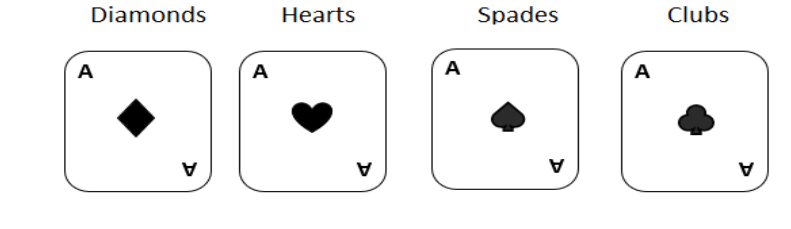
: From a well shuffled pack of \[52\] cards, one card is drawn at random. Find the probability of getting a diamond.
Answer
 Verified
583.8k+ views
Hint: There are total \[52\] cards in a deck with \[4\] different suits: ace, diamonds, hearts and clubs. All the suits have equal number of cards and each suit has \[13\] cards. Hence to arrive at the probability, we will have to divide \[13\] by \[52\] with the formula \[P(E) = \dfrac{{Number\,of\,favourable\,outcomes}}{{Total\,number\,of\,outcomes}}\] .
Complete step-by-step answer:
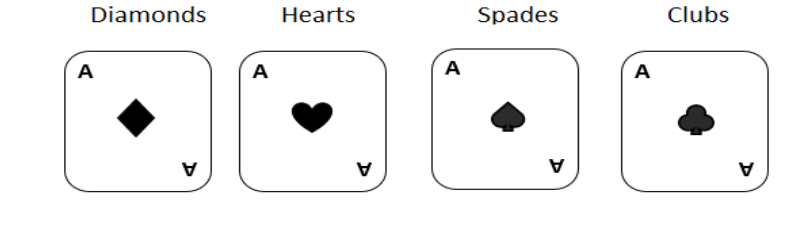
We are given the figure as follows, represented as a well shuffled pack of \[52\] cards, one card is drawn at random. Find the probability of getting a diamond.
We will use combination techniques to find out the solution. A combination is a mathematical technique for calculating the number of possible arrangements in a collection of items where the order of the items is irrelevant. It is denoted as \[n{C_r}\] where \[n\] is the total number of objects and \[r\] is the number of selections.
The formula to find combination is given as follows:
\[n{C_r} = \dfrac{{n!}}{{r!(n - r)!}}\]
Moreover, probability of an event can be obtained as ratio of occurrence of an event to the total sample size. The formula of finding probability of a favourable event is \[P(E) = \dfrac{{Number\,of\,favourable\,outcomes}}{{Total\,number\,of\,outcomes}}\]
Now we can proceed to solve the sum as follows:
Total cards in pack are \[52\] . Hence the total combination of selecting one card will be-
\[n{C_r} = \dfrac{{52!}}{{1!(52 - 1)!}}\]
\[ = \dfrac{{52!}}{{1!(51)!}}\]
\[ = \dfrac{{52 \times 51!}}{{1!(51)!}}\]
\[ = 51{C_1}\]
Total number of diamonds in a pack are \[13\] starting from A to \[10\] , King, Queen and Jack. Hence the total combination of selecting one card of diamond will be-
\[n{C_r} = \dfrac{{13!}}{{1!(13 - 1)!}}\]
\[ = \dfrac{{13!}}{{1!(12)!}}\]
\[ = \dfrac{{13 \times 12!}}{{1!(12)!}}\]
\[ = 13{C_1}\]
Now let the probability of getting a diamond be \[P(D)\] :
\[P(D) = \dfrac{{Number\,of\,getting\,diamond}}{{Total\,number\,of\,cards}}\]
\[ = \dfrac{{13{C_1}}}{{52{C_1}}}\]
\[ = \dfrac{{13}}{{52}}\]
\[ = \dfrac{1}{4}\]
In terms of percentage, it will be \[\dfrac{1}{4} \times 100 = 25\% \]
So, the correct answer is “ \[ = \dfrac{1}{4}\] ”.
Note: We can solve the sum directly without applying the combination formula since there is selection of only one card.
We know that there are \[13\] diamond cards so favourable outcomes will be \[13\] and sample size will be \[52\] as the total number of cards. We use the probability formula to obtain the required solution.
Complete step-by-step answer:
We are given the figure as follows, represented as a well shuffled pack of \[52\] cards, one card is drawn at random. Find the probability of getting a diamond.
We will use combination techniques to find out the solution. A combination is a mathematical technique for calculating the number of possible arrangements in a collection of items where the order of the items is irrelevant. It is denoted as \[n{C_r}\] where \[n\] is the total number of objects and \[r\] is the number of selections.
The formula to find combination is given as follows:
\[n{C_r} = \dfrac{{n!}}{{r!(n - r)!}}\]
Moreover, probability of an event can be obtained as ratio of occurrence of an event to the total sample size. The formula of finding probability of a favourable event is \[P(E) = \dfrac{{Number\,of\,favourable\,outcomes}}{{Total\,number\,of\,outcomes}}\]
Now we can proceed to solve the sum as follows:
Total cards in pack are \[52\] . Hence the total combination of selecting one card will be-
\[n{C_r} = \dfrac{{52!}}{{1!(52 - 1)!}}\]
\[ = \dfrac{{52!}}{{1!(51)!}}\]
\[ = \dfrac{{52 \times 51!}}{{1!(51)!}}\]
\[ = 51{C_1}\]
Total number of diamonds in a pack are \[13\] starting from A to \[10\] , King, Queen and Jack. Hence the total combination of selecting one card of diamond will be-
\[n{C_r} = \dfrac{{13!}}{{1!(13 - 1)!}}\]
\[ = \dfrac{{13!}}{{1!(12)!}}\]
\[ = \dfrac{{13 \times 12!}}{{1!(12)!}}\]
\[ = 13{C_1}\]
Now let the probability of getting a diamond be \[P(D)\] :
\[P(D) = \dfrac{{Number\,of\,getting\,diamond}}{{Total\,number\,of\,cards}}\]
\[ = \dfrac{{13{C_1}}}{{52{C_1}}}\]
\[ = \dfrac{{13}}{{52}}\]
\[ = \dfrac{1}{4}\]
In terms of percentage, it will be \[\dfrac{1}{4} \times 100 = 25\% \]
So, the correct answer is “ \[ = \dfrac{1}{4}\] ”.
Note: We can solve the sum directly without applying the combination formula since there is selection of only one card.
We know that there are \[13\] diamond cards so favourable outcomes will be \[13\] and sample size will be \[52\] as the total number of cards. We use the probability formula to obtain the required solution.
Recently Updated Pages
Master Class 12 Economics: Engaging Questions & Answers for Success

Master Class 12 Social Science: Engaging Questions & Answers for Success
Master Class 12 English: Engaging Questions & Answers for Success
Master Class 12 Maths: Engaging Questions & Answers for Success
Master Class 12 Physics: Engaging Questions & Answers for Success
Master Class 12 Biology: Engaging Questions & Answers for Success
Trending doubts
Draw a labelled sketch of the human eye class 12 physics CBSE
Which are the Top 10 Largest Countries of the World?
Draw ray diagrams each showing i myopic eye and ii class 12 physics CBSE
Which is the correct genotypic ratio of mendel dihybrid class 12 biology CBSE
Differentiate between homogeneous and heterogeneous class 12 chemistry CBSE
Which animal never drinks water in its entire life class 12 biology CBSE