




How is fringe width of an interference in Young’s double slit experiment affected if the two slits are brought closer to each other?
Answer
 Verified
556.8k+ views
Hint: Here, it is asked that what happens to the fringe width of interference in Young’s double slit experiment when the slits are brought closer. For this we have to study the Young’s double slit experiment thoroughly and understand the properties of interference and its patterns.
Complete answer:
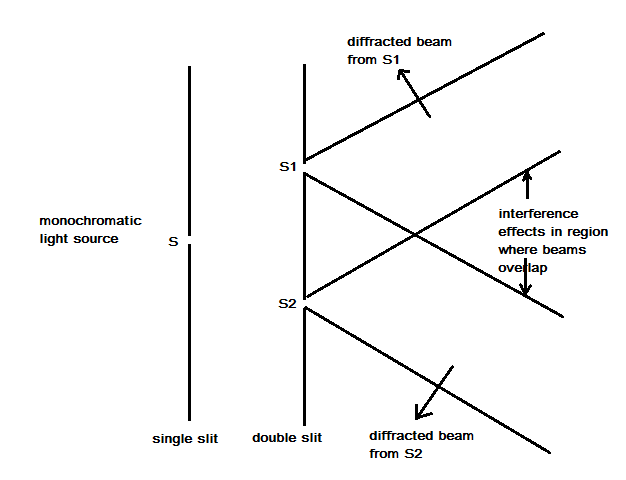
Monochromatic light (single wavelength) from narrow vertical slit S falls on two narrow slits S1 and S2 which are very close together and parallel to S. S1 and S2 act as two coherent sources (both being derived from S). If S, S1 and S2 all are very narrow, diffraction (bending of light at openings whose width is of the order of wavelength of light) causes the emerging beams to spread into the region beyond the slits. Superposition occurs in the shaded area, where the diffracted beams overlap. Alternate bright and dark equally spaced vertical bands (interference fringes) can be observed on a screen placed at some distance from the slits. If either of S1 or S2 is covered, the fringes disappear. Consider figure given below:
Interference: The phenomenon in which two waves superpose to form the resultant wave of the lower, higher or same amplitude. The most commonly known interference is the optical interference or light interference.
Complete answer:
Monochromatic light (single wavelength) from narrow vertical slit S falls on two narrow slits S1 and S2 which are very close together and parallel to S. S1 and S2 act as two coherent sources (both being derived from S). If S, S1 and S2 all are very narrow, diffraction (bending of light at openings whose width is of the order of wavelength of light) causes the emerging beams to spread into the region beyond the slits. Superposition occurs in the shaded area, where the diffracted beams overlap. Alternate bright and dark equally spaced vertical bands (interference fringes) can be observed on a screen placed at some distance from the slits. If either of S1 or S2 is covered, the fringes disappear. Consider figure given below:
Interference: The phenomenon in which two waves superpose to form the resultant wave of the lower, higher or same amplitude. The most commonly known interference is the optical interference or light interference.
Recently Updated Pages
Master Class 12 Business Studies: Engaging Questions & Answers for Success

Master Class 12 Biology: Engaging Questions & Answers for Success
Master Class 12 Chemistry: Engaging Questions & Answers for Success
Class 12 Question and Answer - Your Ultimate Solutions Guide
Master Class 11 Social Science: Engaging Questions & Answers for Success
Master Class 11 English: Engaging Questions & Answers for Success
Trending doubts
Which is more stable and why class 12 chemistry CBSE
Which are the Top 10 Largest Countries of the World?
Draw a labelled sketch of the human eye class 12 physics CBSE
Differentiate between homogeneous and heterogeneous class 12 chemistry CBSE
What are the major means of transport Explain each class 12 social science CBSE
Sulphuric acid is known as the king of acids State class 12 chemistry CBSE