




What is the frequency of power in the a.c circuit when connected to a capacitor? Given \[f = 50{\text{ Hz}}\] and \[V = 220{\text{ V}}\].
A. \[{\text{ 50 Hz}}\]
B. \[{\text{ 100 Hz}}\]
C. \[{\text{ 60 Hz}}\]
D. Zero \[{\text{Hz}}\]
Answer
 Verified
572.1k+ views
Hint: Total Power consumed in the circuit is the product of voltage of circuit and the current flowing in the circuit. In A.c circuit we can find the instantaneous power of circuit by multiplying the instantaneous voltage and current. Also the alternating current or alternating voltage has some frequency.
Formula used:
\[P = VI\]
Where, \[P = \] Total power consumed, \[V = \] Voltage and \[I = \] Current.
Complete step by step answer:
In an A.C circuit the instantaneous power of the circuit is calculated by multiplying instantaneous voltage and instantaneous current. This can be represented as:
\[P = VI\]
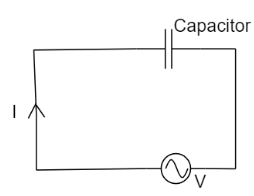
Now we can calculated instantaneous voltage as:
\[V = {V_ \circ }\sin (wt)\] _______________\[(1)\]
Similarly instantaneous value of current can be calculated as:
\[I = {I_ \circ }\sin (wt)\]
But in a capacitor the current leads to its original value by a phase angle of \[\dfrac{\pi }{2}\] or \[{90^ \circ }\] . Thus it can be represented as:
\[I = {I_ \circ }\sin \left( {wt{\text{ + }}\dfrac{\pi }{2}} \right)\] _____________\[(2)\]
By using equation \[(1)\] and \[(2)\] , we can write the power as,
\[P = VI\]
\[\Rightarrow P = {V_ \circ }\sin (wt){\text{ }} \times {\text{ }}{I_ \circ }\sin \left( {wt{\text{ + }}\dfrac{\pi }{2}} \right)\]
We can write, \[\sin \left( {wt{\text{ + }}\dfrac{\pi }{2}} \right){\text{ = cos(}}wt{\text{)}}\] . Therefore equation can be deduced as:
\[P = {V_ \circ }\sin (wt){\text{ }} \times {\text{ }}{I_ \circ }\cos (wt)\]
On rearranging the terms we get the result as:
\[P = {V_ \circ }{I_ \circ }\sin (wt){\text{ }} \times \cos (wt)\]
On multiplying and dividing by two we get the result as:
\[P = \dfrac{{{V_ \circ }{I_ \circ }}}{2}{\text{ }} \times {\text{ 2}}\sin (wt) \times \cos (wt)\]
We know that, \[{\text{2}}\sin (wt) \times \cos (wt){\text{ = }}\sin \left( {2wt} \right)\]
\[P = \dfrac{{{V_ \circ }{I_ \circ }}}{2}{\text{ }} \times {\text{ sin(2}}wt{\text{)}}\]
Therefore we can observe that magnitude of power will be equal to \[\dfrac{{{V_ \circ }{I_ \circ }}}{2}\] and its frequency will be equal to \[2w\] , which is double of original frequency. According to the question the frequency is \[f = 50{\text{ Hz}}\]. Therefore the frequency of power will be \[2 \times 50 = 100{\text{ Hz}}\].
Hence the correct option is B.
Note: It must be noted that \[w = 2\pi f\]. Power consumption gets reduced to \[\dfrac{{{V_ \circ }{I_ \circ }}}{2}\] when the capacitor is used in a.c circuit and frequency becomes double of original frequency. In an inductive circuit the current lags by \[\dfrac{\pi }{2}\]. Since the current leads in the capacitive circuit this is why it is used to store charge.
Formula used:
\[P = VI\]
Where, \[P = \] Total power consumed, \[V = \] Voltage and \[I = \] Current.
Complete step by step answer:
In an A.C circuit the instantaneous power of the circuit is calculated by multiplying instantaneous voltage and instantaneous current. This can be represented as:
\[P = VI\]
Now we can calculated instantaneous voltage as:
\[V = {V_ \circ }\sin (wt)\] _______________\[(1)\]
Similarly instantaneous value of current can be calculated as:
\[I = {I_ \circ }\sin (wt)\]
But in a capacitor the current leads to its original value by a phase angle of \[\dfrac{\pi }{2}\] or \[{90^ \circ }\] . Thus it can be represented as:
\[I = {I_ \circ }\sin \left( {wt{\text{ + }}\dfrac{\pi }{2}} \right)\] _____________\[(2)\]
By using equation \[(1)\] and \[(2)\] , we can write the power as,
\[P = VI\]
\[\Rightarrow P = {V_ \circ }\sin (wt){\text{ }} \times {\text{ }}{I_ \circ }\sin \left( {wt{\text{ + }}\dfrac{\pi }{2}} \right)\]
We can write, \[\sin \left( {wt{\text{ + }}\dfrac{\pi }{2}} \right){\text{ = cos(}}wt{\text{)}}\] . Therefore equation can be deduced as:
\[P = {V_ \circ }\sin (wt){\text{ }} \times {\text{ }}{I_ \circ }\cos (wt)\]
On rearranging the terms we get the result as:
\[P = {V_ \circ }{I_ \circ }\sin (wt){\text{ }} \times \cos (wt)\]
On multiplying and dividing by two we get the result as:
\[P = \dfrac{{{V_ \circ }{I_ \circ }}}{2}{\text{ }} \times {\text{ 2}}\sin (wt) \times \cos (wt)\]
We know that, \[{\text{2}}\sin (wt) \times \cos (wt){\text{ = }}\sin \left( {2wt} \right)\]
\[P = \dfrac{{{V_ \circ }{I_ \circ }}}{2}{\text{ }} \times {\text{ sin(2}}wt{\text{)}}\]
Therefore we can observe that magnitude of power will be equal to \[\dfrac{{{V_ \circ }{I_ \circ }}}{2}\] and its frequency will be equal to \[2w\] , which is double of original frequency. According to the question the frequency is \[f = 50{\text{ Hz}}\]. Therefore the frequency of power will be \[2 \times 50 = 100{\text{ Hz}}\].
Hence the correct option is B.
Note: It must be noted that \[w = 2\pi f\]. Power consumption gets reduced to \[\dfrac{{{V_ \circ }{I_ \circ }}}{2}\] when the capacitor is used in a.c circuit and frequency becomes double of original frequency. In an inductive circuit the current lags by \[\dfrac{\pi }{2}\]. Since the current leads in the capacitive circuit this is why it is used to store charge.
Recently Updated Pages
Explain the structure of megasporangium class 12 biology CBSE

Why is chloroform kept in dark coloured bottles class 12 chemistry CBSE
Derive the balancing condition of a Wheatstone bri class 12 physics CBSE
Draw VI characteristics of a pn junction diode Explain class 12 physics CBSE
Is it possible to carry pride in ones language too class 12 english CBSE
In a population at Hardy Weinberg equilibrium the allele class 12 biology CBSE
Trending doubts
Draw a labelled sketch of the human eye class 12 physics CBSE
Which are the Top 10 Largest Countries of the World?
Draw ray diagrams each showing i myopic eye and ii class 12 physics CBSE
One megawatt is equal to how many units of electri class 12 physics CBSE
Which is the correct genotypic ratio of mendel dihybrid class 12 biology CBSE
Give 10 examples of unisexual and bisexual flowers